4.07.2008


Arcadia Publishing Photo Books - Old News Reviews
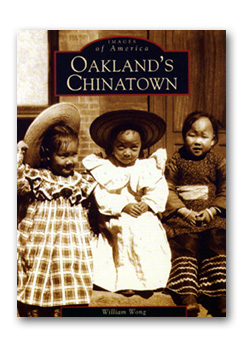
Today through Friday I'm going to post a book review a day. That's only 5 book reviews so I think I can handle it. Instead of thick academic stuff I'm only reviewing photo books, zines, and coffee table books because sometimes that kind of thing is more fun. And for the hell of it I'm starting by reviewing a whole series: the Arcadia Publishing photo books. They're a sort of brilliant, hyper-local niche marketing concept: one photo book for each community, sub-culture, and era within a particular town or region. The photo reproduction is low-quality and the writing varies depending on the editor of each book, but they tend to pick solid, local historian/authors and the photos are priceless even if they're a little grainy.
Some likeable Bay Area centric titles include Oakland's Chinatown by local sweetheart Bill Wong, San Francisco State University by State's own archivist Meredith Eliassen, and The Pullman Porters and West Oakland by a roving pair of black history researchers. But there are dozens of other titles focused on the history of our towns' fire departments, movie theaters, sports teams and neighborhoods.
4.06.2008
Folkstreams
Thanks to WFMU I just discovered a great site called folkstreams. It houses short documentaries about American folk life - mostly the music but also the dances, rituals and work of the cultural groups, villages, and neighborhoods of North America. The films mostly have an anthropology department flavor with square and white, middle-class voiceovers, but I tend to think they're worth it. Here are some of their California focused offerings:
Enjoy folks.
Pizza Pizza Daddy-O about Black girl playground chants.
Two Homes, One Heart about Sikh women living in Sacramento - mostly focusing on Punjabi traditional dance.
Cowboy Poets (OK, not California, but still Western and awesome).
Enjoy folks.
4.04.2008
The Clash of '68
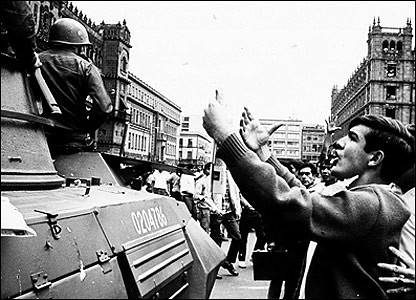
Demonstrator at Tlatelolco, Mexico City, October 2, 1968
from the El Universal archives
The Pacific Film Archive in Berkeley is hosting a little festival called The Clash of 68. Classic revolutionary films from the era as well as contemporary pieces reflecting on that radical time. The program includes the beautiful and inspiring Battle of Algiers and the depressing but pivotal Queimada! which is usually only available in its butchered North American cut.
4.03.2008
MY MOM ALWAYS HATED YOU CAPITALISM
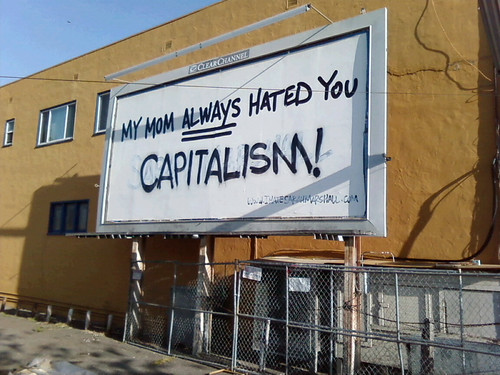
At the corner of Sacramento and Ashby today.
Bay Area billboard observers will also be interested in the Billboard Liberation Front, the California Department of Corrections and Freeway Blogger.
4.02.2008
More Suffling
Here's a mini follow up to that book review of Suffled How it Gush: It looks like Shon has a blog that elaborates on his Balkan ruminations. (Shon is so anti-self promoting that even when I emailed to tell him I loved his book he replied without mentioning the blog.) Shon's just set off to teach English to Roma folks in refugee camps in Kosovo, so I bet he'll have some interesting stuff to say in the coming months.
4.01.2008
April History Carnival
This month’s History Carnival is up at The Vapour Trail. Lots of really awesome looking posts especially about women’s history are highlighted.
The next carnival will post on May Day right here at Bay Radical. You can submit stuff to me using the submission form and if you’ve got questions just email bayradical at gmail dot com.
The next carnival will post on May Day right here at Bay Radical. You can submit stuff to me using the submission form and if you’ve got questions just email bayradical at gmail dot com.
San Francisco State on Strike
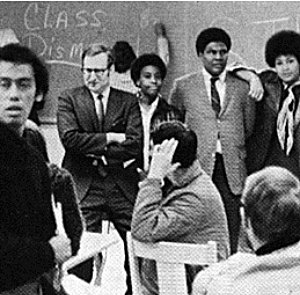
San Francisco State lacks ivy and graying brick and doddering old Englishmen riding their bicycles to class or whatever it is that makes for a prestigious university. It is a working-class college by design and students are as likely to show up on the streetcar as they are to live on campus, just like in the 1960s. Its public school nature might explain why the student activism that was almost ubiquitous on campuses in the mid-1960s looked different at State than it did at schools filled with the children of the ruling class. Maybe the Sixties activism at State had a more lasting impact too. While college students around the country helped stop the Vietnam war, the current mire in Iraq leaves that victory a little hollow. But the demonstrations at State led to the formation of the country's first ethnic studies department – an institution that quickly spread to campuses around the country and is still a major feature of universities around the world. The classic Sixties student concerns were at State too. Anti-war students held marches and sit-ins at State. But anti-war protests were only a part of the picture.
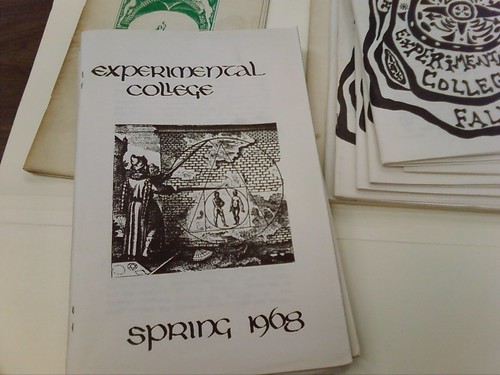
State had innovated the general education requirement that students at most colleges now expect (or dread), but by 1965, State students were criticizing these general classes as irrelevant. They founded their own Experimental College – student-run seminars on topics like social change, avant-garde art and personal growth. After Steven Gaskin's Monday night class on mysticism, spirituality and etcetera outgrew its home at the Experimental College he brought his dozens of followers in a caravan of school buses to Tennessee where they founded the archetypical counterculture commune - The Farm. The trippy Experimental College people opened up thinking about what a college could be. They made student directed education a reality, which probably influenced the focus of the third and most lasting thread in State's student movement.
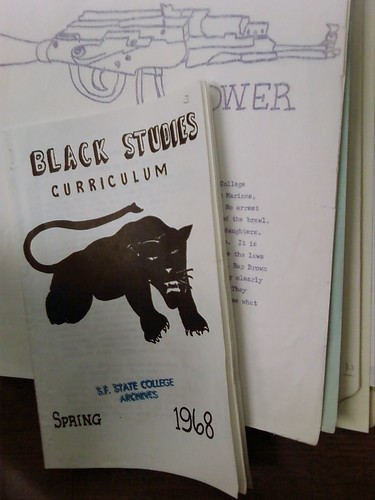
That third thread was the increasing militancy among black, Latino, Asian-American, and indigenous student activists. Radical students of color, many who were involved in off-campus movement work, wanted curriculum that mattered to them. They wanted the college to offer something beyond the white, Western histories, art, music, and perspectives that dominated academics at the time. They wanted teachers who came from their own communities and meaningful access to education for the people of color who were not getting admission to the school in the first place. Students of color wanted a say in the programs that impacted them, and as such, a formerly white-run community tutoring program where mostly white State students worked with mostly black children in the Fillmore was one of the first campus organizations to have a total personnel and color changeover. Black tutors rejected the apparent paternalism of the liberal white tutors and stepped in to teach black kids themselves. On campus, students and progressive instructors pushed for Black Studies classes and got them, but only with part-time professors. Student leaders pushed for a recognized Black Studies department with full time black professors. They argued for broader admissions policies to allow poor black and brown kids access to the school.
Mainstream white students started getting nervous. The campus newspaper, The Gater, printed a notice from their white editor stating that he had written to the Carnegie Corporation asking them to reverse their plans to fund off campus State programs including programs of the Black Student Union. This was 1967. Non-violent civil rights groups seemed irrelevant to a lot of young, black activists in San Francisco who were more likely to find inspiration from Malcolm X than Martin Luther King. The larger protest movement was taking on a militant flavor too. In this context, a few irate black students responded to the Gator editorial by beating the editor in question.
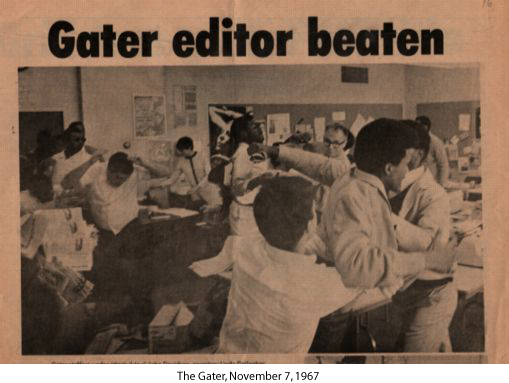
From the SF State Library Strike Collection
The students involved in the beating were suspended, supporters demonstrated in their defense, campus organizing grew. Part of what made the SF State struggle special was that students resisted a dichotomous view of race as simply black and white. Filipino and Chicano students were as influential as Black students in forming the radical agendas of the moment. PACE, San Francisco State's Pilipino American student group may have been the first radical Filipino American organization in the country. PACE, the Latin American Students Organization, El Renacimiento, a Mexican American student organization and other ethnic-based student groups united under the banner of the Third World Liberation Front. Radical white students supported Third World students with their own demonstrations opposing the war and supporting the call for racial fairness and Ethnic Studies programming. By 1968 students around the country (and in Mexico, Germany, France, Japan, and elsewhere) were seizing university buildings in protest or for their own purposes. In March of 1968 the Third World Liberation Front took over the YMCA office at State.
The administration cracked down. Not just on students but also on their progressive teachers. Professor and activist Juan Martinez had been hired by the history department and also to direct a new program aimed at bringing more "minority" students to the campus. When in the spring of 1968 he helped bring several hundred Mexican and Pilipino American students to demand applications from the Dean of Admissions, he was told that he would not be re-hired in the fall. George Murray, a minister of education with the Black Panther Party, was hired to teach general ed English classes, but when he told an audience at Fresno State that, "we are slaves and the only way to become free is to kill all the slave masters", he was suspended. George Murray's suspension triggered a breaking point for student activists, and in November of 1968 students walked out of classes. Led by Black and Third World students and supported by the radical and mostly white Students for a Democratic Society, they created two lists of their strike terms (one from the Black Student Union and one from the Third World Liberation Front) that included the demand to re-hire George Murray, automatic admission for all Third World Students who applied to the school, and a creation of permanent Black Studies and Ethnic Studies departments with paid, full-time staff.
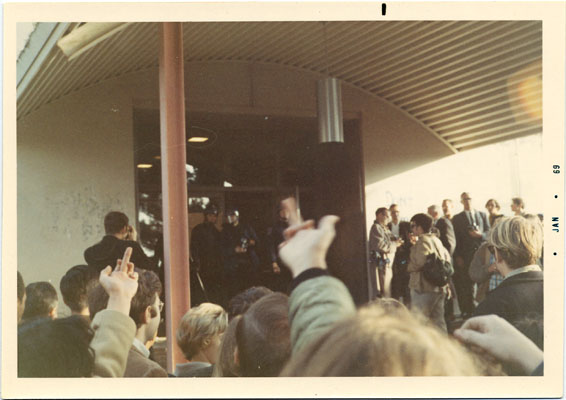
From the San Francisco History Center
The administration panicked. The police were called in, in large numbers and clad in riot helmets. A series of college presidents resigned before S. I. Hayakawa, the Canadian-born Japanese-American professor was promoted to the position. (Hayakawa initially made a name for himself in Semantics and he wrote an important book which he hoped would serve as a critique of fascist propaganda. Apparently critiquing fascism lost its appeal – after State he served as a Republican in the US Senate and in the early '80s he founded US English, an English-only advocacy organization. I should also mention that for most of his career he was known for wearing a jaunty Tam-o-Shanter.)
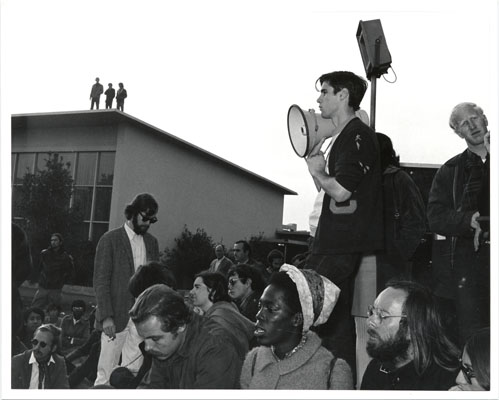
From the San Francisco History Center
Hayakawa's first official act as president was shutting down the campus. If students insisted on walking out of class, then school would be closed to avoid the massive demonstrations. When school officially re-opened in early December (with sparse student attendance), Hayakawa confronted demonstrators who were broadcasting pro-strike messages from a soundtruck on the corner of 19th and Holloway. As the argument escalated the college president climbed on top of the protestors' truck to rip the wires out of its speakers. In return, someone pulled his tam off his head. In the hubbub Hayakawa apparently yelled ''You're fired!'' at author and State professor Kay Boyle, and she apparently replied by calling him 'Hayakawa Eichmann". The strike went on.
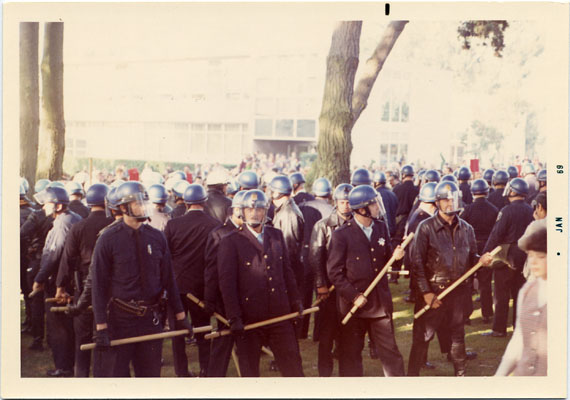
From the San Francisco History Center
By early January of 1969, Hayakawa had banned all gatherings on the central campus and limited access for non-students. Picketers were required to remain on the perimeters of the property. But at this point the situation was uncontainable. The SF State local of the California Teachers Federation joined the strike demanding educational reform, removal of police from the campus, agreement to student demands, and a collective bargaining contract. When the San Francisco Superior Court ordered the teachers back to work the next day they refused.
Strike related protests happened frequently and on and off campus. Sympathetic City College of San Francisco students marched to State to express their solidarity. State students and supporters marched to City Hall. Across the bridge students at Oakland City College (now called Merritt) protested in support of the struggle. In January of 1969 Third World students at U.C. Berkeley started their own, related strike for Black and Ethnic Studies departments. Movements for Black and Ethnic Studies were growing at campuses in New York, New Jersey, Washington, Wisconsin, North Carolina, all over.
The strike went on. Lines of police occupied the campus all day like a military force. One freshman was injured when his homemade bomb blew up in his hands. Professional negotiators were called in. San Francisco's Mayor Alioto appointed a citizens committee to negotiate the strike. And finally in March, the Third World Liberation Front, the Black Students Union, and university administrators (not including Hayakawa) signed a compromise agreement: An ethnic studies department was established. The university pledged to admit hundreds of new black and third world students. In short, we won. We won at State and like dominos, universities around the country dropped their resistance to Ethnic Studies programs, hired more teachers of color, admitted more black and third world students. Community control seems a pretty abstract idea now, but classes and teachers that reflect our real experiences and lives are the lasting gift that San Francisco State strikers left us when they took control of their own education and their own institution. So thank you.
For more on the San Francisco State Strike:
PACE has a little youtube video about their history:
And here's a short documentary on the strike from SGTV:
State has a great archive of the strike. Some of it is online here. Check out their list of books on the strike too.
For a little first person story related to the strike check out Its About Time, a Black Panther Party commemorative website for an account of the related San Francisco Community College strike. Don’t miss the PDFed news articles from the time, linked at the bottom of the article.
Shaping San Francisco has another account, and another.
Finally, if you can stomach some annoying Marxist voiceover for the sake of some fantastic footage, California Newsreel's San Francisco State: On Strike is worth a watch. It includes some pretty ugly police brutality that I hadn't thought to anticipate when I watched it with my five year old.
3.31.2008
Scraper Bike
Scraper Bike from Da Trunk Boiz:
What does this have to do with history? Not much. But check out ghost ridin' the trike!
What does this have to do with history? Not much. But check out ghost ridin' the trike!
3.26.2008
Suffled How It Gush: Old News Book Reviews
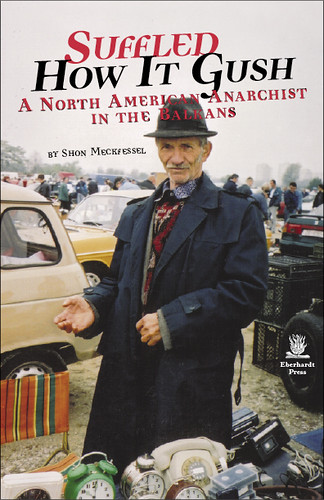
Shon Meckfessel's Suffled How it Gush tells the story of the Balkans from the perspective of Beckett-quoting street kids, hard-luck drunks, black-eyed fighters, squatters, singers, and protesters. It's part punk travelogue, part history lesson, part anarchist theory. Fortunately it's also very good, which is why I'm posting about it here despite its tenuous connection to Bay Area radical history.
Shon happens to have been my high school boyfriend. I hope he doesn't mind my saying that we had a very sweet if chaste relationship. I recall many happy drives in his old Jetta, his right hand holding mine across the emergency brake, his left hand crossing himself when he needed to change gears. While I'm revealing Shon's secrets I'll also mention that he was the first bass player for Cake. I seem to remember he did a stint trucking tomatoes around the Central Valley too. In any case, he has found himself in writing. Suffled How it Gush is poignant, often funny, never sentimental. Reading it made me feel smarter. I love how Shon quotes his favorite hardcore bands and Hannah Arendt within pages of each other. I loved following his drunken travels among the disaffected of post-Communist Eastern Europe, even as I was grateful not to be sharing a train car with him and his satchel of dirty laundry.
Shon gives Balkan history lessons without resorting to nostalgia and describes contemporary life there without choosing national or ethnic loyalties. His friends are Serbian, Croatian, Romani, Muslims, Jews, travelers from around the world who optimistically refer to themselves as 'penguins' – those who refuse to define themselves by the nations where they were born. I hope I'm getting this right when I say that Shon's thesis comes down to the idea that nationalism and neo-liberal economics, not supposedly deep-seated ethnic hatreds, are the causes of crises in Serbia, Croatia, Cyprus, etc. War is shown to be both immoral and absurd through his friends' matter-of-fact stories of survival and tenacity amid NATO bombings and genocidal ethnic purges. Despite the built-in cynicism required of any self-respecting punk boy abroad, Shon shows a certain cheerful optimism, happily reveling in the chaos of the Eastern European Third World and dreaming of a kinder, stateless world. If you can find it, I hope you'll read it.
3.18.2008
Stop the War
Holy cow have I ever gotten behind on blogging! Forgive me; I'm a single, working mom and I've been trying to get into nursing school, so unfortunately I can't always make enough time to post regularly, but I believe things have calmed down enough for me to get back in the saddle a bit. I'm putting the finishing touches on a post for next week. In the mean time, it’s the five year anniversary of this war in Iraq, and there's a big demo in the city tomorrow. (Direct action info here.)
Forty-one years ago 100,000 people marched from Second and Market to Kezar Stadium to protest the war in Vietnam. It took 8 years after that march, but we ended that war. Let's not have 8 more years of this one.
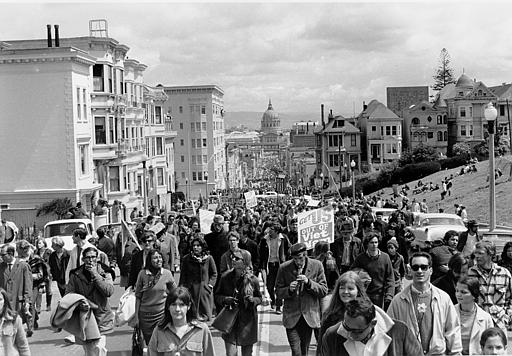
Forty-one years ago 100,000 people marched from Second and Market to Kezar Stadium to protest the war in Vietnam. It took 8 years after that march, but we ended that war. Let's not have 8 more years of this one.
3.01.2008
History Carnival
A blog carnival is a collection of blog posts on a given subject. This month's history blog carnival is up and full of interesting links worth clicking.
2.29.2008
Educate to Liberate
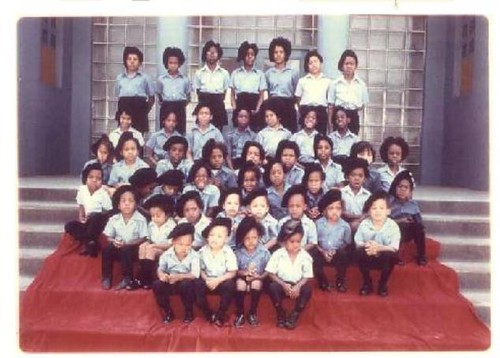
I finally got down to the Oakland History Room to check out Billy X. Jennings' exhibit on the Black Panther Party children's schools. You'll never see more adorable pictures of revolutionary education.
There are a few photos downstairs and more upstairs in front of the elevator and inside the Oakland History Room. I was especially into the shots of the kids doing Karate.
2.27.2008
RIP William Buckley
Old-school conservative windbag William Buckley Jr. died today. Bankrolled by the ill-gotten wealth of his oil-speculator daddy, Bill Jr. can be remembered for his bold pro-segregation stance and his innovative ideas on public health (he stated in a New York Times OpEd that, “Everyone detected with AIDS should be tattooed in the upper forearm to prevent common needle users, and on the buttocks, to prevent the victimization of homosexuals"). Let's look back at Buckley's glory days as he gets his rhetorical butt kicked by a youthful Noam Chomsky:
2.23.2008
Books for Kids
I try not to be too heavy-handed about politics with my kids but I do hope they will get some basics about how we are where we are. Here are two "messagy" books I've been reading to them lately:
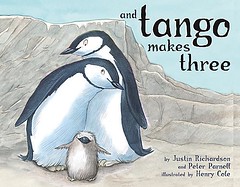
And Tango Makes Three by Justin Richardson and Peter Parnell and illustrated by Henry Cole is the sweetest little bit of gay propaganda you could possibly read to your children. It's the true story of two male penguins in the Central Park Zoo who entwined necks, vocalized together, had sex with each other (OK, that part's not in the kids book), and were finally given the opportunity to raise an adopted penguin chick. You have to be a truly homophobic grinch to remain untouched by what sweet dads the gay penguin pair made. And the story is not too preachy feeling - what kid doesn't want to hear about penguins?
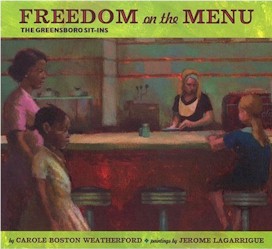
Freedom on the Menu by Carole Weatherford and illustrated by Jerome Lagarrigue tells the story of the 1960 Greensboro lunch counter sit-ins that led to the desegregation of Woolworths' and other restaurants throughout the South. I love how Freedom on the Menu emphasizes community action instead of just one or two key leaders. And even though it deals with the painful topic of segregation, it feels optimistic and hopeful about the power of collective action. The lunch counter sit-ins were started and led by college students and the book is told from a child's eye view which makes it easier for a five year old to connect with.
Bring on your suggestions for kids' books about activism and history folks!
And Tango Makes Three by Justin Richardson and Peter Parnell and illustrated by Henry Cole is the sweetest little bit of gay propaganda you could possibly read to your children. It's the true story of two male penguins in the Central Park Zoo who entwined necks, vocalized together, had sex with each other (OK, that part's not in the kids book), and were finally given the opportunity to raise an adopted penguin chick. You have to be a truly homophobic grinch to remain untouched by what sweet dads the gay penguin pair made. And the story is not too preachy feeling - what kid doesn't want to hear about penguins?
Freedom on the Menu by Carole Weatherford and illustrated by Jerome Lagarrigue tells the story of the 1960 Greensboro lunch counter sit-ins that led to the desegregation of Woolworths' and other restaurants throughout the South. I love how Freedom on the Menu emphasizes community action instead of just one or two key leaders. And even though it deals with the painful topic of segregation, it feels optimistic and hopeful about the power of collective action. The lunch counter sit-ins were started and led by college students and the book is told from a child's eye view which makes it easier for a five year old to connect with.
Bring on your suggestions for kids' books about activism and history folks!
2.12.2008
Oakland Memorials
This project ended with the close of the year but it's worth checking into: blogger nic b. documented the site of every homicide in Oakland in 2007 on his site Oakland Makeshift Memorials. Especially heartbreaking are the comments left by loved ones of the deceased.
2.06.2008
Happy New Year!
East Oakland is snapping with fireworks and standing on my back porch I can smell the sharp warm smoke that's everywhere in this little town tonight.
It's the Year of the Rat folks! Happy New Year!
It's the Year of the Rat folks! Happy New Year!
Milk
In case you, like me, fail to keep up with Hollywood, I'll fill you in that Milk, a biopic about this country's first openly gay politician, has been shooting in the Castro this week. Unfortunately, I snoozed on my opportunity to serve as an extra in the movie but because I'm a sour grapes type, I'll go ahead and say that I have a hard time picturing Sean Penn as the charming and sexy, Jewish and gay Harvey Milk. Castro Shopper has good photos of the current Castro 70s Makeover, but if you want to get to know Harvey, I suggest tracking down the moving documentary The Times of Harvey Milk. Here's an excerpt:
2.02.2008
More Carolina Chocolate Drops
A couple weeks ago I posted some videos from the adorably old-timey Carolina Chocolate Drops. Today blogger Undercover Black Man posted about them including a link to their cover of Hit 'Em Up Style.
And speaking of Undercover Black Man aka: David Mills, writer from some of TVs most favorites including The Wire, he's promised to do a bunch of Black History Month posts and if you're interested in good writing and history I suggest checking him out. He's never shy about addressing controversy, as his inaugural Black History Month post demonstrates.
And speaking of Undercover Black Man aka: David Mills, writer from some of TVs most favorites including The Wire, he's promised to do a bunch of Black History Month posts and if you're interested in good writing and history I suggest checking him out. He's never shy about addressing controversy, as his inaugural Black History Month post demonstrates.
2.01.2008
Friday Night Videos
I said I was going to start posting videos on Fridays, and then I kinda bailed, but now I'm back with the classic/ultimate in Bay Area Radical Music. In fact, they've been around long enough now that they're kinda historical too. Ladies, gentlemen, and none-of-the-above: The Coup!
Giant Burger represent!
Oakland, California 94610
Smash up the place
(I picked old ones for the history angle folks)
Giant Burger represent!
Oakland, California 94610
Smash up the place
(I picked old ones for the history angle folks)
1.30.2008
the Library of Congress on Flickr
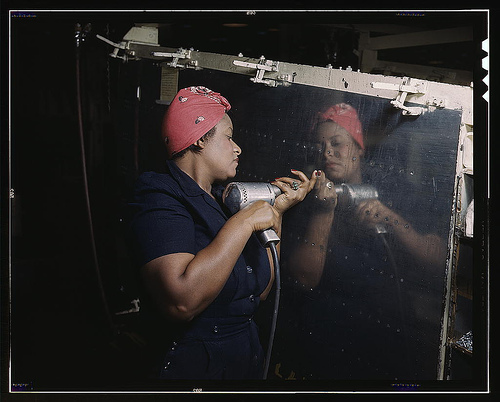
Operating a hand drill at Vultee-Nashville, woman is working on a "Vengeance" dive bomber, Alfred Palmer, photographer, 1943
In fun Flickr news, the Library of Congress has a new Flickr page where they'll be posting some of their enormous catalog of public domain photos. Well worth a visit.
1.25.2008
Point Pinole
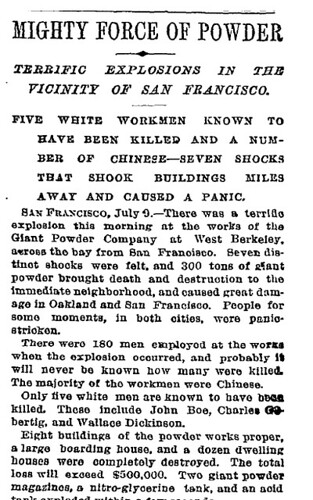
The typically racist New York Times
In July of 1892, an enormous explosion in what was then West Berkeley rocked so hard that windows across the bay on Nob Hill crashed to the ground. An unknown number of people died and many more were injured. The blast wasn't the first to destroy a factory of the Giant Powder Company – the first company licensed to use Alfred Nobel's recipe for dynamite. They'd already blown themselves out of locations in Oakland and San Francisco. After this explosion they relocated to the most distant Bay Area spot they could find – Point Pinole in what is now Richmond, but what they then dubbed Giant, California – a company town now totally disappeared.
There's a lot to say about this bit of history: about how Nobel tried to tame his own guilt for inventing Dynamite by establishing the Nobel Prizes in his will (and what a joke those prizes have become ever since one went to Henry Kissinger); about the life-threatening work of running a dynamite factory, and the mostly Chinese workforce, hired by white bosses who knew they could exploit local xenophobia and pay Chinese workers less to do one of the most dangerous jobs possible; about the sulfur mining in the Oakland hills that supplied the dynamite factories and that left a superfund site that still drains sulfuric acid downhill into a pretty little pond at Mills College. But instead of all that, I'm posting to say that Point Pinole is an absolutely lovely spot for a hike. Almost all the trails are flat and much is wheelchair accessible, the fishing is, apparently, not bad, and if you don't mind walking around directly on top of a major earthquake fault, the views are lovely.
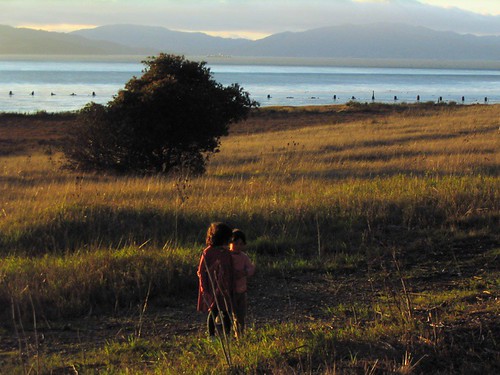
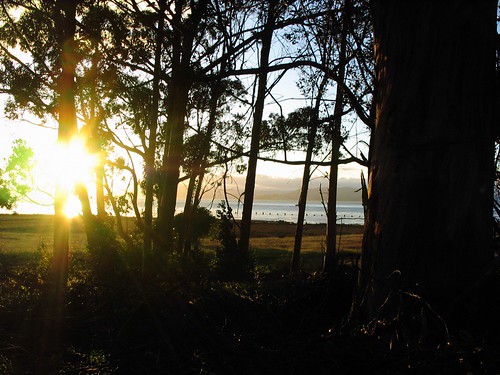
There's not much left of the explosives factories. Apparently the old narrow gauge railway that moved explosives around the premises was purchased for use at Disneyland. Most of the buildings were destroyed. Bethlehem Steel bought the land to build a steel plant, but nothing came of it and finally the East Bay Regional Parks acquired the land in the early '70s. It's a lovely place to take a walk, whether you care to nerd-out about history or not. Point Pinole, here's a little of what it looks like:

1.21.2008
Martin Luther King Jr.
...A true revolution of values will lay hand on the world order and say of war, This way of settling differences is not just. This business of burning human beings with napalm, of filling our nation's homes with orphans and widows, of injecting poisonous drugs of hate into the veins of peoples normally humane, of sending men home from dark and bloody battlefields physically handicapped and psychologically deranged, cannot be reconciled with wisdom, justice, and love. A nation that continues year after year to spend more money on military defense than on programs of social uplift is approaching spiritual death...
Full text and audio of Martin Luther King Jr.'s speech, Beyond Vietnam, is available here.
1.15.2008
Driven Out
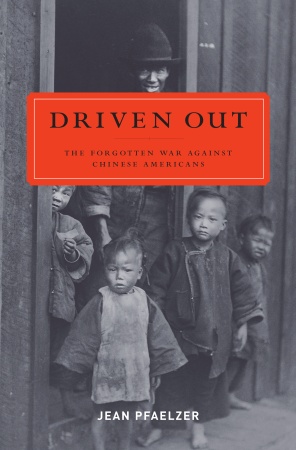
Since I started tracking visits to this site I’ve noticed one post gets more visits than any other. I wanted to pass on a related resource for folks who came here to read about the violence that Chinese-Americans faced in the Western United States throughout the 19th and early 20th centuries.
Driven Out is the deepest, most thorough examination of that shameful piece of history that I’ve found. I’ll display a rare moment of agreement with the New York Times in saying that the book contains an unfortunate lack of analysis and narrative that would have made it better reading, but I still recommend this to anyone looking for more on the issue. Pfaelzer's research is strong and she looks unflinchingly at what she rightly calls pogroms of Chinese-Americans, citing case after case after case of legal and extra-legal violence and expulsion of Chinese immigrants. Its difficult reading, but worthwhile for the sake of understanding a long-suppressed history.
1.11.2008
Friday Night Videos
I've been wanting to launch a Friday music feature here on Bay Rad and I guess I'm finally getting around to it. Mostly I'll be posting explicitly political music and activist soundtracks but I couldn't resist the adorable and historical Carolina Chocolate Drops for an opening act. I chose the first video because it starts with a history lesson:
1.08.2008
Cliopatra Awards
Forget the Oscars, the Emmys and the Darwin Awards. The real news is finally in: here are this year's winners of the history blogging awards! Oddly, they don't have a category for screeds by crotchety leftists, otherwise I would have been a shoe-in.
1.07.2008
Bay Area Directory of COLLECTIVES
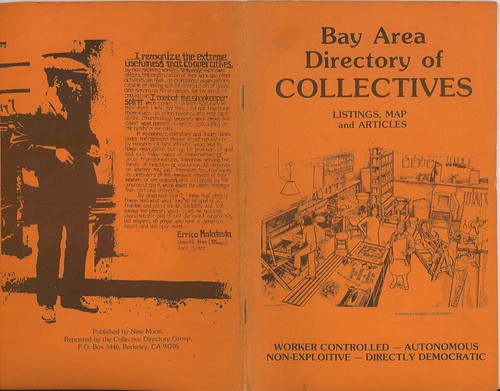
My dad just dug this handy guide to Bay Area collectives out of some long-buried filing cabinet. It looks to have been printed in 1980. I note with some amusement and some sadness that several pages of the booklet are taken up by a critique and rebuttal of itself. For some obsessive-compulsive reason I decided to scan the whole thing, so if you'd like to find out where you could have purchased collectively produced bagels in 1980, or if you want to know where Lilith, A Woman's Theater was located, feel free to click here for the full set of scans.
(Look, they've got it at Bolerium for $15 bucks!)
1.02.2008
Freedom of Information Act
Unbelievably, Bush just signed a bill that will reform the Freedom of Information Act (FOIA) to reduce some of the bureaucracy that comes with requesting government records and to create accountability for delays in processing those requests. These reforms should allow the public and the media better access to government records, although they won't require any more actual openness on the government's part. In other words, if the FBI crossed out large portions of your grandmother the communist labor organizer's record before sending you a copy, they can still do that. Bummer.
Still, there's no better time than now to request your FBI file, or if your life hasn't been interesting enough, get your grandpa's.
Still, there's no better time than now to request your FBI file, or if your life hasn't been interesting enough, get your grandpa's.
1.01.2008
General Strike Heads Up
The Davis Radio Theater will be premiering a new radio play about the Oakland General Strike on KDVS tonight at six. You can stream it live from the KDVS site. Enjoy!
12.31.2007
The Murder of Fred Hampton
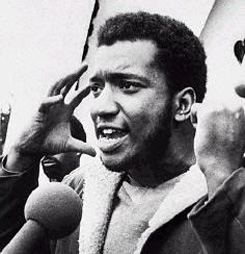
Thanks to Axis of Evel Knievel I found the classic documentary about the life and death of Chicago Black Panther Fred Hampton online. Everyone says that Fred was special. He'd get up at dawn to rally his recruits, then go off to cook in the free breakfast program, and spend his days on other programs, meetings and coalition work. Its no secret that there were guns in his house when he died, but there's also no longer any controversy that he was murdered in his sleep by a dozen Chicago cops. He was 21.
The film came out before certain details of the case were understood. For example, his close comrade William O'Neil who was with him the night before he was killed turns out to have been an FBI informant. Still, the movie is well worth watching. Here's the link.
Subscribe to:
Posts (Atom)
