Showing posts with label 1960s. Show all posts

4.10.2008

Emory Douglas - Old News Reviews

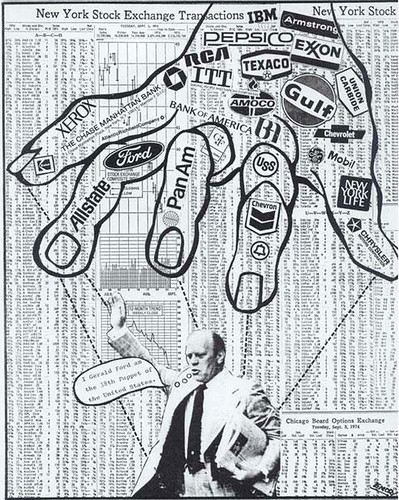
emory_ford.jpg
Emory Douglas' perspective on Gerald Ford


It's day 4 of the Week of Book Reviews, and today I'm talking about Black Panther : The Revolutionary Art of Emory Douglas. The essays are good reading for someone new to Black Panther Party history and the interview with Douglas near the end provides insight into his personal story. Mostly this book provides beautiful, large, full-color reproductions of the artwork Douglas produced for the Black Panther Party newspaper. To get a sense of his stlye, you can view a bunch of the posters on the website associated with the MOCA exhibit of his work.

4.04.2008

The Clash of '68

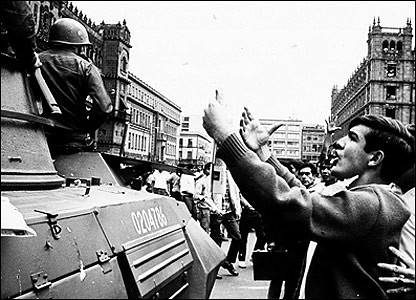
tlatelolco
Demonstrator at Tlatelolco, Mexico City, October 2, 1968
from the El Universal archives


The Pacific Film Archive in Berkeley is hosting a little festival called The Clash of 68. Classic revolutionary films from the era as well as contemporary pieces reflecting on that radical time. The program includes the beautiful and inspiring Battle of Algiers and the depressing but pivotal Queimada! which is usually only available in its butchered North American cut.

3.18.2008

Stop the War

Holy cow have I ever gotten behind on blogging! Forgive me; I'm a single, working mom and I've been trying to get into nursing school, so unfortunately I can't always make enough time to post regularly, but I believe things have calmed down enough for me to get back in the saddle a bit. I'm putting the finishing touches on a post for next week. In the mean time, it’s the five year anniversary of this war in Iraq, and there's a big demo in the city tomorrow. (Direct action info here.)

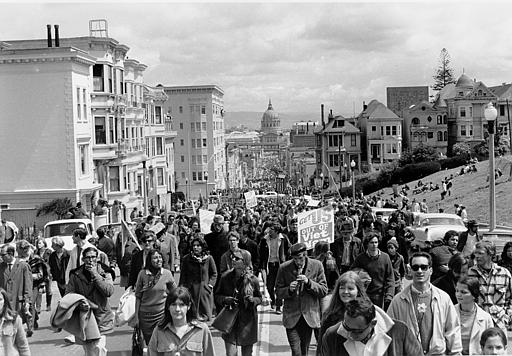
Forty-one years ago 100,000 people marched from Second and Market to Kezar Stadium to protest the war in Vietnam. It took 8 years after that march, but we ended that war. Let's not have 8 more years of this one.

1967 US Out of Vietnam.jpg

1.21.2008

Martin Luther King Jr.


...A true revolution of values will lay hand on the world order and say of war, This way of settling differences is not just. This business of burning human beings with napalm, of filling our nation's homes with orphans and widows, of injecting poisonous drugs of hate into the veins of peoples normally humane, of sending men home from dark and bloody battlefields physically handicapped and psychologically deranged, cannot be reconciled with wisdom, justice, and love. A nation that continues year after year to spend more money on military defense than on programs of social uplift is approaching spiritual death...


Full text and audio of Martin Luther King Jr.'s speech, Beyond Vietnam, is available here.

12.31.2007

The Murder of Fred Hampton


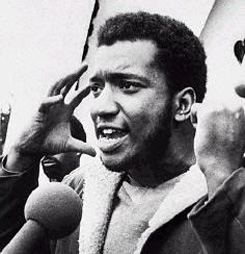
Fred

Thanks to Axis of Evel Knievel I found the classic documentary about the life and death of Chicago Black Panther Fred Hampton online. Everyone says that Fred was special. He'd get up at dawn to rally his recruits, then go off to cook in the free breakfast program, and spend his days on other programs, meetings and coalition work. Its no secret that there were guns in his house when he died, but there's also no longer any controversy that he was murdered in his sleep by a dozen Chicago cops. He was 21.

The film came out before certain details of the case were understood. For example, his close comrade William O'Neil who was with him the night before he was killed turns out to have been an FBI informant. Still, the movie is well worth watching. Here's the link.

12.28.2007

Community Clinics

Over the last few days I've learned some exciting new facts about scabies. Shall I share?

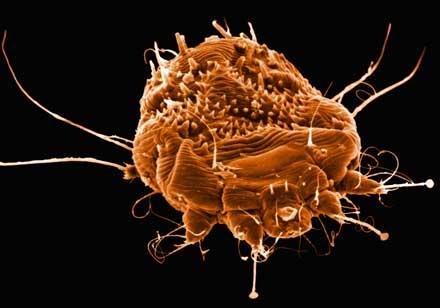
scabies mite.jpg
The Scabies Mite: as ugly as it is unpleasant


1) The first and most exciting fact I've learned about scabies is that I DO NOT HAVE IT. It took two visits to my friend the PA who works in an STD clinic, a phone call to the craigslist date who could have given it to me, and finally, my own admission that I don't actually have scabies symptoms to convince me, but I'm now sure that I do not have a communicable disease, at least not one involving tiny mites that cause uncontrolled itching by shitting underneath the skin.

2) If I did have scabies, or any other disease for that matter, I would be 100% reliant on my saint-like friend the PA who works in an STD clinic to care for me because actually, as it turns out, having no health insurance and living in the East Bay = having almost no medical care at all. I called three or four local low-income clinics and they all told me that they only do intake for new patients ONCE A MONTH. So in other words, keep scratching for a couple weeks until we can see you. The exception is the Berkeley Free Clinic, but their hours are limited as is the range of care available there.

3) Even if they take forever to see you, the folks who run the Bay Area's community clinics still rock. I spent 15 or 20 minutes on the phone with a nice gentleman at the Free Clinic who failed to scream and hang up when I said I thought I had a social disease and then shared his recommendation for best East Bay community health clinic (LifeLong Medical Care). The person answering the phone at Lyon-Martin was also patient and kind even as she was telling me that their next appointment for new patients wasn't until January 18th.

I'm a former radical health care provider and I've got a very big and very special spot in my heart for community health care of all types. The Bay Area is home to a number of community clinics that grew out of a part of late-60s history where folks believed that health care was a basic human right and also that people could and should control their own care. If I ever get my shit together to write a book about Bay Area history, it'll be about the history of the Bay Area community health movement, but its going to take a lot of research because I don't know much beyond the skeleton. I can tell you about a few of the local community clinics though.

La Clinica de la Raza was founded in 1971 by Chicano students and doctors and community folks to provide community-based care in the Fruitvale neighborhood of Oakland. Now that La Clinica is one of the largest non-profits in the East Bay, it doesn't quite have the homemade community feel that started things off. On the other hand, they now provide health care for thousands of uninsured folks from South East Asia, all over Latin America, and all over East Oakland. Similarly, the Native American Health Center started in '72 when Indian activists and allies, post-Alcatraz occupation, called for a self-directed clinic for Native folks.

The way I heard the story of the Berkeley Free Clinic was that it was founded during the People's Park Riot by medic veterans of the Vietnam War. I can't recall the details of that story so I'll have to go with the vague history they have up on their site.

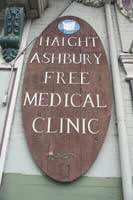
HAFC

The BFC is especially close to my radical health care heart because they primarily use lay medical workers – non-professionals who undergo a rigorous in-house training program. A trip to the BFC often involves a discussion with the staff medic in front of an open medical textbook, with both of you trying to figure out what's bugging you.

The Haight Ashbury Free Clinic is the most famous of our clinics. As I understand it, they were among the first medical clinics to treat drug addicts like human beings, and they still specialize in treating addiction and caring for addicts. I liked this free-association piece about their history from David Smith, the clinic founder.

Thanks clinics. I'm going to celebrate my lack of scabies by signing up to become a patient somewheres.

11.22.2007

Alcatraz

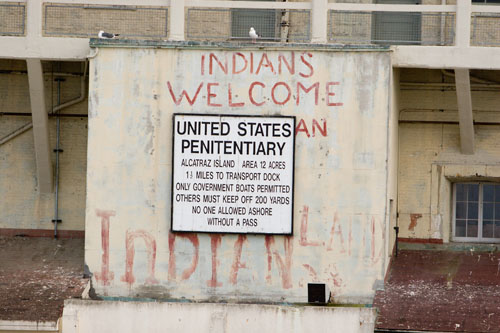
Indians Welcome.jpg


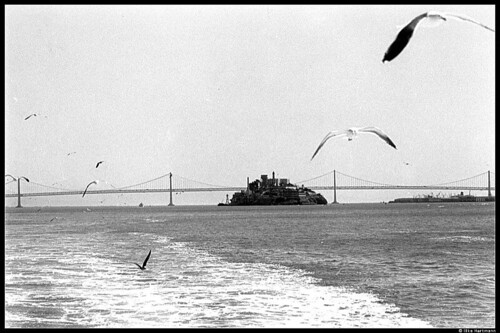
From 1969 to 1971 a pan-national group of Indian activists called Indians of All Tribes occupied Alcatraz Island, reclaiming the land 'by right of discovery'. This was their proclamation:


I N D I A N S O F A L L N A T I O N S

THE ALCATRAZ PROCLAMATION
to the
Great White Father and his People

1969


We, the native Americans, reclaim the land known as Alcatraz Island in the name of all American Indians by right of discovery.

We wish to be fair and honorable in our dealings with the Caucasian inhabitants of this land, and hereby offer the following treaty:

We will purchase said Alcatraz Island for twenty-four dollars in glass beads and red cloth, a precedent set by the white man's purchase of a similar island about 300 years ago. We know that $24 in trade goods for these 16 acres is more than was paid when Manhattan Island was sold, but we know that land values have risen over the years. Our offer of $1.24 per acres is greater than the $0.47 per acre the white men are now paying the California Indians for their lands.

We will give to the inhabitants of this island a portion of the land for their own to then to be held in trust...by the Bureau of Caucasian Affairs...in perpetuity -- for as long as the sun shall rise and the rivers go down to the sea. We will further guide the inhabitants in the proper way of living. We will offer them our religion, our education, our life-ways in order to help them achieve our level of civilization and thus raise them and all their white brothers up from their savage and unhappy state. We offer this treaty in good faith and wish to be fair and honorable in our dealings with all white men.

We feel that this so-called Alcatraz Island is more than suitable for an Indian reservation, as determined by the white man's own standards. By this, we mean that this place resembles most Indian reservations in that:

1. It is isolated from modern facilities, and without adequate means of transportation.
2. It has no fresh running water.
3. It has inadequate sanitation facilities.
4. There are no oil or mineral rights.
5. There is no industry and so unemployment is very great.
6. There are no health-care facilities.
7. The soil is rocky and non-productive, and the land does not support game.
8. There are no educational facilities.
9. The population has always exceeded the land base.
10. The population has always been held as prisoners and kept dependent upon others.

Further, it would be fitting and symbolic that ships from all over the world, entering the Golden Gate, would first see Indian land, and thus be reminded of the true history of this nation. This tiny island would be a symbol of the great lands once ruled by free and noble Indians.

What use will we make of this land?

Since the San Francisco Indian Center burned down, there is no place for Indians to assemble and carry on tribal life here in the white man's city. Therefore, we plan to develop on this island several Indian institutions:

1. A Center for Native American Studies will be developed which will educate them to the skills and knowledge relevant to improve the lives and spirits of all Indian peoples. Attached to this center will be traveling universities, managed by Indians, which will go to the Indian Reservations, learning those necessary and relevant materials now about.

2. An American Indian Spiritual Center, which will practice our ancient tribal religious and sacred healing ceremonies. Our cultural arts will be featured and our young people trained in music, dance, and healing rituals.

3. An Indian Center of Ecology, which will train and support our young people in scientific research and practice to restore our lands and waters to their pure and natural state. We will work to de-pollute the air and waters of the Bay Area. We will seek to restore fish and animal life to the area and to revitalize sea-life which has been threatened by the white man's way. We will set up facilities to desalt sea water for human benefit.

4. A Great Indian Training School will be developed to teach our people how to make a living in the world, improve our standard of living, and to end hunger and unemployment among all our people. This training school will include a center for Indian arts and crafts, and an Indian restaurant serving native foods, which will restore Indian culinary arts. This center will display Indian arts and offer Indian foods to the public, so that all may know of the beauty and spirit of the traditional Indian ways.

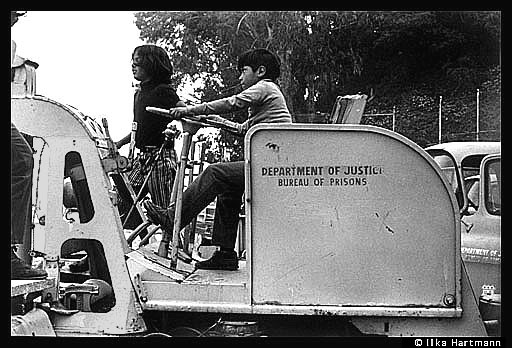
Kids on Alcatraz.jpg
Alcatraz kids playing on abandoned equipment. Photo by Ilka Hartmann.


Some of the present buildings will be taken over to develop an American Indian Museum which will depict our native food and other cultural contributions we have given to the world. Another part of the museum will present some of the things the white man has given to the Indians in return for the land and life he took:

disease, alcohol, poverty, and cultural decimation (as symbolized by old tin cans, barbed wire, rubber tires, plastic containers, etc.). Part of the museum will remain a dungeon to symbolize both those Indian captives who were incarcerated for challenging white authority and those who were imprisoned on reservations. The museum will show the noble and tragic events of Indian history, including the broken treaties, the documentary of the Trail of Tears, the Massacre of Wounded Knee, as well as the victory over Yellow-Hair Custer and his army.

In the name of all Indians, therefore, we reclaim this island for our Indian nations, for all these reasons. We feel this claim is just and proper, and that this land should rightfully be granted to us for as long as the rivers run and the sun shall shine.

We hold the rock!


--------------------------------


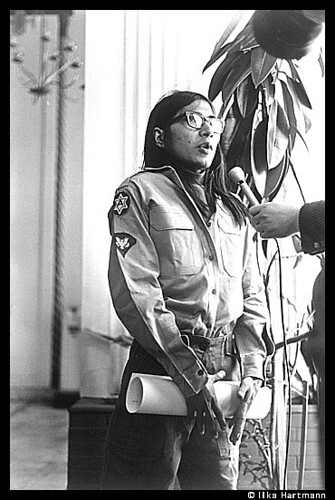
 Whitemankiller
Alcatraz occupier Atha Rider Whitemankiller after the
last residents were forcibly removed from the island.
Photo by Ilka Hartmann.


The Alcatraz occupation on the internet:
An article from the Native Press; original documents from Indians of All Tribes (and related ephemera); the National Park Service; and American Indian Studies professor Troy Johnson's Alcatraz site with a lot of period photos, including all but one of the photos in this post.

The Alcatraz occupation on paper:
Ojibway activist and occupation organizer Adam Fortunate Eagle's Alcatraz! Alcatraz! and Heart of the Rock (co-written with sympathetic white guy journalist Tim Findley); Like a Hurricane from Comanche writer Paul Chaat Smith, and Osage professor and writer Robert Allen Warrior; probable white guy American Indian Studies professor Troy R. Johnson's The Occupation of Alcatraz Island, Alcatraz: Indian Land Forever, and You Are on Indian Land! Alcatraz Island, 1969-1971.

The Alcatraz occupation on film:
Alcatraz is Not an Island documentary website including video of occupation veterans.

Alcatraz veiew.jpg
Alcatraz photo by Ilka Hartmann.


Happy Thanksgiving folks.

10.31.2007

Sir! No Sir!

Sir! No Sir!.jpg


Shoot, folks have been telling me to watch this for months - I guess at this point it's been a couple years. Anyhow, I finally saw Sir! No Sir! last night. I had about 30 other things to do, but I'm glad I blew them off because this is a great movie and I learned so much!

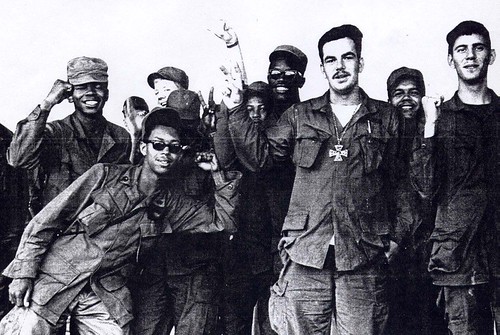
I'm embarrassed to admit that I was at least 25 before I understood that the US had actually lost the war in Vietnam. And I sure didn't get the level of resistance against the war within the military until I saw this movie. There's even some great local info including a bit about vets breaking our of the stockade at the Presidio in San Francisco. The stockade at the Presidio?? See, I've managed to spend my naive 33 years thinking of the Presidio as a really pretty park. Sometimes learning history makes me feel like a moron. Anyhow, here's the extended 12 minute trailer:

The Free Speech Movement


Don't you just love that? In truth, I don't know much about the Free Speech Movement beyond the basics: Mario Savio and other students who had worked on civil rights campaigns in the segregated South came back to school at Berkeley and brought the tactics of the Civil Rights Movement with them – this time advocating for everyone's basic rights to free expression. I'm not one for hero worship, and I know that Mario Savio was just a part of a large movement, but I love listening to him here because he fucking means what he's saying. There's nothing rehearsed or rehashed about that speech. It's from the heart, 100%. I love that passion. I love that kind of need.

The internet's got a lot of resources about the FSM. Notably, the Bacroft library at UC Berkeley has a pile of documents online as part of their Free Speech Movement Digital Archive. They link to transcriptions of all kinds of related original documents (like flyers, newspaper articles, relevant government paperwork, etc), and a collection of related oral histories - for example - you can read the reaction of then President of UC Berkeley Clark Kerr to the movement. (He's the guy that Mario Savio is pissed off at in the video above.) I also recommend this segment of a lovely interview with civil rights attorney and Old Left royal Robert Treuhaft who represented the FSM, and got booked with the activists during what turned out to be the largest mass arrest of students in this country's history.

Savio.org is the site that represents a fund established in Mario's honor which awards young activists, and also pays for annual lectures in his name. This year's lecture is coming up tomorrow! Angela Davis will be speaking about "Prisons, Democracy, and Empire". (I love listening to Angela, not just because she's one of the smartest people ever, but also because she thinks that history is important, and historical context is so often incorporated into what she has to say.)

Free Speech Movement Archives includes a number of nice overviews, timelines, etc that help to summarize the movement. From that site I found a link to this little photo gallery from Ron Enfield who was chief photographer for the Daily Californian at the time that the movement was active.

Of course, free expression is still an issue. It's always an issue. The Cal Disorientation Guide has this to say about our current rights to free speech on the Cal campus. Enjoy the links folks, while we still get to read 'em.

9.30.2007

Compton's Cafeteria Riot


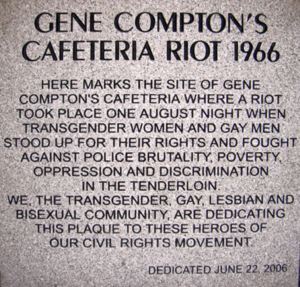
It's a hot August night in San Francisco in 1966 -- three years before the famed Stonewall. Compton's Cafeteria, in the seedy Tenderloin district, is hopping with its usual assortment of transgender people, young street hustlers, and down-and-out regulars. The management, annoyed by the noisy crowd at one table, calls the police. When a surly cop, accustomed to manhandling Compton's clientele, attempts to arrest one of the queens, she throws her coffee in his face. Mayhem erupts -- windows break, furniture flies through the air. Police reinforcements arrive, and the fighting spills into the street. For the first time, the drag queens band together to fight back, getting the better of the cops, whom they kick and stomp with their high-heeled shoes and beat with their heavy purses. For everyone at Compton's that night, one thing was certain -- things would never be the same again.
photo and text from comptonscafeteriariot.org


More than ten years ago, historian, author, and former director of the GLBT Historical Society Susan Stryker uncovered the history of a riot in San Francisco's Tenderloin district. In 2005, together with fellow historian-turned-filmmaker Victor Silverman and producer Jack Walsh, she released a documentary about that night, its context, and the early gay liberation and transexual human rights movements which the riot helped to inspire. Before Susan's work on this project, the Compton's story was mostly forgotten, but that doesn't mean that night didn't matter. It was a turning point for the queer community: San Franciscans were catalyzed by the event to start organizing, and the boldness of those queens and queers sent a message to the cops that harassing and brutalizing trans people, queer people, and poor people wasn't going to fly anymore. That spontaneous, furious fight was a landmark in the movement against police brutality and for human rights.

Wikipedia has a bit more on the riot, Susan's film delves into the whole story. It's called Screaming Queens. Here's a clip:

7.23.2007

Ericka Huggins

Dana and I went out to Thai food on Grand Avenue the other day, and happened to sit next to one of my heroes. Later I wished I had said something really thoughtful and articulate like, "Excuse me, I apologize for interrupting your meal, but I couldn't let you leave without telling you how grateful I am for the work you've done to support the liberation of African American people, and of all people, and for the many very real sacrifices you've made over these many years. Thank you." Of course, if I had actually talked to her in the moment, whatever I said would have come out making me sound like a gibbering stalker, (I know this to be true because I ran into her once before, and did talk to her like a gibbering stalker), so it's for the best that I contented myself to bask in the glow of her fashionable (although in no way ostentatious) back, which was seated only a foot or two away from me.

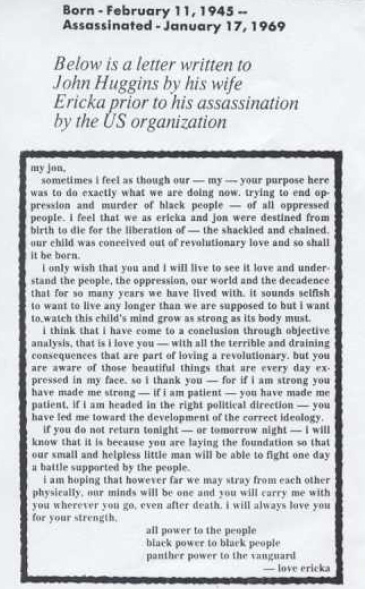
I doubt she's recognized much now, but Ericka Huggins spent a few years being infamous. In 1970, she was a defendant in an internationally notorious and highly politicized murder trial in New Haven, Connecticut. Folks like Dr. Benjamin Spock and writer Jean Genet came to Yale to speak on her behalf. One year before that trial, her husband John Huggins, a leader in the Los Angeles chapter of the Black Panthers, was killed at UCLA by members of a rival activist faction. Throughout the 70s she co-authored a book of poems with Huey Newton, held political offices, and directed a Black Panther school. I wish I knew more about what she's doing now – meditation, spirituality and education seem to be among her current interests, and she does some speaking about her time in the Black Panthers, but it's hard to find out much about her because, although one site says that she's writing a memoir, she clearly isn't out to promote herself, which is a consistent theme for her, actually.

Ericka grew up in Washington, D.C. She was politicized early on, attending the March on Washington when she was 15. The late 60s, the moment when Ericka was coming of age, was a point of increasing militancy among activists in general, and Black activists in particular. (SNCC for example, a major organization in the Civil Rights Movement, officially changed its strategy from specifically nonviolent, to including a broader range of tactics when Stokely Carmichael took over the organization in 1966.) Like thousands of young people around her, Ericka probably felt shocked and horrified by the poverty and violence that Black people and poor people were experiencing around her. Race riots were a regular feature of the late 60s, and were invariably inspired by, and then followed by, harsh police violence. The Vietnam War, and protests against it, escalated around her. Internationally, militancy seemed to be on the increase, with revolutionary movements gaining prominence in Palestine, Northern Ireland, and even next door in Quebec. In this context, in 1968, Ericka joined the Black Panthers. She met John ("Jon" in Ericka's love letters) at college and they moved together to LA where they got very involved in the growing Panther chapter there. They took and then taught political education classes, organized, fundraised, served in the Party social programs, and I'll assume they studied marksmanship, a requirement for all Party members. John took on a leadership position. Ericka got pregnant.
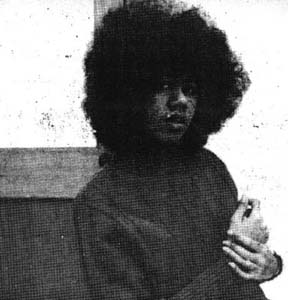


Ericka in the late 60s
With his beard and bellbottoms, John gave off much more of a hippy vibe than his fellow militants, especially Bunchy Carter, a charismatic former gang leader who was a rising star in the Party (and was known for his impeccable style), and who was with John on the day they met with, and then were shot and killed by members of the US organization at UCLA. I won't pretend that the details of this story aren't complicated*, but one thing we do know from 1975 senate hearings on the FBI's counterintelligence program (Cointelpro) is that the FBI actively sought to increase tension between the Panthers and US**, before and after these killings, by sending inflammatory cartoons and letters to both organizations, and by propagating rumors about each organization. I've read that Richard Held, the FBI officer in charge of the L.A. office at that time took credit for the deaths of Huggins and Carter. I can't back that one up with a citation though.

After John's death, Ericka moved with her daughter Mai to Connecticut where John's parents lived. With local activists, she started a Panther chapter in Bridgeport, and then moved it to New Haven. She was 21.

In her memoir, A Taste of Power, Brown remembers Ericka as being checked out and disconnected after John's death. An interview with a Connecticut Panther in another memoir - David Hilliard's This Side of Glory - describes her as "spaced out but genuine". I don't know why she kept sleepwalking through her activist career at that point. Maybe if your partner is killed for the revolution, you feel you must soldier on, to give his memory meaning. Especially because, as she trudged through what must have been a personal nightmare, the bigger community was turning uglier around her too.


John Huggins was killed on January 17th, 1969. That night, the LAPD raided John and Ericka's home and arrested all twelve Panthers inside, including Ericka with their infant daughter. There were no real charges filed against those arrested – the LAPD justified the arrests by saying that they were preempting retaliatory action towards members of US. This kind of police action towards the Panthers was typical. They raided Panther offices across the country frequently, and often repetitively, sometimes looking for specific suspects, sometimes just to destroy their typewriters, or break up their free breakfast program, which the FBI specifically sought to destroy. (Details on that here. Just search for "breakfast".) In April of '69, 21 New York Panthers were arrested and charged with conspiracy. All 21 were eventually found innocent. Also in April, the Des Moines Panther office was leveled by a bomb blast, injuring two Panthers. In response, local police arrested Panthers. In the first two weeks of May that year, the LAPD arrested 42 Black Panthers. Of course, this hostility wasn't one sided. The Panthers were both a service organization and a militant one, and as much as their free clothing, free food, free medical clinics, ambulance service, and free breakfast programs have been underreported, their armed confrontation of police was also quite real. Panthers regularly engaged in shootouts with police, and not all these were initiated by the cops. After all, the Panthers were trying to engage in a revolutionary struggle.

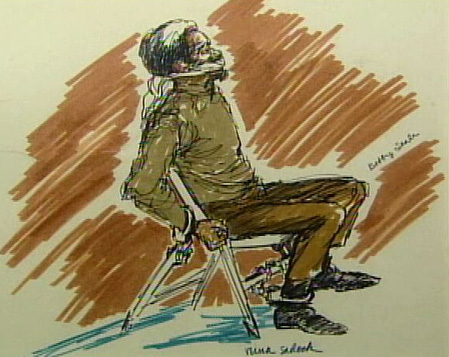
Outside of the Panthers, even mainstream liberals were aware of how harsh the repercussion could be for activists who opposed the status quo. In August of 1968, Chicago Mayor Richard Daley had sent 12,000 police officers and 7,500 National Guard in to disrupt protests at the Democratic Convention. (Bobby Seale, the Panther's co-founder and essentially second-in-command officer, spent several years fighting legal charges from the Convention protests. He'd famously been bound and gagged in the courtroom during his trial.) In December of 1968, more than 450 students at SF State were arrested in connection with a student strike in support of Black Studies program. And only a few months earlier, police had massacred hundreds of student demonstrators in Mexico City. Vietnam raged on. Nixon had just been inaugurated. Someone who was as involved in the Panthers as Ericka was in early 1969 must have been pretty convinced that the revolution was needed, that it was coming, that a new system of socialist governance prioritizing self-determination for Black people and economic fairness for all seemed like a real possibility. And militant struggle probably felt like it was the strategy for bringing that revolution.


seale bound.jpg

Courtroom illustration of Bobby Seale, bound and gagged during the initial Chicago 8 hearings

It feels important to know all this context before you read what happened next. What happened next is that that someone, a Panther, murdered someone else, another Panther, a 19 year old from New York. And that young murder victim, Alex Rackley, was killed after two days of being tortured – having boiling water poured on his body and so forth. And Ericka was in the house where all this happened.

A mentally-unstable out of town Panther named George Sams instigated the kidnapping and torture of Rackley, who he accused of being an undercover agent. Several New Haven Panthers participated in the torture and then in the murder. Sams only did four years in prison for the killing, and rumors persist that he was an agent provocateur himself, although I've never read any evidence for this. He was certainly crazy, and was heavily medicated during his own trial. And it is unarguable that the Panthers were heavily infiltrated. Still, at the point when you are pouring boiling water on someone, or even watching your comrade pour boiling water on someone, you must take some personal responsibility. Going along with what you're told isn't any more justifiable for revolutionaries than it is for Nazis.
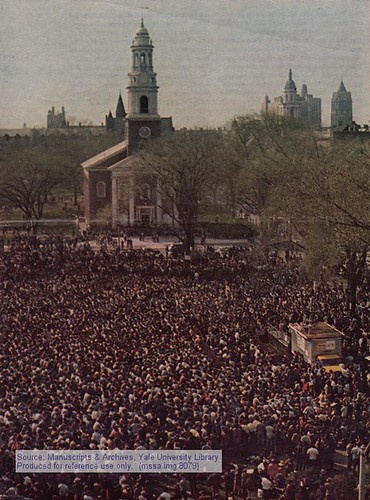


May Day rally at Yale protesting the trial of Ericka Huggins and Bobby Seale
While it's not a justification, I'm sure that Ericka Huggins learned this lesson. After the actual killers were convicted (some confessed, turning state's evidence), she and Bobby Seale were tried for ordering the murders. They spent two years in jail in New Haven during the proceedings, inspiring an international protest movement.*** Yale students staged a months-long strike, starting with a massive May Day rally featuring Abbie Hoffman et al. While she was in prison, Free Jazz pianist Francois Tusques composed a song for her. (You can listen to it on this archived WFMU jazz show. The song starts roughly at minute 1:46 and then restarts at 1:48.)

What shocks me about Ericka Huggins, is that after seeing the absolute ugliest sides of revolutionary movements, she moved to the Bay Area and spent the 1970s working on the Panther newspaper, running for and then serving on the Berkeley Community Development Council (an anti-poverty agency) and on the Alameda County School Board, and eventually running the last surviving segment of the Black Panther Party – their children's school. She was, I guess, one of the last members of the Black Panther Party, since she continued to run the school throughout the 1970s until it finally closed in the early 80s, long after every other Panther institution was gone, and after Huey Newton, the organizations' charismatic but borderline leader had lost all credibility among activists and even most of his friends.

Another thing that strikes me about Ericka Huggins is the way she just doesn't show up in Panther memoirs. Elaine Brown, who named her daughter Ericka dedicates more page space to her than any other Panther alum. As far as I remember, everything Elaine says is positive, and even in her book, there's not much. In other memoirs, Ericka tends to show up for a few pages as a benign force and then disappear, as if she was never there. For someone who was so important in the Party, I can only guess that she found a way to stay out of everyone's way and for the most part, do the work that felt important, instead of engaging in power-plays or battles of ego.


The Oakland Community School - the final Black Panther project.
Sitting next to her at dinner, I confess I had a difficult time paying enough attention to my date. What does someone who spent more than a decade trying to make the impossible work feel when it doesn’t? What does it feel like to be so key in a grassroots, militant, educated, disciplined, activist corps - a group that seemed so close to revolution – and then to lose it? Does she resent the way Panther leaders spiraled out of control? Does she feel defeated by the forces of the state – the FBI, the police, the media – that did, in fact defeat her movement? Does she feel manipulated? Is she angry? Her manner is quiet and poised. She projects a feeling of attentive calm. I hope she thinks back on serving free food to children, on writing and explaining, on teaching and running a school that provided a real alternative for kids who needed it and feels proud.

_________

That's how I ended this article. And I was just looking for a few more photos before posting, when I decided to start googling Ericka's name and the world "meditation" (since I know she's a practitioner) and found her to be associated with that ashram on San Pablo – Syda.

Apparently, the New Yorker did an investigation of Syda a few years ago, and quoted members who reported sexual and financial abuses within the largely secretive organization. Former members complained that they were harrassed if they spoke out. There's a website where ex-members share their (bad) experiences, although for the record, most of the alleged abuses happened quite a while ago, and even the New Yorker article points out that most members have no contact with the people at the top of the organization, and simply go to Syda's various ashrams to meditate, chant, and find spiritual community. At this point, I'm feeling a bit depressed by imagining my hero as a cult member. And I'm sure it's more complicated than that anyway. I guess I shouldn't be surprised that she can stomach a degree of unquestioned hierarchy, since she managed to work under an abusive power fiend like Huey Newton for so long.

I really admire Ericka Huggins. I'm not an investigative reporter, and if I was, why would I want to 'expose' someone who has spent most of her life working for good? So what if she likes charismatic leaders? I want to respect the fact that she has a life. Has some privacy. So good luck to you Ericka. I'm not going to read any more about what you did or what you do. Thank you for your work. Good luck to you in your life.


_______________

*Trying to make out what really happened here is completely impossible. Every Panther has their story, and the stories tend to contradict each other.

**Every December I subject some poor soul to my annual anti-Kwanzaa rant. I know that if the holiday has come to have meaning for people, I should support it, but for me it is uglied by the fact that it was created by Ron Karenga (or, as he named himself, Maulana – a Swahili word for master teacher). Karenga was the head of US at the time of the UCLA shooting. He went on to serve prison time for assaulting and torturing two female members of his organization.

** As usual, Snopes does a nice job of clarifying the line of bullshit that circulated on the net a few years ago suggesting that Hillary Rodham, a Yalie, was Ericka's defender. (As if Hillary would have advocated for militants!


If you're not done already with learning about Ericka:

I mentioned it a bunch of times because A Taste of Power talks more about Ericka than most published material on the Panthers. The author, Elaine Brown, has been accused of including some inaccuracies, or maybe outright lies in this book, but it is as good a history of the Black Panther Party as any, and, coming from a woman's perspective, manages to be honest about some of the disparities that did exist in the organization.

Most of what I know about Ericka's trial comes from the long out-of-print Agony in New Haven, which was certainly descriptive. It seemed to depict the four month long jury selection process in real time, detailing each potential juror, each recess called by the judge, and each outfit chosen by the various lawyers. Well written, but only worth while if you're obsessed. There's a newer book I haven't read yet called Murder in the Model City which probably provides some more context.

I know he's become controversial, even among radicals, but Ward Churchill's Agents of Repression (written with Jim Vander Wall) is still the most readable, detailed, and footnoted book I know about Cointelpro and it's where I first learned anything about the Panthers. I recommend it.

Finally, the very best website for Black Panther information is It's About Time. This site has tons of original source material on the Party: newspaper transcriptions, dozens of photos, regional chapter histories, and updates on issues impacting former Panthers now. Most of the photos in this post came from that site (thank you!) and I haven't even gotten half-way through all there is to read there yet. Check it out.

Note that I've made a couple small factual and editorial corrections and changes since I first wrote this, although the post is pretty much the same as the original.
6.12.2007

Happy Loving Day

The supreme court finally struck down miscegenation laws 40 years ago, on this day. Happy Loving Day everybody!

(Found on metafilter.)
 
Creative Commons License
Some Rights Reserved.