Showing posts with label American Indian. Show all posts

11.22.2007

Alcatraz

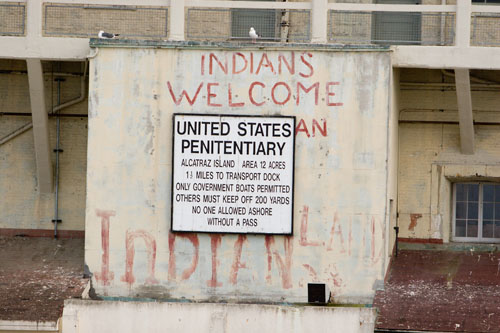
Indians Welcome.jpg


From 1969 to 1971 a pan-national group of Indian activists called Indians of All Tribes occupied Alcatraz Island, reclaiming the land 'by right of discovery'. This was their proclamation:


I N D I A N S O F A L L N A T I O N S

THE ALCATRAZ PROCLAMATION
to the
Great White Father and his People

1969


We, the native Americans, reclaim the land known as Alcatraz Island in the name of all American Indians by right of discovery.

We wish to be fair and honorable in our dealings with the Caucasian inhabitants of this land, and hereby offer the following treaty:

We will purchase said Alcatraz Island for twenty-four dollars in glass beads and red cloth, a precedent set by the white man's purchase of a similar island about 300 years ago. We know that $24 in trade goods for these 16 acres is more than was paid when Manhattan Island was sold, but we know that land values have risen over the years. Our offer of $1.24 per acres is greater than the $0.47 per acre the white men are now paying the California Indians for their lands.

We will give to the inhabitants of this island a portion of the land for their own to then to be held in trust...by the Bureau of Caucasian Affairs...in perpetuity -- for as long as the sun shall rise and the rivers go down to the sea. We will further guide the inhabitants in the proper way of living. We will offer them our religion, our education, our life-ways in order to help them achieve our level of civilization and thus raise them and all their white brothers up from their savage and unhappy state. We offer this treaty in good faith and wish to be fair and honorable in our dealings with all white men.

We feel that this so-called Alcatraz Island is more than suitable for an Indian reservation, as determined by the white man's own standards. By this, we mean that this place resembles most Indian reservations in that:

1. It is isolated from modern facilities, and without adequate means of transportation.
2. It has no fresh running water.
3. It has inadequate sanitation facilities.
4. There are no oil or mineral rights.
5. There is no industry and so unemployment is very great.
6. There are no health-care facilities.
7. The soil is rocky and non-productive, and the land does not support game.
8. There are no educational facilities.
9. The population has always exceeded the land base.
10. The population has always been held as prisoners and kept dependent upon others.

Further, it would be fitting and symbolic that ships from all over the world, entering the Golden Gate, would first see Indian land, and thus be reminded of the true history of this nation. This tiny island would be a symbol of the great lands once ruled by free and noble Indians.

What use will we make of this land?

Since the San Francisco Indian Center burned down, there is no place for Indians to assemble and carry on tribal life here in the white man's city. Therefore, we plan to develop on this island several Indian institutions:

1. A Center for Native American Studies will be developed which will educate them to the skills and knowledge relevant to improve the lives and spirits of all Indian peoples. Attached to this center will be traveling universities, managed by Indians, which will go to the Indian Reservations, learning those necessary and relevant materials now about.

2. An American Indian Spiritual Center, which will practice our ancient tribal religious and sacred healing ceremonies. Our cultural arts will be featured and our young people trained in music, dance, and healing rituals.

3. An Indian Center of Ecology, which will train and support our young people in scientific research and practice to restore our lands and waters to their pure and natural state. We will work to de-pollute the air and waters of the Bay Area. We will seek to restore fish and animal life to the area and to revitalize sea-life which has been threatened by the white man's way. We will set up facilities to desalt sea water for human benefit.

4. A Great Indian Training School will be developed to teach our people how to make a living in the world, improve our standard of living, and to end hunger and unemployment among all our people. This training school will include a center for Indian arts and crafts, and an Indian restaurant serving native foods, which will restore Indian culinary arts. This center will display Indian arts and offer Indian foods to the public, so that all may know of the beauty and spirit of the traditional Indian ways.

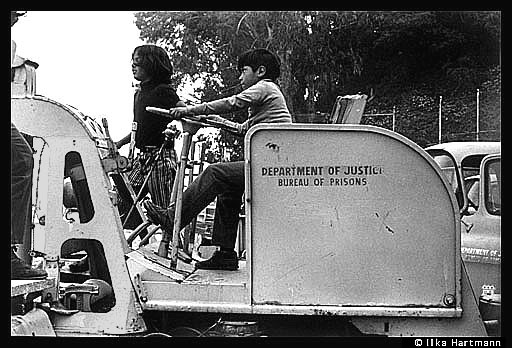
Kids on Alcatraz.jpg
Alcatraz kids playing on abandoned equipment. Photo by Ilka Hartmann.


Some of the present buildings will be taken over to develop an American Indian Museum which will depict our native food and other cultural contributions we have given to the world. Another part of the museum will present some of the things the white man has given to the Indians in return for the land and life he took:

disease, alcohol, poverty, and cultural decimation (as symbolized by old tin cans, barbed wire, rubber tires, plastic containers, etc.). Part of the museum will remain a dungeon to symbolize both those Indian captives who were incarcerated for challenging white authority and those who were imprisoned on reservations. The museum will show the noble and tragic events of Indian history, including the broken treaties, the documentary of the Trail of Tears, the Massacre of Wounded Knee, as well as the victory over Yellow-Hair Custer and his army.

In the name of all Indians, therefore, we reclaim this island for our Indian nations, for all these reasons. We feel this claim is just and proper, and that this land should rightfully be granted to us for as long as the rivers run and the sun shall shine.

We hold the rock!

--------------------------------
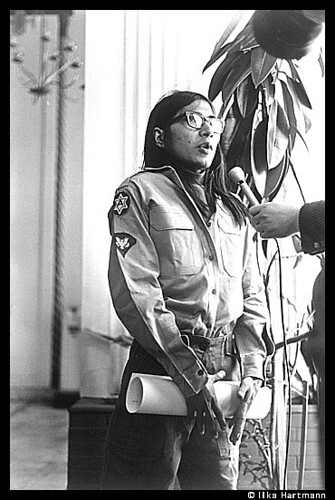


 Whitemankiller
Alcatraz occupier Atha Rider Whitemankiller after the
last residents were forcibly removed from the island.
Photo by Ilka Hartmann.


The Alcatraz occupation on the internet:
An article from the Native Press; original documents from Indians of All Tribes (and related ephemera); the National Park Service; and American Indian Studies professor Troy Johnson's Alcatraz site with a lot of period photos, including all but one of the photos in this post.

The Alcatraz occupation on paper:
Ojibway activist and occupation organizer Adam Fortunate Eagle's Alcatraz! Alcatraz! and Heart of the Rock (co-written with sympathetic white guy journalist Tim Findley); Like a Hurricane from Comanche writer Paul Chaat Smith, and Osage professor and writer Robert Allen Warrior; probable white guy American Indian Studies professor Troy R. Johnson's The Occupation of Alcatraz Island, Alcatraz: Indian Land Forever, and You Are on Indian Land! Alcatraz Island, 1969-1971.

The Alcatraz occupation on film:
Alcatraz is Not an Island documentary website including video of occupation veterans.
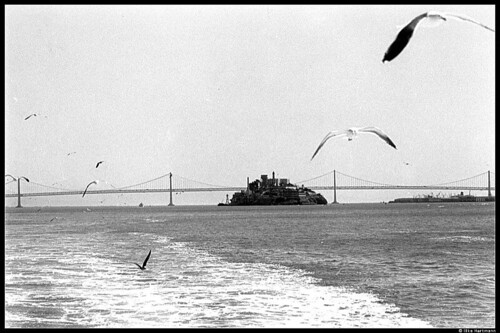
Alcatraz veiew.jpg
Alcatraz photo by Ilka Hartmann.


Happy Thanksgiving folks.

11.16.2007

The Shellmound


 banana republic.jpg
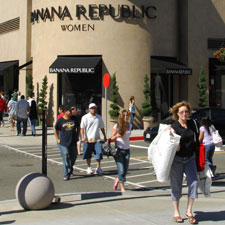
The Bay Street Mall, home of the Apple Store, California Pizza Kitchen, H&M, and a wealth (so to speak) of other one-step-above the hoi polloi chain stores has been thoughtful enough to include a bit of local history on their website. I'll give you an excerpt: One day, a group of people, the Ohlone, arrived at the Bay… This was a great place to live, with plenty of everything people might need: water, food, space, and the materials to make shelters. The Ohlone decided to stay and call this place home. One paragraph later we learn that Today Bay Street Emeryville, an urban village where people can shop, dine, live and be entertained, calls the site home.

The mall website fails to mention the moments that intervened between today and the 'day' that tribal people, now called the Ohlone, arrived at the mouth of Temescal Creek where the mall now sits. Presumably, mall managers would rather not linger on historical happenings like the deadly Spanish Mission system that enslaved California's coastal tribal people, or the factories that for 75 years occupied the mall's current location, producing paints and pesticides and leaching heavy metals into the groundwater, or the protests that archaeologists and local Muwekma Ohlone activists registered in opposition to the mall's construction.

Most notably, promotional materials fail to clearly explain the fact that the mall is sitting on top of the remaining portions of what was probably the Bay Area's largest shellmound. Oh, they mention the Shellmound. The Mall faces Emeryville's "Shellmound Street", and they even put up a commemorative exhibit about the mound (and I do mean commemorative, since it emphasizes the past over present-day Bay Area Indian communities.) Their commemorative mini-mound was mandated by Emeryville's city council as an appeasement to the people who were understandably concerned about the construction of a mall atop the spot where their ancestors are buried.

Let me back up a minute.

The Shellmound at the base of Temescal Creek was at one time roughly 60 feet high and 350 feet in diameter. It, along with five or six smaller adjoining mounds lined the marshy land where the creek, now culverted under the streets of Oakland and Emeryville, meets the Bay.

There are hundreds of shellmounds scattered along the mouths of the Bay Area's numerous creeks. Anthropologists in the early 1900s counted at least 425. The remains of a massive shellmound sit underneath Spenger's - the old-school fish restaurant near the base of University Avenue in Berkeley. Shellmounds are found in coastal regions around the world from Brazil to British Colombia, Australia to Denmark.


View Larger Map
This residential street in Alameda was once a large shellmound.


The Emeryville Shellmound is made up of thousands of years of accumulated shells (shellmounds get their name from the enormous volume of waste-shells that make up much of their bulk), along with earth, ash, and other remnants from the villagers who lived nearby and likely also on top of the mound. It also contained and still contains bodies of the human dead - sometimes accompanied by traditional burial objects. Anthropologists wager that the purpose of the mound changed over time, but it appears that it was a home, a place to deposit refuse, and a burial ground all at once. For non-Ohlone people, the mound can at the least serve as a reminder of both the mundanities of daily life and the rituals of loss that made up the experiences of the tribal people who lived and continue to live here. For many Ohlone people, the mound is the place where their ancestors are buried, and as such, Ohlone activists have worked to have their graveyard treated with appropriate respect and dignity.

According to the detailed journals of Spanish surveyors who were the first Europeans to explore the Bay, what is now the Emeryville Shellmound was already abandoned before Spanish invasion in the 1700s. It wasn't long after the Spanish came that the destruction of the mound began. Luis Peralta, the Spanish soldier who had received a land grant of the entire East Bay as a reward for his military service (mostly killing Indians, actually) apparently used the base of the mound as a place to corral and slaughter his cattle. Or maybe his son Vicente who settled in the Temescal area actually did the cattle ranching – I have to read up on this more at some point.

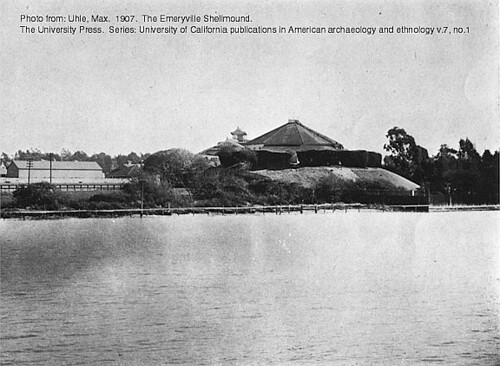
In the 1870s the enormous mound was turned into a sort of local amusement park (the Bay Area had a number of these places, but that's another post). Developers chopped the top off the mound to add a pavilion where (white) revelers could watch the Bay while they got loaded and literally danced on the graves of the indigenous dead.

EmeryvilleShellmound.jpg
1902 photo (published in 1907) of Shellmound Park, from the University of California's collection


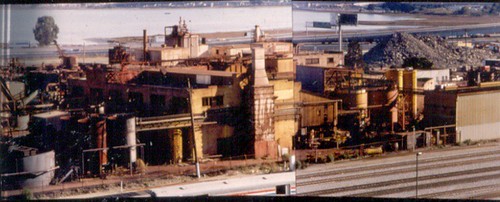
In 1924, the mound suffered a greater blow. Steam shovels removed the bulk of it to make way for paint and pesticide factories. At the time of the destruction, the mound's importance was already well-understood, even by non-native people. It had been twice excavated by researchers from the University of California - this overview of Bay Area shellmounds was written by one N.C. Nelson in the early 1900s. While the language is peppered with outmoded and racist ideas about the coastal tribes, the often lovely descriptions of the mounds make clear that anthropologists understood at least some of their significance.

toxic emeryville.jpg
Rusting factories on the remaining portion of the mound


The factories were torn down in the late '90s. While City of Emeryville officials were in the midst of deciding how to develop the at that point vacant land, a particularly heavy rainy season upset the ground where the factories had been leaching arsenic, heavy metals, and other poisons for more than 70 years, and toxic runoff started to pour into the Bay. The city hired workers to stop the runoff, and as they dug holding pools, the workers discovered that a large portion of the Shellmound, thought to be totally destroyed, was still there just under the topsoil. The City hired an archaeologist who reported that the area was "massively significant". They promptly fired him. They also brought in the Native American Heritage Commission, which appointed a "Most Likely Descendant" of the dead found inside the mound.


 Abalone Pendant.jpg
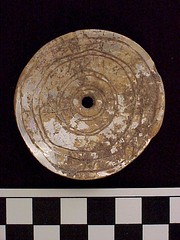
An abalone pendant from the mound
It should be obvious that the descendants of the ancient people who lived in the Bay Area do not speak with one voice. Historian Andrew Galvan, an Ohlone, favored exploring the mound for its archaeological value. But the local tribal community, officially represented in this case by 'most likely descendant' Katherine Perez, tended to oppose further excavation and instead pushed for reburial of the remains and sealing of the mound. For it's part, the City of Emeryville was under no legal obligation to listen to anyone, so they followed their pocketbooks by limiting the controversial archaeological research and allowing developers to move forward with building the Disney-esque shopping/entertainment/living complex that we have today.

When I walk into the Bay Street Mall my heart breaks. What kills me is how very many people are drawn there. On the immaculate, privately owned and maintained streets I see people of every ethnicity and age. Gay and lesbian folks. Transgender folks. The wealthy and the working class. I've even spotted one of the Bay's favorite leftist hip hop artists dining at California Pizza Kitchen (hey, I was dining there myself). There is a way that the Mall is like my dream of an idealized Bay Area where all kinds of people can be both themselves and be together, working, eating, laughing, but it's the looking-glass ideal. Behind the mall are minimum-wage retail workers, piles of clothes and toys and things, made by sweatshop workers in China, the environmental cost of the hundreds of cars stacked in the parking lots. And most painful, the mall's foundations, which rest on human remains.

Today, Indian People Organizing for Change along with members of Vallejo Intertribal SSP&RIT and their allies were meeting at the Intertribal Friendship House to launch a Shellmound Peace Walk, visiting Shellmounds and other sacred sites around the Bay Area, praying, and drawing attention to the past that is under all of our feet. The walk will wind up the day after thanksgiving, Buy Nothing Day, at the Bay Street Mall.

shellmound demo.jpg
Photo of 2006 demonstration taken by M. Villanueva, posted on indybay.org


Do you want to know more about the Ohlone or the Shellmound?

The short film Shellmound will be screening this Sunday, November 18th at La Pena as part of the Hecho en Califas festival.

The City of Emeryville's site about the Shellmound, created as part of their compromise agreement with local Ohlone people has quite a bit of (at times softened) historical information including photographs of dozens of artifacts found during the 1999 excavation.

A lovely site about East Bay Creeks features photos of the current Temescal Creek outflow.

Wikipedia handles Ohlone issues fairly well.

This SF weekly article has some interesting background about the Muwekma Ohlone tribe.

A recent study of bird bones from the Shellmound led one investigator to the conclusion that local tribes overhunted native birds to a significant enough degree to have severely reduced sea bird populations here. I was interested in the way this article challenges simplistic stereotypes about Indian people.

There were a number of articles about the mound written during the development and construction of the Mall:

The East Bay Express, Terrain Magazine and California Wild all printed worthwhile pieces.
 
Creative Commons License
Some Rights Reserved.