Showing posts with label 1970s. Show all posts
4.10.2008
Emory Douglas - Old News Reviews
It's day 4 of the Week of Book Reviews, and today I'm talking about Black Panther : The Revolutionary Art of Emory Douglas. The essays are good reading for someone new to Black Panther Party history and the interview with Douglas near the end provides insight into his personal story. Mostly this book provides beautiful, large, full-color reproductions of the artwork Douglas produced for the Black Panther Party newspaper. To get a sense of his stlye, you can view a bunch of the posters on the website associated with the MOCA exhibit of his work.
2.29.2008
Educate to Liberate
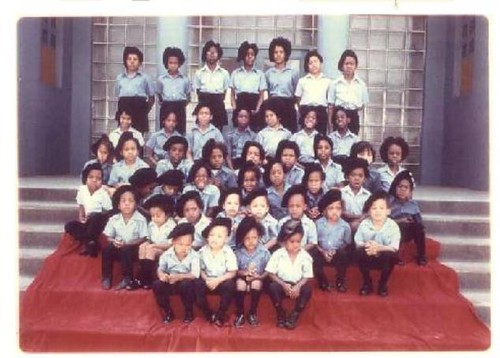
I finally got down to the Oakland History Room to check out Billy X. Jennings' exhibit on the Black Panther Party children's schools. You'll never see more adorable pictures of revolutionary education.
There are a few photos downstairs and more upstairs in front of the elevator and inside the Oakland History Room. I was especially into the shots of the kids doing Karate.
2.06.2008
Milk
In case you, like me, fail to keep up with Hollywood, I'll fill you in that Milk, a biopic about this country's first openly gay politician, has been shooting in the Castro this week. Unfortunately, I snoozed on my opportunity to serve as an extra in the movie but because I'm a sour grapes type, I'll go ahead and say that I have a hard time picturing Sean Penn as the charming and sexy, Jewish and gay Harvey Milk. Castro Shopper has good photos of the current Castro 70s Makeover, but if you want to get to know Harvey, I suggest tracking down the moving documentary The Times of Harvey Milk. Here's an excerpt:
1.07.2008
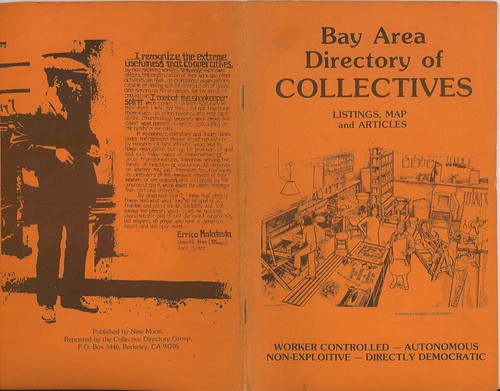
Bay Area Directory of COLLECTIVES
My dad just dug this handy guide to Bay Area collectives out of some long-buried filing cabinet. It looks to have been printed in 1980. I note with some amusement and some sadness that several pages of the booklet are taken up by a critique and rebuttal of itself. For some obsessive-compulsive reason I decided to scan the whole thing, so if you'd like to find out where you could have purchased collectively produced bagels in 1980, or if you want to know where Lilith, A Woman's Theater was located, feel free to click here for the full set of scans.
(Look, they've got it at Bolerium for $15 bucks!)
12.28.2007
Community Clinics
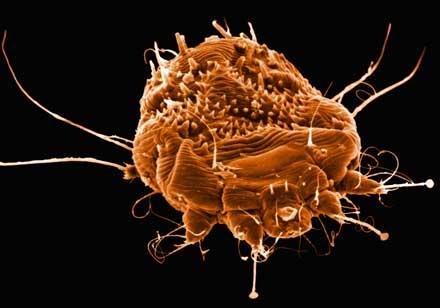
Over the last few days I've learned some exciting new facts about scabies. Shall I share?
1) The first and most exciting fact I've learned about scabies is that I DO NOT HAVE IT. It took two visits to my friend the PA who works in an STD clinic, a phone call to the craigslist date who could have given it to me, and finally, my own admission that I don't actually have scabies symptoms to convince me, but I'm now sure that I do not have a communicable disease, at least not one involving tiny mites that cause uncontrolled itching by shitting underneath the skin.
2) If I did have scabies, or any other disease for that matter, I would be 100% reliant on my saint-like friend the PA who works in an STD clinic to care for me because actually, as it turns out, having no health insurance and living in the East Bay = having almost no medical care at all. I called three or four local low-income clinics and they all told me that they only do intake for new patients ONCE A MONTH. So in other words, keep scratching for a couple weeks until we can see you. The exception is the Berkeley Free Clinic, but their hours are limited as is the range of care available there.
3) Even if they take forever to see you, the folks who run the Bay Area's community clinics still rock. I spent 15 or 20 minutes on the phone with a nice gentleman at the Free Clinic who failed to scream and hang up when I said I thought I had a social disease and then shared his recommendation for best East Bay community health clinic (LifeLong Medical Care). The person answering the phone at Lyon-Martin was also patient and kind even as she was telling me that their next appointment for new patients wasn't until January 18th.
I'm a former radical health care provider and I've got a very big and very special spot in my heart for community health care of all types. The Bay Area is home to a number of community clinics that grew out of a part of late-60s history where folks believed that health care was a basic human right and also that people could and should control their own care. If I ever get my shit together to write a book about Bay Area history, it'll be about the history of the Bay Area community health movement, but its going to take a lot of research because I don't know much beyond the skeleton. I can tell you about a few of the local community clinics though.
La Clinica de la Raza was founded in 1971 by Chicano students and doctors and community folks to provide community-based care in the Fruitvale neighborhood of Oakland. Now that La Clinica is one of the largest non-profits in the East Bay, it doesn't quite have the homemade community feel that started things off. On the other hand, they now provide health care for thousands of uninsured folks from South East Asia, all over Latin America, and all over East Oakland. Similarly, the Native American Health Center started in '72 when Indian activists and allies, post-Alcatraz occupation, called for a self-directed clinic for Native folks.
The way I heard the story of the Berkeley Free Clinic was that it was founded during the People's Park Riot by medic veterans of the Vietnam War. I can't recall the details of that story so I'll have to go with the vague history they have up on their site.
The BFC is especially close to my radical health care heart because they primarily use lay medical workers – non-professionals who undergo a rigorous in-house training program. A trip to the BFC often involves a discussion with the staff medic in front of an open medical textbook, with both of you trying to figure out what's bugging you.
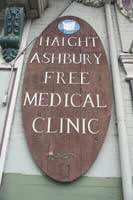
The Haight Ashbury Free Clinic is the most famous of our clinics. As I understand it, they were among the first medical clinics to treat drug addicts like human beings, and they still specialize in treating addiction and caring for addicts. I liked this free-association piece about their history from David Smith, the clinic founder.
Thanks clinics. I'm going to celebrate my lack of scabies by signing up to become a patient somewheres.
1) The first and most exciting fact I've learned about scabies is that I DO NOT HAVE IT. It took two visits to my friend the PA who works in an STD clinic, a phone call to the craigslist date who could have given it to me, and finally, my own admission that I don't actually have scabies symptoms to convince me, but I'm now sure that I do not have a communicable disease, at least not one involving tiny mites that cause uncontrolled itching by shitting underneath the skin.
2) If I did have scabies, or any other disease for that matter, I would be 100% reliant on my saint-like friend the PA who works in an STD clinic to care for me because actually, as it turns out, having no health insurance and living in the East Bay = having almost no medical care at all. I called three or four local low-income clinics and they all told me that they only do intake for new patients ONCE A MONTH. So in other words, keep scratching for a couple weeks until we can see you. The exception is the Berkeley Free Clinic, but their hours are limited as is the range of care available there.
3) Even if they take forever to see you, the folks who run the Bay Area's community clinics still rock. I spent 15 or 20 minutes on the phone with a nice gentleman at the Free Clinic who failed to scream and hang up when I said I thought I had a social disease and then shared his recommendation for best East Bay community health clinic (LifeLong Medical Care). The person answering the phone at Lyon-Martin was also patient and kind even as she was telling me that their next appointment for new patients wasn't until January 18th.
I'm a former radical health care provider and I've got a very big and very special spot in my heart for community health care of all types. The Bay Area is home to a number of community clinics that grew out of a part of late-60s history where folks believed that health care was a basic human right and also that people could and should control their own care. If I ever get my shit together to write a book about Bay Area history, it'll be about the history of the Bay Area community health movement, but its going to take a lot of research because I don't know much beyond the skeleton. I can tell you about a few of the local community clinics though.
La Clinica de la Raza was founded in 1971 by Chicano students and doctors and community folks to provide community-based care in the Fruitvale neighborhood of Oakland. Now that La Clinica is one of the largest non-profits in the East Bay, it doesn't quite have the homemade community feel that started things off. On the other hand, they now provide health care for thousands of uninsured folks from South East Asia, all over Latin America, and all over East Oakland. Similarly, the Native American Health Center started in '72 when Indian activists and allies, post-Alcatraz occupation, called for a self-directed clinic for Native folks.
The way I heard the story of the Berkeley Free Clinic was that it was founded during the People's Park Riot by medic veterans of the Vietnam War. I can't recall the details of that story so I'll have to go with the vague history they have up on their site.
The BFC is especially close to my radical health care heart because they primarily use lay medical workers – non-professionals who undergo a rigorous in-house training program. A trip to the BFC often involves a discussion with the staff medic in front of an open medical textbook, with both of you trying to figure out what's bugging you.
The Haight Ashbury Free Clinic is the most famous of our clinics. As I understand it, they were among the first medical clinics to treat drug addicts like human beings, and they still specialize in treating addiction and caring for addicts. I liked this free-association piece about their history from David Smith, the clinic founder.
Thanks clinics. I'm going to celebrate my lack of scabies by signing up to become a patient somewheres.
12.25.2007
Lost Amusement
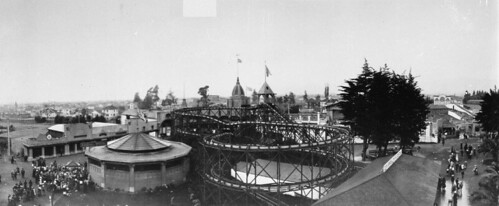
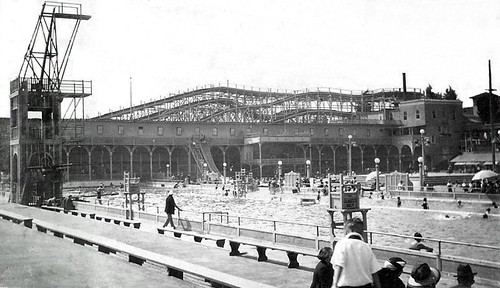
Finals are over (thank the maker) and apparently, some guy named Jesus was born today. Seems like the right time to talk about boozing, gambling, and flipping upside-down on roller coasters. Here goes: Before TiVo, iPods, or Guitar Hero, when folks had to leave the house for a little something exciting, the Bay Area was peppered with amusement parks. The parks incorporated natural beauty along with human-made entertaiments like junk food, race-tracks and shooting ranges.
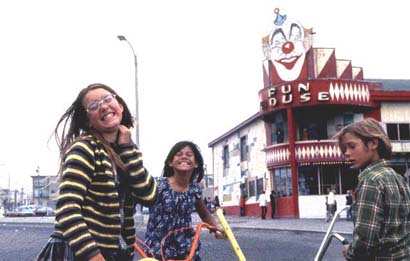
Playland at the Beach is the most well known of our lost parks. It started as a disorganized collection of concessions and rides at Ocean Beach in the late 1800s and only shut down in the early 1970s. At one point it spanned three city blocks and included roller coasters, merry-go-rounds, five restaurants, and eventually the Sutro Baths and the Cliff House restaurant which to this day traps tourists before they fall off the edge of San Francisco and onto Seal Rock in the Pacific. Outsidelands.org collects photos and stories of Playland and wikipedia has a pretty thorough entry including descriptions of the various rides nausea inducing rides like the Aeroplane Swing, the Whip, and Dodg-em.

Chelle and Noelle Beloy in front of the Fun House at Playland at the Beach.
Copyright Dennis O'Rorke, early 1970s from outsidelands.org.
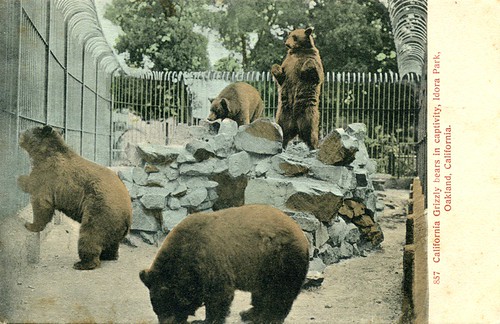
From 1904 until 1929, Idora Park in the present day Oakland neighborhood of Temescal was home to a miniature railway, a car race track, the Illusion Theater, a successful opera house, and a skating rink that billed itself as the largest in the world. The park also housed a number of caged animal displays and served as a temporary home of the Oakland Oaks baseball team. This postcard set provides some images of that disappeared park.
Shellmound Park in Emeryville lasted from 1876 to 1924. It was built, morbidly, on the lopped off top of the Bay Area's largest indigenous Shellmound. The best online resource about the park is this PDF from the Emeryville Historical Society. You can read there about the pleasant picnic grounds, the shooting range, bowling alley, bicycle and horse racing and two dance pavilions that were part of this destination for San Franciscans who wanted panoramic Bay views and a getaway from city hustle. The picnic grounds in particular were utilized by all types of local civic groups, ranging from the Household of Ruth, a Black women's chapter of the Odd Fellows, to the notoriously racist Workingmen's Party. Local anti-gambling ordinances and the new national alcohol prohibition killed Shellmound Park. There's no point in picnics and horse races without booze, apparently.
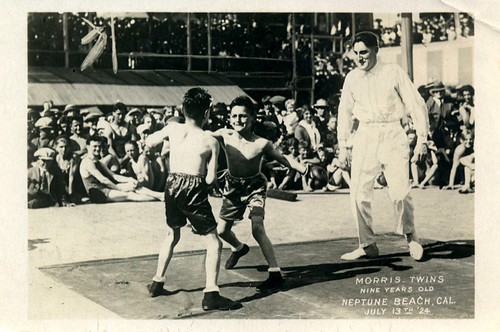
Neptune Beach didn't open until 1917, late compared to other Bay Area parks, and it lasted until 1939 when the depression and increasing car use spurred in part by the recently completed San Francisco Bay Bridge made Alameda a less appealing destination for Bay Area funseekers. While it lasted it contained a giant swimming area, prime beach land, snacks, concessions, and a roller coaster that offered views across the Bay to San Francisco.
Amusement parks were popular around the country in the early 20th century. Most started as Trolley Parks, created by the streetcar companies as a destination for trolley lines. The parks were often built at beaches or, as in Idora Park, at locations that otherwise showed off nature's lovelier features. The natural features were eventually obscured by the gaudy rides that were installed later. The parks patterned themselves after each other and tended to rip off rides and even their names from larger or more successful parks elsewhere in the country. You might recognize the name "Playland" for example from the more famous Long Island park of the same name. Like the streetcar companies that built these places, the parks themselves were killed by the rise of car culture – not to mention the Great Depression and then television. Although as in the case of Playland, there were some late holdouts. Amusement Park fans are quite loyal. Besides lovingly maintained memorial websites to the various amusement parks, the Neptune Beach Amusement Museum is trying to build a physical space in the old location of Neptune Beach.
(Thanks so much to peacay at the beautiful bibliodyssey for giving me the Cliff House link that started me on this post.)
11.22.2007
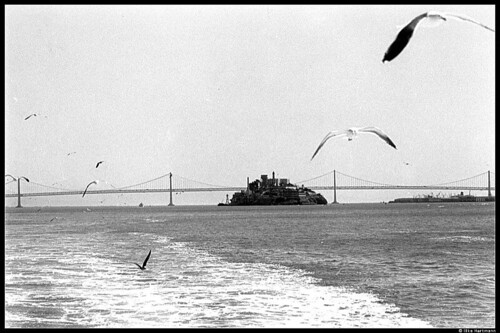
Alcatraz
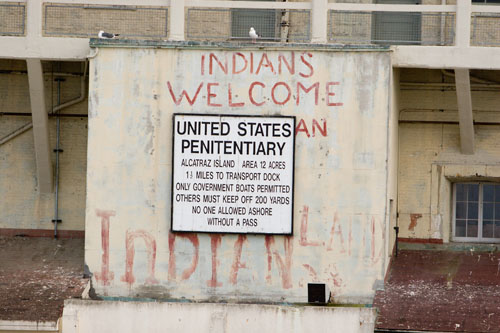
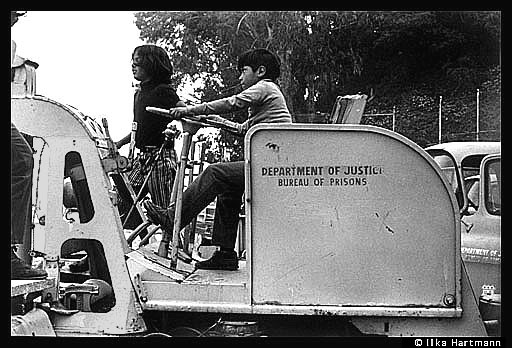
From 1969 to 1971 a pan-national group of Indian activists called Indians of All Tribes occupied Alcatraz Island, reclaiming the land 'by right of discovery'. This was their proclamation:
I N D I A N S O F A L L N A T I O N S
THE ALCATRAZ PROCLAMATION
to the
Great White Father and his People
1969
We, the native Americans, reclaim the land known as Alcatraz Island in the name of all American Indians by right of discovery.
We wish to be fair and honorable in our dealings with the Caucasian inhabitants of this land, and hereby offer the following treaty:
We will purchase said Alcatraz Island for twenty-four dollars in glass beads and red cloth, a precedent set by the white man's purchase of a similar island about 300 years ago. We know that $24 in trade goods for these 16 acres is more than was paid when Manhattan Island was sold, but we know that land values have risen over the years. Our offer of $1.24 per acres is greater than the $0.47 per acre the white men are now paying the California Indians for their lands.
We will give to the inhabitants of this island a portion of the land for their own to then to be held in trust...by the Bureau of Caucasian Affairs...in perpetuity -- for as long as the sun shall rise and the rivers go down to the sea. We will further guide the inhabitants in the proper way of living. We will offer them our religion, our education, our life-ways in order to help them achieve our level of civilization and thus raise them and all their white brothers up from their savage and unhappy state. We offer this treaty in good faith and wish to be fair and honorable in our dealings with all white men.
We feel that this so-called Alcatraz Island is more than suitable for an Indian reservation, as determined by the white man's own standards. By this, we mean that this place resembles most Indian reservations in that:
1. It is isolated from modern facilities, and without adequate means of transportation.
2. It has no fresh running water.
3. It has inadequate sanitation facilities.
4. There are no oil or mineral rights.
5. There is no industry and so unemployment is very great.
6. There are no health-care facilities.
7. The soil is rocky and non-productive, and the land does not support game.
8. There are no educational facilities.
9. The population has always exceeded the land base.
10. The population has always been held as prisoners and kept dependent upon others.
Further, it would be fitting and symbolic that ships from all over the world, entering the Golden Gate, would first see Indian land, and thus be reminded of the true history of this nation. This tiny island would be a symbol of the great lands once ruled by free and noble Indians.
What use will we make of this land?
Since the San Francisco Indian Center burned down, there is no place for Indians to assemble and carry on tribal life here in the white man's city. Therefore, we plan to develop on this island several Indian institutions:
1. A Center for Native American Studies will be developed which will educate them to the skills and knowledge relevant to improve the lives and spirits of all Indian peoples. Attached to this center will be traveling universities, managed by Indians, which will go to the Indian Reservations, learning those necessary and relevant materials now about.
2. An American Indian Spiritual Center, which will practice our ancient tribal religious and sacred healing ceremonies. Our cultural arts will be featured and our young people trained in music, dance, and healing rituals.
3. An Indian Center of Ecology, which will train and support our young people in scientific research and practice to restore our lands and waters to their pure and natural state. We will work to de-pollute the air and waters of the Bay Area. We will seek to restore fish and animal life to the area and to revitalize sea-life which has been threatened by the white man's way. We will set up facilities to desalt sea water for human benefit.
4. A Great Indian Training School will be developed to teach our people how to make a living in the world, improve our standard of living, and to end hunger and unemployment among all our people. This training school will include a center for Indian arts and crafts, and an Indian restaurant serving native foods, which will restore Indian culinary arts. This center will display Indian arts and offer Indian foods to the public, so that all may know of the beauty and spirit of the traditional Indian ways.
Some of the present buildings will be taken over to develop an American Indian Museum which will depict our native food and other cultural contributions we have given to the world. Another part of the museum will present some of the things the white man has given to the Indians in return for the land and life he took:
disease, alcohol, poverty, and cultural decimation (as symbolized by old tin cans, barbed wire, rubber tires, plastic containers, etc.). Part of the museum will remain a dungeon to symbolize both those Indian captives who were incarcerated for challenging white authority and those who were imprisoned on reservations. The museum will show the noble and tragic events of Indian history, including the broken treaties, the documentary of the Trail of Tears, the Massacre of Wounded Knee, as well as the victory over Yellow-Hair Custer and his army.
In the name of all Indians, therefore, we reclaim this island for our Indian nations, for all these reasons. We feel this claim is just and proper, and that this land should rightfully be granted to us for as long as the rivers run and the sun shall shine.
We hold the rock!
--------------------------------

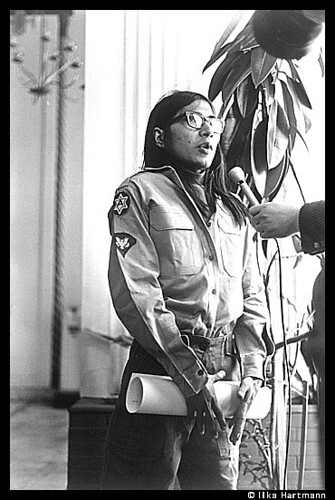
Alcatraz occupier Atha Rider Whitemankiller after the
last residents were forcibly removed from the island.
Photo by Ilka Hartmann.
The Alcatraz occupation on the internet:
An article from the Native Press; original documents from Indians of All Tribes (and related ephemera); the National Park Service; and American Indian Studies professor Troy Johnson's Alcatraz site with a lot of period photos, including all but one of the photos in this post.
The Alcatraz occupation on paper:
Ojibway activist and occupation organizer Adam Fortunate Eagle's Alcatraz! Alcatraz! and Heart of the Rock (co-written with sympathetic white guy journalist Tim Findley); Like a Hurricane from Comanche writer Paul Chaat Smith, and Osage professor and writer Robert Allen Warrior; probable white guy American Indian Studies professor Troy R. Johnson's The Occupation of Alcatraz Island, Alcatraz: Indian Land Forever, and You Are on Indian Land! Alcatraz Island, 1969-1971.
The Alcatraz occupation on film:
Alcatraz is Not an Island documentary website including video of occupation veterans.
Happy Thanksgiving folks.
Labels:
1960s,
1970s,
American Indian,
holidays,
islands
10.31.2007
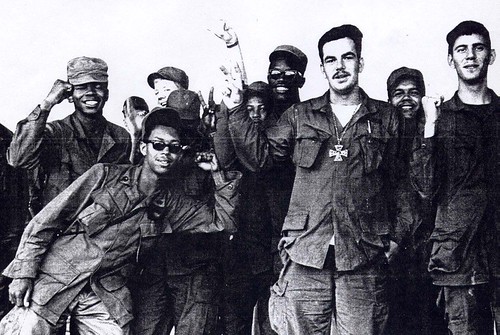
Sir! No Sir!
Shoot, folks have been telling me to watch this for months - I guess at this point it's been a couple years. Anyhow, I finally saw Sir! No Sir! last night. I had about 30 other things to do, but I'm glad I blew them off because this is a great movie and I learned so much!
I'm embarrassed to admit that I was at least 25 before I understood that the US had actually lost the war in Vietnam. And I sure didn't get the level of resistance against the war within the military until I saw this movie. There's even some great local info including a bit about vets breaking our of the stockade at the Presidio in San Francisco. The stockade at the Presidio?? See, I've managed to spend my naive 33 years thinking of the Presidio as a really pretty park. Sometimes learning history makes me feel like a moron. Anyhow, here's the extended 12 minute trailer:
10.23.2007
You Can't Stop Me – an interview with Cathy Cade
If you have an image in your head of a lesbian feminist, Cathy Cade probably helped put in there. For at least my entire adult life, I've been looking at her pictures in the dozen books and magazines where they've been featured, and in her own book, A Lesbian Photo Album: The Lives of Seven Lesbian Feminists.
Cathy became an activist while she was in college: in 1966 she joined the Civil Rights Movement, demonstrating and organizing with SNCC. As an opponent of the Vietnam War, she helped found the Tulane chapter of SDS, and later was an early actor in the Women's Movement. In 1970, Cathy moved to San Francisco where she soon came out as a lesbian and started taking pictures, and her interconnected dedication to social justice and to photography has persisted throughout her life. Along with her documentary photo projects, Cathy runs a business as a professional photographer and personal historian. (Her website has details.) I was so excited when Cathy agreed to do an interview with me, and not only did we have a great time talking, but she managed to recruit me to a whole pile of women's history related projects she's involved with!
Along with the interview, I asked Cathy to chose a few pictures which show how her work has changed over the years. You can find them below, each with a little bit of background from her in the caption.

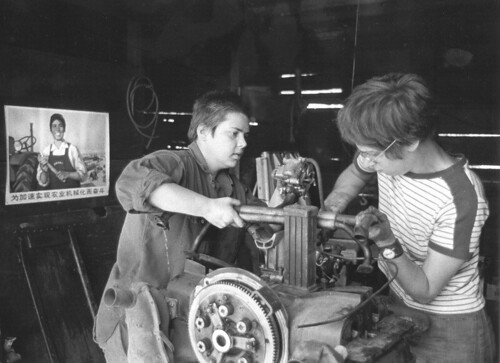
Gail Grassi and Kate Kaufman repairing a car. "It was a time when we all looked to the Chinese Revolution for progressive ideas of making the world a better place for people."
Bay Radical You talked before we started taping about how when you first started doing photography, you couldn't believe that women could really use that equipment.
Cathy Cade That's right.
BR You started taking pictures in '71 – is that right?
CC Ya. The same spring I came out as a lesbian; they were very connected. It was a time when a lot of lesbians were getting into the trades. And so one of the first things I did was photograph women in the trades, and photograph my friends tuning their cars, and the Women's Press Collective printing books, and carpenters. I still like to do that. Recently I've been photographing men doing skilled work. Uptown Body and Fender is in downtown Oakland and the woman who owns that loves art and she hired me to photograph her workers. [Now] there are these big beautiful black and white prints up on the wall, so when you've had your car smashed up you drive in there and you get out of your car and here are all these skilled mechanics doing their work.
BR That's really cool.
CC It turns out I like to photograph men doing skilled work also.
BR Have you taken pictures of men over the years?
CC Some gay men. But this is all political. Most of the men who work in that shop are immigrants from Latin America, one of whom was just being deported the other day. So it all stays political.
BR Was there some lag between when you started taking pictures and when you started thinking of yourself as a photographer?
CC Not very much, but it's a good question because one of the reasons I started taking pictures was because I was tired of going to meetings and all the processing and yet I still wanted to be in the movement. I figured I could make my contribution and not have to go to so many meetings. When I started photographing there were all these new magazines, and there [were] new exhibit opportunities because the women's movement and the lesbian feminist movement was just bursting out. And so my work got used right away. There wasn't any long period of me wondering if anybody was going to like my work or anything. It was totally grabbed up and used in newspapers, and magazines, and local exhibits, and in the new coffeehouses, so that made it really easy.
I didn't want to use the word "artist" because when I was growing up an artist was one of these rare people who was born with humongous talent and "please don’t embarrass us by thinking that you might be talented". But there were people like Holly Near and others using the word "cultural worker", so I could call myself a cultural worker. Things have changed over the years and I call myself an artist. And I'm glad to identify as an artist, but the fact that I was starting to do my photo work when it was wanted, needed, used and I could call myself a cultural worker – was helpful!

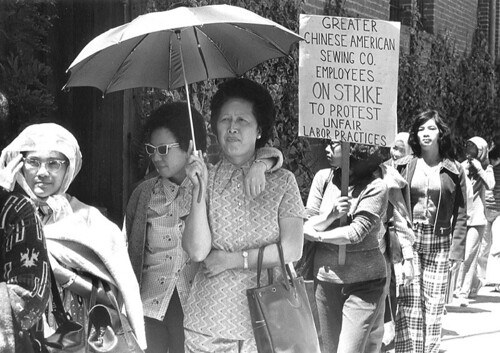
"I became involved with a coalition of union women called Union WAGE - Union Women's Alliance to Gain Equality. Some of the leadership were of an older generation than we were and had been activists in the '30s. This was one of the only places in the '70s where women in the women's movement of different generations were connecting with each other."
BR Right. That makes sense.
CC I didn't get paid.
BR Right. [Laughing] Some things don't change.
CC I think that I worked in photography as opposed to film partly because I could take pictures without having to raise a lot of money. My attitude a lot was, "You can't stop me." With a camera and wanting to take pictures and maybe wanting to get them out a little bit, the "you can't stop me" would work.
Now a days with the new technology you probably can make little films and put them up on YouTube, that's probably shifted.

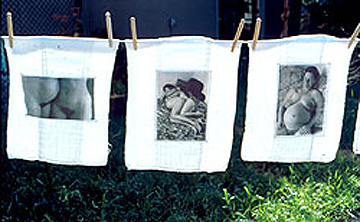
"I wanted to do a book on lesbian mothering but I never got to, and when I couldn't do a book I said 'I'm going to take some of my favorite images, and I'm going to print them on cloth and embroider the cloth onto diapers'. The great thing about it is, I hang it up on a clothes line with old fashioned clothes pins - I can hang up an exhibit in 20 minutes - which means that I can hang it up for a one day event. I have it in the works to expand it."
BR Right. Well, it's a trade off because, what we don't have now is a movement to go with it and so it's…
CC You don't think we do?
BR Well, I'm curious how you think about it because your work was such a part of a movement. Does it still feel like its connected to a movement in the same way?
CC Well, backup a minute. I had two kids as a lesbian by donor insemination. My first son was born in '78, and my second in '85 – this was the beginning of this new lesbian mothering movement – so I had my kids and raised my kids in a political context. There were those years where lesbian mothering was my movement. After they got to a certain age, I guess high school or something, they weren't around as much and I started looking around and saying, "OK, so where's the Women's Movement? Where's the Lesbian Movement now?" And I couldn't find it. At first it seemed like it was nowhere. Like, when I moved out here in '71, I knew where the Women's Liberation Movement was: it was at Glide Church on Friday nights at 7:30.
BR That makes it easy!
CC Ya! But then we're talking the late '80s, early '90s, it's like nowhere and everywhere. And that's what it feels like now. But I'm now more and more connected with an old lesbian movement, and that's easier to identify - where it is - so I've lucked out again, in another identifiable movement.

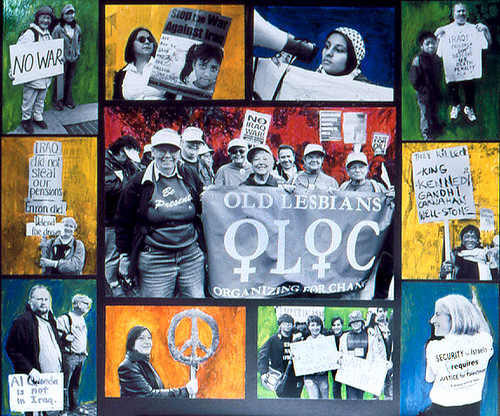
Old Lesbians Organizing for Change marching at an early anti-Iraq War demonstration. "I started cutting up my pictures and making collages. This was radical. I had all been black and white, documentary photography, and all the sudden I'm cutting up a print and I'm going, 'Who do you think you are? God?'"
BR [There's a] theme that I see in your pictures that I wondered if you see, or if you have other themes that you want to point out: The subjects in your pictures are without self-consciousness, and especially because it's women doing non-traditional work, or people who are seen by the outside world as ugly in a certain way, that you just present in this really matter-of-fact way.
CC Well, I really appreciate you calling it that because some people think I'm overly positive, disgustingly positive, just this old Pollyanna, so it's nice of you to call it self-acceptance and a lack of self-consciousness. But I really did want to show us as human beings and to show us acting out of our personal power. Those early women in the trades pictures have a lot of sense of personal power you know. And I wanted to show women as smart and loving.
And the lesbian mothering pictures, I called them "mothering" not just "lesbian mothers" because nobody talked about mothering and what a job [it] was, and that it had skills. Part of what I wanted to do in those pictures was to articulate, "What do mothers do?" Not just what do lesbian mothers do but, "What is the job of mothering?"
The other thing is the everydayness - celebrating the everydayness. Everyday activities and everyday people.

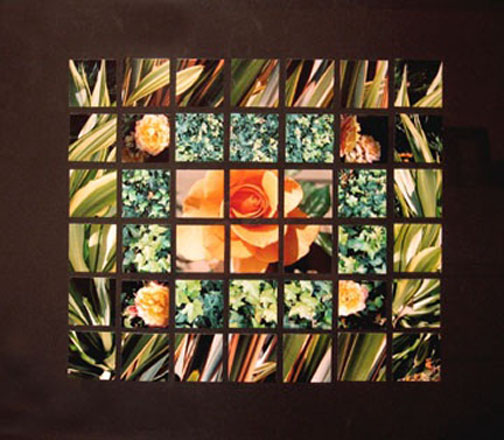
"These quilt photos start out being 4X6 color prints that I take to the lab and they make 'em. No more sweating in the dark room. I cut the prints up and I reassemble them like you would a quilt if you had little pieces of cloth. They're about beauty, and I think in this day and age beauty brings hope, and getting to have hope is very political."
Cathy became an activist while she was in college: in 1966 she joined the Civil Rights Movement, demonstrating and organizing with SNCC. As an opponent of the Vietnam War, she helped found the Tulane chapter of SDS, and later was an early actor in the Women's Movement. In 1970, Cathy moved to San Francisco where she soon came out as a lesbian and started taking pictures, and her interconnected dedication to social justice and to photography has persisted throughout her life. Along with her documentary photo projects, Cathy runs a business as a professional photographer and personal historian. (Her website has details.) I was so excited when Cathy agreed to do an interview with me, and not only did we have a great time talking, but she managed to recruit me to a whole pile of women's history related projects she's involved with!
Along with the interview, I asked Cathy to chose a few pictures which show how her work has changed over the years. You can find them below, each with a little bit of background from her in the caption.

Gail Grassi and Kate Kaufman repairing a car. "It was a time when we all looked to the Chinese Revolution for progressive ideas of making the world a better place for people."
Bay Radical You talked before we started taping about how when you first started doing photography, you couldn't believe that women could really use that equipment.
Cathy Cade That's right.
BR You started taking pictures in '71 – is that right?
CC Ya. The same spring I came out as a lesbian; they were very connected. It was a time when a lot of lesbians were getting into the trades. And so one of the first things I did was photograph women in the trades, and photograph my friends tuning their cars, and the Women's Press Collective printing books, and carpenters. I still like to do that. Recently I've been photographing men doing skilled work. Uptown Body and Fender is in downtown Oakland and the woman who owns that loves art and she hired me to photograph her workers. [Now] there are these big beautiful black and white prints up on the wall, so when you've had your car smashed up you drive in there and you get out of your car and here are all these skilled mechanics doing their work.
BR That's really cool.
CC It turns out I like to photograph men doing skilled work also.
BR Have you taken pictures of men over the years?
CC Some gay men. But this is all political. Most of the men who work in that shop are immigrants from Latin America, one of whom was just being deported the other day. So it all stays political.
BR Was there some lag between when you started taking pictures and when you started thinking of yourself as a photographer?
CC Not very much, but it's a good question because one of the reasons I started taking pictures was because I was tired of going to meetings and all the processing and yet I still wanted to be in the movement. I figured I could make my contribution and not have to go to so many meetings. When I started photographing there were all these new magazines, and there [were] new exhibit opportunities because the women's movement and the lesbian feminist movement was just bursting out. And so my work got used right away. There wasn't any long period of me wondering if anybody was going to like my work or anything. It was totally grabbed up and used in newspapers, and magazines, and local exhibits, and in the new coffeehouses, so that made it really easy.
I didn't want to use the word "artist" because when I was growing up an artist was one of these rare people who was born with humongous talent and "please don’t embarrass us by thinking that you might be talented". But there were people like Holly Near and others using the word "cultural worker", so I could call myself a cultural worker. Things have changed over the years and I call myself an artist. And I'm glad to identify as an artist, but the fact that I was starting to do my photo work when it was wanted, needed, used and I could call myself a cultural worker – was helpful!

"I became involved with a coalition of union women called Union WAGE - Union Women's Alliance to Gain Equality. Some of the leadership were of an older generation than we were and had been activists in the '30s. This was one of the only places in the '70s where women in the women's movement of different generations were connecting with each other."
BR Right. That makes sense.
CC I didn't get paid.
BR Right. [Laughing] Some things don't change.
CC I think that I worked in photography as opposed to film partly because I could take pictures without having to raise a lot of money. My attitude a lot was, "You can't stop me." With a camera and wanting to take pictures and maybe wanting to get them out a little bit, the "you can't stop me" would work.
Now a days with the new technology you probably can make little films and put them up on YouTube, that's probably shifted.

"I wanted to do a book on lesbian mothering but I never got to, and when I couldn't do a book I said 'I'm going to take some of my favorite images, and I'm going to print them on cloth and embroider the cloth onto diapers'. The great thing about it is, I hang it up on a clothes line with old fashioned clothes pins - I can hang up an exhibit in 20 minutes - which means that I can hang it up for a one day event. I have it in the works to expand it."
BR Right. Well, it's a trade off because, what we don't have now is a movement to go with it and so it's…
CC You don't think we do?
BR Well, I'm curious how you think about it because your work was such a part of a movement. Does it still feel like its connected to a movement in the same way?
CC Well, backup a minute. I had two kids as a lesbian by donor insemination. My first son was born in '78, and my second in '85 – this was the beginning of this new lesbian mothering movement – so I had my kids and raised my kids in a political context. There were those years where lesbian mothering was my movement. After they got to a certain age, I guess high school or something, they weren't around as much and I started looking around and saying, "OK, so where's the Women's Movement? Where's the Lesbian Movement now?" And I couldn't find it. At first it seemed like it was nowhere. Like, when I moved out here in '71, I knew where the Women's Liberation Movement was: it was at Glide Church on Friday nights at 7:30.
BR That makes it easy!
CC Ya! But then we're talking the late '80s, early '90s, it's like nowhere and everywhere. And that's what it feels like now. But I'm now more and more connected with an old lesbian movement, and that's easier to identify - where it is - so I've lucked out again, in another identifiable movement.

Old Lesbians Organizing for Change marching at an early anti-Iraq War demonstration. "I started cutting up my pictures and making collages. This was radical. I had all been black and white, documentary photography, and all the sudden I'm cutting up a print and I'm going, 'Who do you think you are? God?'"
BR [There's a] theme that I see in your pictures that I wondered if you see, or if you have other themes that you want to point out: The subjects in your pictures are without self-consciousness, and especially because it's women doing non-traditional work, or people who are seen by the outside world as ugly in a certain way, that you just present in this really matter-of-fact way.
CC Well, I really appreciate you calling it that because some people think I'm overly positive, disgustingly positive, just this old Pollyanna, so it's nice of you to call it self-acceptance and a lack of self-consciousness. But I really did want to show us as human beings and to show us acting out of our personal power. Those early women in the trades pictures have a lot of sense of personal power you know. And I wanted to show women as smart and loving.
And the lesbian mothering pictures, I called them "mothering" not just "lesbian mothers" because nobody talked about mothering and what a job [it] was, and that it had skills. Part of what I wanted to do in those pictures was to articulate, "What do mothers do?" Not just what do lesbian mothers do but, "What is the job of mothering?"
The other thing is the everydayness - celebrating the everydayness. Everyday activities and everyday people.

"These quilt photos start out being 4X6 color prints that I take to the lab and they make 'em. No more sweating in the dark room. I cut the prints up and I reassemble them like you would a quilt if you had little pieces of cloth. They're about beauty, and I think in this day and age beauty brings hope, and getting to have hope is very political."
10.07.2007
Wattstax
Have you seen Wattstax? Maybe because it was released a year before I was born, I never saw it until just this second. I thought I would watch it while I worked on the homework for my web design class, but this is shredding me - I cannot take my eyes off the screen! Not only is it an amazing concert movie, not only is it an awesome document of a particular historical moment, but the seventies outfits are blowing me away!
If you have a pulse, you must watch this film. Here's the preview (you can ignore the dumb voiceover, but don't miss Oaklander Ted "Isaac, Your Bartender" Lange!):
8.05.2007
Free the SF 8!
When I started this site, I wanted to find a way to connect historical movements with contemporary struggles. Unfortunately, I now have an opportunity to do that:
Eight men are in jail in San Francisco, charged with a 30 year old murder. All these guys were radicals a long, long time ago. When they were charged this year, some of them were still community activists, a couple were already serving prison time, mostly, they are older men who one would be hard-pressed to see as dangerous. In the words of 64-year old defendant Ray Boudreaux (an electrician who lives in Southern California), "…for the last 25 years I've lived a pretty peaceful and quiet life. My politics are still the same. It's just that I'm not active. People come to me sometimes as a peace-maker."
I'm aware that most of us progressives suffer from a certain overwhelm about the unjustly imprisoned. We marched to Free Mumia until our marches petered out into t-shirts and then occasional arguments and then, nothing. Mumia is still on death row. We've been carrying our "Free Peltier" signs since 1977 but with every rejected parole hearing, we say less about him. It's easy to give up when we feel so hopeless, and for that reason, it's important to find ways to stay connected to the people who are stuck behind bars.
Mostly, when I think about these guys in jail in San Francisco, I think about their families. I imagine my dad having to go to jail at this point in his life – how he'd feel – how I'd feel. You don't even have to know that they're innocent to agree that they should be given a reasonable bail (it was set at 3 million each) so they can go home while they deal with the legal proceedings that are still ahead of them. For me, a prison abolitionist, just knowing that eight former activists who are clearly not a threat to anyone now are in jail is enough to push me to want to do something. If you're better motivated by outrage, then you should know that the evidence that prosecutors say points to these men was obtained through torture.
There are eight men in jail now – there on the strength of a confession obtained under torture. That's ugly and worth fighting against. But its worth also wondering what the point of this is for the state. While I'm not going to suggest a conspiracy, it's pretty obvious what message this is sending to any radical activists now: take your movement beyond the choreographed protest march and you'll spend the rest of your life with the threat of prison hanging over you. It's important that we stick up for each other as activists, even 30 years after the movement is gone. Solidarity isn't a one-time action, it's a lifetime commitment.
All of this is a long introduction to what I want to say here, which is this: Tomorrow, Monday, August 6th, the San Francisco 8 will be having a hearing dealing with the terms of their bail and other matters, and your presence at that hearing would not only make a psychological difference for the guys, but would also help make a point to the court, prosecutors, and media, that we care about these men, and want to see them treated fairly. It doesn't take a lot of work to get down to 850 Bryant. I've made the trip twice, both times with kids (sure, I only made it through 15 minutes of hearings before I had to usher the bored and confused 4 and 5 year olds out of the courtroom, but I did manage to show up). Go down. Show your support. Check out the website. Put up a poster. Wear a button. Blog about them. Do what you can, because you can do something.
When a Grand Jury started calling former Panthers to testify about the murder case a couple years ago, four men were jailed for refusing to testify. At that time, Bay Area activists Andres AlegrÃa, Claude Marks & others at The Freedom Archives made a video about the grand jury resistors called Legacy of Torture. It played at the Roxy and various venues around town. Here's the preview:
Eight men are in jail in San Francisco, charged with a 30 year old murder. All these guys were radicals a long, long time ago. When they were charged this year, some of them were still community activists, a couple were already serving prison time, mostly, they are older men who one would be hard-pressed to see as dangerous. In the words of 64-year old defendant Ray Boudreaux (an electrician who lives in Southern California), "…for the last 25 years I've lived a pretty peaceful and quiet life. My politics are still the same. It's just that I'm not active. People come to me sometimes as a peace-maker."
I'm aware that most of us progressives suffer from a certain overwhelm about the unjustly imprisoned. We marched to Free Mumia until our marches petered out into t-shirts and then occasional arguments and then, nothing. Mumia is still on death row. We've been carrying our "Free Peltier" signs since 1977 but with every rejected parole hearing, we say less about him. It's easy to give up when we feel so hopeless, and for that reason, it's important to find ways to stay connected to the people who are stuck behind bars.
Mostly, when I think about these guys in jail in San Francisco, I think about their families. I imagine my dad having to go to jail at this point in his life – how he'd feel – how I'd feel. You don't even have to know that they're innocent to agree that they should be given a reasonable bail (it was set at 3 million each) so they can go home while they deal with the legal proceedings that are still ahead of them. For me, a prison abolitionist, just knowing that eight former activists who are clearly not a threat to anyone now are in jail is enough to push me to want to do something. If you're better motivated by outrage, then you should know that the evidence that prosecutors say points to these men was obtained through torture.
There are eight men in jail now – there on the strength of a confession obtained under torture. That's ugly and worth fighting against. But its worth also wondering what the point of this is for the state. While I'm not going to suggest a conspiracy, it's pretty obvious what message this is sending to any radical activists now: take your movement beyond the choreographed protest march and you'll spend the rest of your life with the threat of prison hanging over you. It's important that we stick up for each other as activists, even 30 years after the movement is gone. Solidarity isn't a one-time action, it's a lifetime commitment.
All of this is a long introduction to what I want to say here, which is this: Tomorrow, Monday, August 6th, the San Francisco 8 will be having a hearing dealing with the terms of their bail and other matters, and your presence at that hearing would not only make a psychological difference for the guys, but would also help make a point to the court, prosecutors, and media, that we care about these men, and want to see them treated fairly. It doesn't take a lot of work to get down to 850 Bryant. I've made the trip twice, both times with kids (sure, I only made it through 15 minutes of hearings before I had to usher the bored and confused 4 and 5 year olds out of the courtroom, but I did manage to show up). Go down. Show your support. Check out the website. Put up a poster. Wear a button. Blog about them. Do what you can, because you can do something.
When a Grand Jury started calling former Panthers to testify about the murder case a couple years ago, four men were jailed for refusing to testify. At that time, Bay Area activists Andres AlegrÃa, Claude Marks & others at The Freedom Archives made a video about the grand jury resistors called Legacy of Torture. It played at the Roxy and various venues around town. Here's the preview:
7.23.2007
Ericka Huggins
Dana and I went out to Thai food on Grand Avenue the other day, and happened to sit next to one of my heroes. Later I wished I had said something really thoughtful and articulate like, "Excuse me, I apologize for interrupting your meal, but I couldn't let you leave without telling you how grateful I am for the work you've done to support the liberation of African American people, and of all people, and for the many very real sacrifices you've made over these many years. Thank you." Of course, if I had actually talked to her in the moment, whatever I said would have come out making me sound like a gibbering stalker, (I know this to be true because I ran into her once before, and did talk to her like a gibbering stalker), so it's for the best that I contented myself to bask in the glow of her fashionable (although in no way ostentatious) back, which was seated only a foot or two away from me.
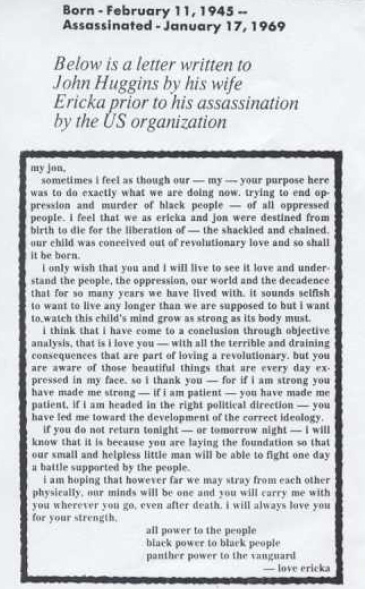
I doubt she's recognized much now, but Ericka Huggins spent a few years being infamous. In 1970, she was a defendant in an internationally notorious and highly politicized murder trial in New Haven, Connecticut. Folks like Dr. Benjamin Spock and writer Jean Genet came to Yale to speak on her behalf. One year before that trial, her husband John Huggins, a leader in the Los Angeles chapter of the Black Panthers, was killed at UCLA by members of a rival activist faction. Throughout the 70s she co-authored a book of poems with Huey Newton, held political offices, and directed a Black Panther school. I wish I knew more about what she's doing now – meditation, spirituality and education seem to be among her current interests, and she does some speaking about her time in the Black Panthers, but it's hard to find out much about her because, although one site says that she's writing a memoir, she clearly isn't out to promote herself, which is a consistent theme for her, actually.
Ericka grew up in Washington, D.C. She was politicized early on, attending the March on Washington when she was 15. The late 60s, the moment when Ericka was coming of age, was a point of increasing militancy among activists in general, and Black activists in particular. (SNCC for example, a major organization in the Civil Rights Movement, officially changed its strategy from specifically nonviolent, to including a broader range of tactics when Stokely Carmichael took over the organization in 1966.) Like thousands of young people around her, Ericka probably felt shocked and horrified by the poverty and violence that Black people and poor people were experiencing around her. Race riots were a regular feature of the late 60s, and were invariably inspired by, and then followed by, harsh police violence. The Vietnam War, and protests against it, escalated around her. Internationally, militancy seemed to be on the increase, with revolutionary movements gaining prominence in Palestine, Northern Ireland, and even next door in Quebec. In this context, in 1968, Ericka joined the Black Panthers. She met John ("Jon" in Ericka's love letters) at college and they moved together to LA where they got very involved in the growing Panther chapter there. They took and then taught political education classes, organized, fundraised, served in the Party social programs, and I'll assume they studied marksmanship, a requirement for all Party members. John took on a leadership position. Ericka got pregnant.
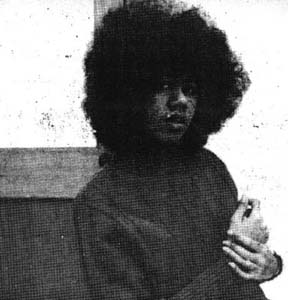
With his beard and bellbottoms, John gave off much more of a hippy vibe than his fellow militants, especially Bunchy Carter, a charismatic former gang leader who was a rising star in the Party (and was known for his impeccable style), and who was with John on the day they met with, and then were shot and killed by members of the US organization at UCLA. I won't pretend that the details of this story aren't complicated*, but one thing we do know from 1975 senate hearings on the FBI's counterintelligence program (Cointelpro) is that the FBI actively sought to increase tension between the Panthers and US**, before and after these killings, by sending inflammatory cartoons and letters to both organizations, and by propagating rumors about each organization. I've read that Richard Held, the FBI officer in charge of the L.A. office at that time took credit for the deaths of Huggins and Carter. I can't back that one up with a citation though.
After John's death, Ericka moved with her daughter Mai to Connecticut where John's parents lived. With local activists, she started a Panther chapter in Bridgeport, and then moved it to New Haven. She was 21.
In her memoir, A Taste of Power, Brown remembers Ericka as being checked out and disconnected after John's death. An interview with a Connecticut Panther in another memoir - David Hilliard's This Side of Glory - describes her as "spaced out but genuine". I don't know why she kept sleepwalking through her activist career at that point. Maybe if your partner is killed for the revolution, you feel you must soldier on, to give his memory meaning. Especially because, as she trudged through what must have been a personal nightmare, the bigger community was turning uglier around her too.
John Huggins was killed on January 17th, 1969. That night, the LAPD raided John and Ericka's home and arrested all twelve Panthers inside, including Ericka with their infant daughter. There were no real charges filed against those arrested – the LAPD justified the arrests by saying that they were preempting retaliatory action towards members of US. This kind of police action towards the Panthers was typical. They raided Panther offices across the country frequently, and often repetitively, sometimes looking for specific suspects, sometimes just to destroy their typewriters, or break up their free breakfast program, which the FBI specifically sought to destroy. (Details on that here. Just search for "breakfast".) In April of '69, 21 New York Panthers were arrested and charged with conspiracy. All 21 were eventually found innocent. Also in April, the Des Moines Panther office was leveled by a bomb blast, injuring two Panthers. In response, local police arrested Panthers. In the first two weeks of May that year, the LAPD arrested 42 Black Panthers. Of course, this hostility wasn't one sided. The Panthers were both a service organization and a militant one, and as much as their free clothing, free food, free medical clinics, ambulance service, and free breakfast programs have been underreported, their armed confrontation of police was also quite real. Panthers regularly engaged in shootouts with police, and not all these were initiated by the cops. After all, the Panthers were trying to engage in a revolutionary struggle.
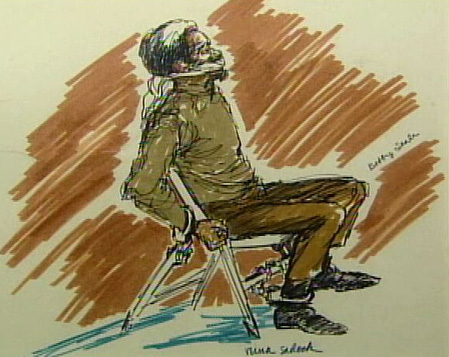
Outside of the Panthers, even mainstream liberals were aware of how harsh the repercussion could be for activists who opposed the status quo. In August of 1968, Chicago Mayor Richard Daley had sent 12,000 police officers and 7,500 National Guard in to disrupt protests at the Democratic Convention. (Bobby Seale, the Panther's co-founder and essentially second-in-command officer, spent several years fighting legal charges from the Convention protests. He'd famously been bound and gagged in the courtroom during his trial.) In December of 1968, more than 450 students at SF State were arrested in connection with a student strike in support of Black Studies program. And only a few months earlier, police had massacred hundreds of student demonstrators in Mexico City. Vietnam raged on. Nixon had just been inaugurated. Someone who was as involved in the Panthers as Ericka was in early 1969 must have been pretty convinced that the revolution was needed, that it was coming, that a new system of socialist governance prioritizing self-determination for Black people and economic fairness for all seemed like a real possibility. And militant struggle probably felt like it was the strategy for bringing that revolution.
Courtroom illustration of Bobby Seale, bound and gagged during the initial Chicago 8 hearings
It feels important to know all this context before you read what happened next. What happened next is that that someone, a Panther, murdered someone else, another Panther, a 19 year old from New York. And that young murder victim, Alex Rackley, was killed after two days of being tortured – having boiling water poured on his body and so forth. And Ericka was in the house where all this happened.
A mentally-unstable out of town Panther named George Sams instigated the kidnapping and torture of Rackley, who he accused of being an undercover agent. Several New Haven Panthers participated in the torture and then in the murder. Sams only did four years in prison for the killing, and rumors persist that he was an agent provocateur himself, although I've never read any evidence for this. He was certainly crazy, and was heavily medicated during his own trial. And it is unarguable that the Panthers were heavily infiltrated. Still, at the point when you are pouring boiling water on someone, or even watching your comrade pour boiling water on someone, you must take some personal responsibility. Going along with what you're told isn't any more justifiable for revolutionaries than it is for Nazis.
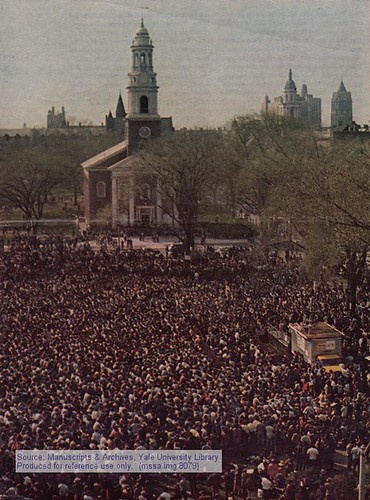
While it's not a justification, I'm sure that Ericka Huggins learned this lesson. After the actual killers were convicted (some confessed, turning state's evidence), she and Bobby Seale were tried for ordering the murders. They spent two years in jail in New Haven during the proceedings, inspiring an international protest movement.*** Yale students staged a months-long strike, starting with a massive May Day rally featuring Abbie Hoffman et al. While she was in prison, Free Jazz pianist Francois Tusques composed a song for her. (You can listen to it on this archived WFMU jazz show. The song starts roughly at minute 1:46 and then restarts at 1:48.)
What shocks me about Ericka Huggins, is that after seeing the absolute ugliest sides of revolutionary movements, she moved to the Bay Area and spent the 1970s working on the Panther newspaper, running for and then serving on the Berkeley Community Development Council (an anti-poverty agency) and on the Alameda County School Board, and eventually running the last surviving segment of the Black Panther Party – their children's school. She was, I guess, one of the last members of the Black Panther Party, since she continued to run the school throughout the 1970s until it finally closed in the early 80s, long after every other Panther institution was gone, and after Huey Newton, the organizations' charismatic but borderline leader had lost all credibility among activists and even most of his friends.
Another thing that strikes me about Ericka Huggins is the way she just doesn't show up in Panther memoirs. Elaine Brown, who named her daughter Ericka dedicates more page space to her than any other Panther alum. As far as I remember, everything Elaine says is positive, and even in her book, there's not much. In other memoirs, Ericka tends to show up for a few pages as a benign force and then disappear, as if she was never there. For someone who was so important in the Party, I can only guess that she found a way to stay out of everyone's way and for the most part, do the work that felt important, instead of engaging in power-plays or battles of ego.
Sitting next to her at dinner, I confess I had a difficult time paying enough attention to my date. What does someone who spent more than a decade trying to make the impossible work feel when it doesn’t? What does it feel like to be so key in a grassroots, militant, educated, disciplined, activist corps - a group that seemed so close to revolution – and then to lose it? Does she resent the way Panther leaders spiraled out of control? Does she feel defeated by the forces of the state – the FBI, the police, the media – that did, in fact defeat her movement? Does she feel manipulated? Is she angry? Her manner is quiet and poised. She projects a feeling of attentive calm. I hope she thinks back on serving free food to children, on writing and explaining, on teaching and running a school that provided a real alternative for kids who needed it and feels proud.
_________
That's how I ended this article. And I was just looking for a few more photos before posting, when I decided to start googling Ericka's name and the world "meditation" (since I know she's a practitioner) and found her to be associated with that ashram on San Pablo – Syda.
Apparently, the New Yorker did an investigation of Syda a few years ago, and quoted members who reported sexual and financial abuses within the largely secretive organization. Former members complained that they were harrassed if they spoke out. There's a website where ex-members share their (bad) experiences, although for the record, most of the alleged abuses happened quite a while ago, and even the New Yorker article points out that most members have no contact with the people at the top of the organization, and simply go to Syda's various ashrams to meditate, chant, and find spiritual community. At this point, I'm feeling a bit depressed by imagining my hero as a cult member. And I'm sure it's more complicated than that anyway. I guess I shouldn't be surprised that she can stomach a degree of unquestioned hierarchy, since she managed to work under an abusive power fiend like Huey Newton for so long.
I really admire Ericka Huggins. I'm not an investigative reporter, and if I was, why would I want to 'expose' someone who has spent most of her life working for good? So what if she likes charismatic leaders? I want to respect the fact that she has a life. Has some privacy. So good luck to you Ericka. I'm not going to read any more about what you did or what you do. Thank you for your work. Good luck to you in your life.
_______________
*Trying to make out what really happened here is completely impossible. Every Panther has their story, and the stories tend to contradict each other.
**Every December I subject some poor soul to my annual anti-Kwanzaa rant. I know that if the holiday has come to have meaning for people, I should support it, but for me it is uglied by the fact that it was created by Ron Karenga (or, as he named himself, Maulana – a Swahili word for master teacher). Karenga was the head of US at the time of the UCLA shooting. He went on to serve prison time for assaulting and torturing two female members of his organization.
** As usual, Snopes does a nice job of clarifying the line of bullshit that circulated on the net a few years ago suggesting that Hillary Rodham, a Yalie, was Ericka's defender. (As if Hillary would have advocated for militants!
If you're not done already with learning about Ericka:
I mentioned it a bunch of times because A Taste of Power talks more about Ericka than most published material on the Panthers. The author, Elaine Brown, has been accused of including some inaccuracies, or maybe outright lies in this book, but it is as good a history of the Black Panther Party as any, and, coming from a woman's perspective, manages to be honest about some of the disparities that did exist in the organization.
Most of what I know about Ericka's trial comes from the long out-of-print Agony in New Haven, which was certainly descriptive. It seemed to depict the four month long jury selection process in real time, detailing each potential juror, each recess called by the judge, and each outfit chosen by the various lawyers. Well written, but only worth while if you're obsessed. There's a newer book I haven't read yet called Murder in the Model City which probably provides some more context.
I know he's become controversial, even among radicals, but Ward Churchill's Agents of Repression (written with Jim Vander Wall) is still the most readable, detailed, and footnoted book I know about Cointelpro and it's where I first learned anything about the Panthers. I recommend it.
Finally, the very best website for Black Panther information is It's About Time. This site has tons of original source material on the Party: newspaper transcriptions, dozens of photos, regional chapter histories, and updates on issues impacting former Panthers now. Most of the photos in this post came from that site (thank you!) and I haven't even gotten half-way through all there is to read there yet. Check it out.
Note that I've made a couple small factual and editorial corrections and changes since I first wrote this, although the post is pretty much the same as the original.
I doubt she's recognized much now, but Ericka Huggins spent a few years being infamous. In 1970, she was a defendant in an internationally notorious and highly politicized murder trial in New Haven, Connecticut. Folks like Dr. Benjamin Spock and writer Jean Genet came to Yale to speak on her behalf. One year before that trial, her husband John Huggins, a leader in the Los Angeles chapter of the Black Panthers, was killed at UCLA by members of a rival activist faction. Throughout the 70s she co-authored a book of poems with Huey Newton, held political offices, and directed a Black Panther school. I wish I knew more about what she's doing now – meditation, spirituality and education seem to be among her current interests, and she does some speaking about her time in the Black Panthers, but it's hard to find out much about her because, although one site says that she's writing a memoir, she clearly isn't out to promote herself, which is a consistent theme for her, actually.
Ericka grew up in Washington, D.C. She was politicized early on, attending the March on Washington when she was 15. The late 60s, the moment when Ericka was coming of age, was a point of increasing militancy among activists in general, and Black activists in particular. (SNCC for example, a major organization in the Civil Rights Movement, officially changed its strategy from specifically nonviolent, to including a broader range of tactics when Stokely Carmichael took over the organization in 1966.) Like thousands of young people around her, Ericka probably felt shocked and horrified by the poverty and violence that Black people and poor people were experiencing around her. Race riots were a regular feature of the late 60s, and were invariably inspired by, and then followed by, harsh police violence. The Vietnam War, and protests against it, escalated around her. Internationally, militancy seemed to be on the increase, with revolutionary movements gaining prominence in Palestine, Northern Ireland, and even next door in Quebec. In this context, in 1968, Ericka joined the Black Panthers. She met John ("Jon" in Ericka's love letters) at college and they moved together to LA where they got very involved in the growing Panther chapter there. They took and then taught political education classes, organized, fundraised, served in the Party social programs, and I'll assume they studied marksmanship, a requirement for all Party members. John took on a leadership position. Ericka got pregnant.
With his beard and bellbottoms, John gave off much more of a hippy vibe than his fellow militants, especially Bunchy Carter, a charismatic former gang leader who was a rising star in the Party (and was known for his impeccable style), and who was with John on the day they met with, and then were shot and killed by members of the US organization at UCLA. I won't pretend that the details of this story aren't complicated*, but one thing we do know from 1975 senate hearings on the FBI's counterintelligence program (Cointelpro) is that the FBI actively sought to increase tension between the Panthers and US**, before and after these killings, by sending inflammatory cartoons and letters to both organizations, and by propagating rumors about each organization. I've read that Richard Held, the FBI officer in charge of the L.A. office at that time took credit for the deaths of Huggins and Carter. I can't back that one up with a citation though.
After John's death, Ericka moved with her daughter Mai to Connecticut where John's parents lived. With local activists, she started a Panther chapter in Bridgeport, and then moved it to New Haven. She was 21.
In her memoir, A Taste of Power, Brown remembers Ericka as being checked out and disconnected after John's death. An interview with a Connecticut Panther in another memoir - David Hilliard's This Side of Glory - describes her as "spaced out but genuine". I don't know why she kept sleepwalking through her activist career at that point. Maybe if your partner is killed for the revolution, you feel you must soldier on, to give his memory meaning. Especially because, as she trudged through what must have been a personal nightmare, the bigger community was turning uglier around her too.
John Huggins was killed on January 17th, 1969. That night, the LAPD raided John and Ericka's home and arrested all twelve Panthers inside, including Ericka with their infant daughter. There were no real charges filed against those arrested – the LAPD justified the arrests by saying that they were preempting retaliatory action towards members of US. This kind of police action towards the Panthers was typical. They raided Panther offices across the country frequently, and often repetitively, sometimes looking for specific suspects, sometimes just to destroy their typewriters, or break up their free breakfast program, which the FBI specifically sought to destroy. (Details on that here. Just search for "breakfast".) In April of '69, 21 New York Panthers were arrested and charged with conspiracy. All 21 were eventually found innocent. Also in April, the Des Moines Panther office was leveled by a bomb blast, injuring two Panthers. In response, local police arrested Panthers. In the first two weeks of May that year, the LAPD arrested 42 Black Panthers. Of course, this hostility wasn't one sided. The Panthers were both a service organization and a militant one, and as much as their free clothing, free food, free medical clinics, ambulance service, and free breakfast programs have been underreported, their armed confrontation of police was also quite real. Panthers regularly engaged in shootouts with police, and not all these were initiated by the cops. After all, the Panthers were trying to engage in a revolutionary struggle.
Outside of the Panthers, even mainstream liberals were aware of how harsh the repercussion could be for activists who opposed the status quo. In August of 1968, Chicago Mayor Richard Daley had sent 12,000 police officers and 7,500 National Guard in to disrupt protests at the Democratic Convention. (Bobby Seale, the Panther's co-founder and essentially second-in-command officer, spent several years fighting legal charges from the Convention protests. He'd famously been bound and gagged in the courtroom during his trial.) In December of 1968, more than 450 students at SF State were arrested in connection with a student strike in support of Black Studies program. And only a few months earlier, police had massacred hundreds of student demonstrators in Mexico City. Vietnam raged on. Nixon had just been inaugurated. Someone who was as involved in the Panthers as Ericka was in early 1969 must have been pretty convinced that the revolution was needed, that it was coming, that a new system of socialist governance prioritizing self-determination for Black people and economic fairness for all seemed like a real possibility. And militant struggle probably felt like it was the strategy for bringing that revolution.
Courtroom illustration of Bobby Seale, bound and gagged during the initial Chicago 8 hearings
It feels important to know all this context before you read what happened next. What happened next is that that someone, a Panther, murdered someone else, another Panther, a 19 year old from New York. And that young murder victim, Alex Rackley, was killed after two days of being tortured – having boiling water poured on his body and so forth. And Ericka was in the house where all this happened.
A mentally-unstable out of town Panther named George Sams instigated the kidnapping and torture of Rackley, who he accused of being an undercover agent. Several New Haven Panthers participated in the torture and then in the murder. Sams only did four years in prison for the killing, and rumors persist that he was an agent provocateur himself, although I've never read any evidence for this. He was certainly crazy, and was heavily medicated during his own trial. And it is unarguable that the Panthers were heavily infiltrated. Still, at the point when you are pouring boiling water on someone, or even watching your comrade pour boiling water on someone, you must take some personal responsibility. Going along with what you're told isn't any more justifiable for revolutionaries than it is for Nazis.
While it's not a justification, I'm sure that Ericka Huggins learned this lesson. After the actual killers were convicted (some confessed, turning state's evidence), she and Bobby Seale were tried for ordering the murders. They spent two years in jail in New Haven during the proceedings, inspiring an international protest movement.*** Yale students staged a months-long strike, starting with a massive May Day rally featuring Abbie Hoffman et al. While she was in prison, Free Jazz pianist Francois Tusques composed a song for her. (You can listen to it on this archived WFMU jazz show. The song starts roughly at minute 1:46 and then restarts at 1:48.)
What shocks me about Ericka Huggins, is that after seeing the absolute ugliest sides of revolutionary movements, she moved to the Bay Area and spent the 1970s working on the Panther newspaper, running for and then serving on the Berkeley Community Development Council (an anti-poverty agency) and on the Alameda County School Board, and eventually running the last surviving segment of the Black Panther Party – their children's school. She was, I guess, one of the last members of the Black Panther Party, since she continued to run the school throughout the 1970s until it finally closed in the early 80s, long after every other Panther institution was gone, and after Huey Newton, the organizations' charismatic but borderline leader had lost all credibility among activists and even most of his friends.
Another thing that strikes me about Ericka Huggins is the way she just doesn't show up in Panther memoirs. Elaine Brown, who named her daughter Ericka dedicates more page space to her than any other Panther alum. As far as I remember, everything Elaine says is positive, and even in her book, there's not much. In other memoirs, Ericka tends to show up for a few pages as a benign force and then disappear, as if she was never there. For someone who was so important in the Party, I can only guess that she found a way to stay out of everyone's way and for the most part, do the work that felt important, instead of engaging in power-plays or battles of ego.
Sitting next to her at dinner, I confess I had a difficult time paying enough attention to my date. What does someone who spent more than a decade trying to make the impossible work feel when it doesn’t? What does it feel like to be so key in a grassroots, militant, educated, disciplined, activist corps - a group that seemed so close to revolution – and then to lose it? Does she resent the way Panther leaders spiraled out of control? Does she feel defeated by the forces of the state – the FBI, the police, the media – that did, in fact defeat her movement? Does she feel manipulated? Is she angry? Her manner is quiet and poised. She projects a feeling of attentive calm. I hope she thinks back on serving free food to children, on writing and explaining, on teaching and running a school that provided a real alternative for kids who needed it and feels proud.
_________
That's how I ended this article. And I was just looking for a few more photos before posting, when I decided to start googling Ericka's name and the world "meditation" (since I know she's a practitioner) and found her to be associated with that ashram on San Pablo – Syda.
Apparently, the New Yorker did an investigation of Syda a few years ago, and quoted members who reported sexual and financial abuses within the largely secretive organization. Former members complained that they were harrassed if they spoke out. There's a website where ex-members share their (bad) experiences, although for the record, most of the alleged abuses happened quite a while ago, and even the New Yorker article points out that most members have no contact with the people at the top of the organization, and simply go to Syda's various ashrams to meditate, chant, and find spiritual community. At this point, I'm feeling a bit depressed by imagining my hero as a cult member. And I'm sure it's more complicated than that anyway. I guess I shouldn't be surprised that she can stomach a degree of unquestioned hierarchy, since she managed to work under an abusive power fiend like Huey Newton for so long.
I really admire Ericka Huggins. I'm not an investigative reporter, and if I was, why would I want to 'expose' someone who has spent most of her life working for good? So what if she likes charismatic leaders? I want to respect the fact that she has a life. Has some privacy. So good luck to you Ericka. I'm not going to read any more about what you did or what you do. Thank you for your work. Good luck to you in your life.
_______________
*Trying to make out what really happened here is completely impossible. Every Panther has their story, and the stories tend to contradict each other.
**Every December I subject some poor soul to my annual anti-Kwanzaa rant. I know that if the holiday has come to have meaning for people, I should support it, but for me it is uglied by the fact that it was created by Ron Karenga (or, as he named himself, Maulana – a Swahili word for master teacher). Karenga was the head of US at the time of the UCLA shooting. He went on to serve prison time for assaulting and torturing two female members of his organization.
** As usual, Snopes does a nice job of clarifying the line of bullshit that circulated on the net a few years ago suggesting that Hillary Rodham, a Yalie, was Ericka's defender. (As if Hillary would have advocated for militants!
If you're not done already with learning about Ericka:
I mentioned it a bunch of times because A Taste of Power talks more about Ericka than most published material on the Panthers. The author, Elaine Brown, has been accused of including some inaccuracies, or maybe outright lies in this book, but it is as good a history of the Black Panther Party as any, and, coming from a woman's perspective, manages to be honest about some of the disparities that did exist in the organization.
Most of what I know about Ericka's trial comes from the long out-of-print Agony in New Haven, which was certainly descriptive. It seemed to depict the four month long jury selection process in real time, detailing each potential juror, each recess called by the judge, and each outfit chosen by the various lawyers. Well written, but only worth while if you're obsessed. There's a newer book I haven't read yet called Murder in the Model City which probably provides some more context.
I know he's become controversial, even among radicals, but Ward Churchill's Agents of Repression (written with Jim Vander Wall) is still the most readable, detailed, and footnoted book I know about Cointelpro and it's where I first learned anything about the Panthers. I recommend it.
Finally, the very best website for Black Panther information is It's About Time. This site has tons of original source material on the Party: newspaper transcriptions, dozens of photos, regional chapter histories, and updates on issues impacting former Panthers now. Most of the photos in this post came from that site (thank you!) and I haven't even gotten half-way through all there is to read there yet. Check it out.
Note that I've made a couple small factual and editorial corrections and changes since I first wrote this, although the post is pretty much the same as the original.
Labels:
1960s,
1970s,
African-American,
Black Panthers,
now
6.17.2007
GLBT Historical Archives
I'm working on an entry about the history of SF and Oakland Chinatowns, but in the meantime, let me turn your attention to the Gay, Lesbian, Bisexual, and Transexual Historical Society's page on youtube. This is the greatest use of youtube I can possibly imagine.
The first video I found there, theoretically of Black Sabbath playing the Folsom Street Parade in 1970, has been vexing me for a while. When I first discovered it, everyone I knew said "there's no fucking way that's Ozzy". I'm no expert on Oz, but I was also confused by the "Folsom Street Parade" thing. Folsom Street Fair didn't start until 1984. What was this drag parade doing South of Market with a big float advertising Sabbath?
Well, thanks to the rocker/investigators of youtube, I finally have my answer. According to user Terrible1, that dude in black atop the Sabbath float is noted San Francisco Satanist, Anton LeVay. Apparently, Ozzy himself also makes a brief appearance. Oz fans, feel free to let me know if you see him here.
Moving on to gayer historical matters, here's Sylvester tearing it up in 1985:
Cakalingus at 5:05.
Seriously, there's a lot of great stuff to explore on their page. This footage of the 1989 Castro sweep is probably only interesting to those of you who were there, but I always enjoy watching queers scream at riot cops. Listen for that catchy slogan: "Media is Bullshit! It's all a pack of LIES!"
I'll finish this post off with an extremely special video of the 1975 Mr. and Miss Gay San Francisco contest. I kind of like that there's no sound, it adds to the ethereal, Antediluvian quality.
The first video I found there, theoretically of Black Sabbath playing the Folsom Street Parade in 1970, has been vexing me for a while. When I first discovered it, everyone I knew said "there's no fucking way that's Ozzy". I'm no expert on Oz, but I was also confused by the "Folsom Street Parade" thing. Folsom Street Fair didn't start until 1984. What was this drag parade doing South of Market with a big float advertising Sabbath?
Well, thanks to the rocker/investigators of youtube, I finally have my answer. According to user Terrible1, that dude in black atop the Sabbath float is noted San Francisco Satanist, Anton LeVay. Apparently, Ozzy himself also makes a brief appearance. Oz fans, feel free to let me know if you see him here.
Moving on to gayer historical matters, here's Sylvester tearing it up in 1985:
Cakalingus at 5:05.
Seriously, there's a lot of great stuff to explore on their page. This footage of the 1989 Castro sweep is probably only interesting to those of you who were there, but I always enjoy watching queers scream at riot cops. Listen for that catchy slogan: "Media is Bullshit! It's all a pack of LIES!"
I'll finish this post off with an extremely special video of the 1975 Mr. and Miss Gay San Francisco contest. I kind of like that there's no sound, it adds to the ethereal, Antediluvian quality.
Subscribe to:
Posts (Atom)