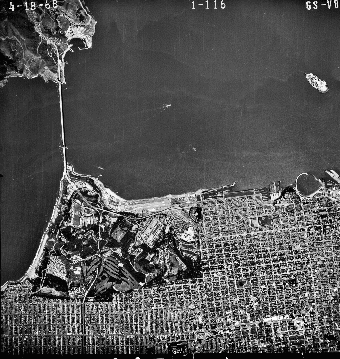
The Bay Street Mall, home of the Apple Store, California Pizza Kitchen, H&M, and a wealth (so to speak) of other one-step-above the hoi polloi chain stores has been thoughtful enough to include a bit of
local history on their website. I'll give you an excerpt:
One day, a group of people, the Ohlone, arrived at the Bay… This was a great place to live, with plenty of everything people might need: water, food, space, and the materials to make shelters. The Ohlone decided to stay and call this place home. One paragraph later we learn that
Today Bay Street Emeryville, an urban village where people can shop, dine, live and be entertained, calls the site home. The mall website fails to mention the moments that intervened between today and the 'day' that tribal people, now called the Ohlone, arrived at the mouth of Temescal Creek where the mall now sits. Presumably, mall managers would rather not linger on historical happenings like the deadly Spanish Mission system that enslaved California's coastal tribal people, or the factories that for 75 years occupied the mall's current location, producing paints and pesticides and leaching heavy metals into the groundwater, or the protests that archaeologists and local
Muwekma Ohlone activists registered in opposition to the mall's construction.
Most notably, promotional materials fail to clearly explain the fact that the mall is sitting on top of the remaining portions of what was probably the Bay Area's largest shellmound. Oh, they mention the Shellmound. The Mall faces Emeryville's "Shellmound Street", and they even put up a commemorative exhibit about the mound (and I do mean commemorative, since it emphasizes the past over present-day Bay Area Indian communities.) Their commemorative
mini-mound was mandated by Emeryville's city council as an appeasement to the people who were understandably concerned about the construction of a mall atop the spot where their ancestors are buried.
Let me back up a minute.
The Shellmound at the base of Temescal Creek was at one time roughly 60 feet high and 350 feet in diameter. It, along with five or six smaller adjoining mounds lined the marshy land where the creek, now culverted under the streets of Oakland and Emeryville, meets the Bay.
There are hundreds of shellmounds scattered along the mouths of the Bay Area's numerous creeks. Anthropologists in the early 1900s counted at least 425. The remains of a massive shellmound sit underneath
Spenger's - the old-school fish restaurant near the base of University Avenue in Berkeley. Shellmounds are found in coastal regions around the world from Brazil to British Colombia, Australia to Denmark.
View Larger MapThis residential street in Alameda was once a large shellmound. The Emeryville Shellmound is made up of thousands of years of accumulated shells (shellmounds get their name from the enormous volume of waste-shells that make up much of their bulk), along with earth, ash, and other remnants from the villagers who lived nearby and likely also on top of the mound. It also contained and still contains bodies of the human dead - sometimes accompanied by traditional burial objects. Anthropologists wager that the purpose of the mound changed over time, but it appears that it was a home, a place to deposit refuse, and a burial ground all at once. For non-Ohlone people, the mound can at the least serve as a reminder of both the mundanities of daily life and the rituals of loss that made up the experiences of the tribal people who lived and continue to live here. For many Ohlone people, the mound is the place where their ancestors are buried, and as such, Ohlone activists have worked to have their graveyard treated with appropriate respect and dignity.
According to the detailed journals of Spanish surveyors who were the first Europeans to explore the Bay, what is now the Emeryville Shellmound was already abandoned before Spanish invasion in the 1700s. It wasn't long after the Spanish came that the destruction of the mound began. Luis Peralta, the Spanish soldier who had received a land grant of the entire East Bay as a reward for his military service (mostly
killing Indians, actually) apparently used the base of the mound as a place to corral and slaughter his cattle. Or maybe his son Vicente who settled in the Temescal area actually did the cattle ranching – I have to read up on this more at some point.
In the 1870s the enormous mound was turned into a sort of local amusement park (the Bay Area had a number of these places, but that's another post). Developers chopped the top off the mound to add a pavilion where (white) revelers could watch the Bay while they got loaded and literally danced on the graves of the indigenous dead.
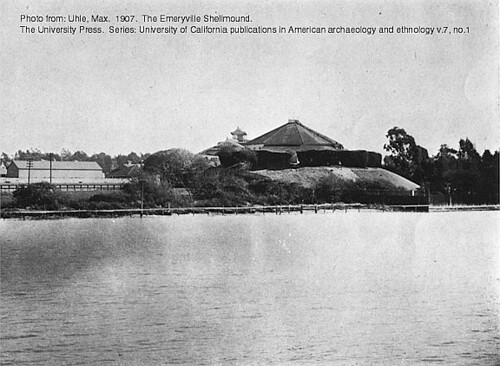 1902 photo (published in 1907) of Shellmound Park, from the University of California's collection
In 1924, the mound suffered a greater blow. Steam shovels removed the bulk of it to make way for paint and pesticide factories. At the time of the destruction, the mound's importance was already well-understood, even by non-native people. It had been twice excavated by researchers from the University of California - this
overview of Bay Area shellmounds was written by one N.C. Nelson in the early 1900s. While the language is peppered with outmoded and racist ideas about the coastal tribes, the often lovely descriptions of the mounds make clear that anthropologists understood at least some of their significance.
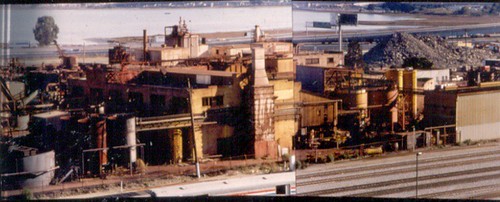 Rusting factories on the remaining portion of the mound
The factories were torn down in the late '90s. While City of Emeryville officials were in the midst of deciding how to develop the at that point vacant land, a particularly heavy rainy season upset the ground where the factories had been leaching arsenic, heavy metals, and other poisons for more than 70 years, and toxic runoff started to pour into the Bay. The city hired workers to stop the runoff, and as they dug holding pools, the workers discovered that a large portion of the Shellmound, thought to be totally destroyed, was still there just under the topsoil. The City hired an archaeologist who reported that the area was "massively significant". They promptly fired him. They also brought in the
Native American Heritage Commission, which appointed a "Most Likely Descendant" of the dead found inside the mound.
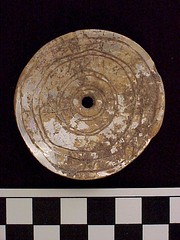 An abalone pendant from the mound
It should be obvious that the descendants of the ancient people who lived in the Bay Area do not speak with one voice. Historian Andrew Galvan, an Ohlone, favored exploring the mound for its archaeological value. But the local tribal community, officially represented in this case by 'most likely descendant' Katherine Perez, tended to oppose further excavation and instead pushed for reburial of the remains and sealing of the mound. For it's part, the City of Emeryville was under no legal obligation to listen to anyone, so they followed their pocketbooks by limiting the controversial archaeological research and allowing developers to move forward with building the Disney-esque shopping/entertainment/living complex that we have today.
When I walk into the Bay Street Mall my heart breaks. What kills me is how very many people are drawn there. On the immaculate, privately owned and maintained streets I see people of every ethnicity and age. Gay and lesbian folks. Transgender folks. The wealthy and the working class. I've even spotted one of the Bay's favorite leftist hip hop artists dining at California Pizza Kitchen (hey, I was dining there myself). There is a way that the Mall is like my dream of an idealized Bay Area where all kinds of people can be both themselves and be together, working, eating, laughing, but it's the looking-glass ideal. Behind the mall are minimum-wage retail workers, piles of clothes and toys and
things, made by sweatshop workers in China, the environmental cost of the hundreds of cars stacked in the parking lots. And most painful, the mall's foundations, which rest on human remains.
Today, Indian People Organizing for Change along with members of Vallejo Intertribal SSP&RIT and their allies were meeting at the
Intertribal Friendship House to launch a Shellmound Peace Walk, visiting Shellmounds and other sacred sites around the Bay Area, praying, and drawing attention to the past that is under all of our feet. The walk will wind up the day after thanksgiving,
Buy Nothing Day, at the Bay Street Mall.
 Photo of 2006 demonstration taken by M. Villanueva, posted on indybay.org
 Do you want to know more about the Ohlone or the Shellmound?
The short film Shellmound will be screening this Sunday, November 18th at La Pena as part of the Hecho en Califas festival.
The City of Emeryville's site about the Shellmound, created as part of their compromise agreement with local Ohlone people has quite a bit of (at times softened) historical information including photographs of dozens of artifacts found during the 1999 excavation.
A lovely site about East Bay Creeks features photos of the current Temescal Creek outflow.
Wikipedia handles Ohlone issues fairly well.
This SF weekly article has some interesting background about the Muwekma Ohlone tribe.
A recent study of bird bones from the Shellmound led one investigator to the conclusion that local tribes overhunted native birds to a significant enough degree to have severely reduced sea bird populations here. I was interested in the way this article challenges simplistic stereotypes about Indian people.
There were a number of articles about the mound written during the development and construction of the Mall:
The East Bay Express, Terrain Magazine and California Wild all printed worthwhile pieces.