Showing posts with label 1920s. Show all posts

12.25.2007

Lost Amusement

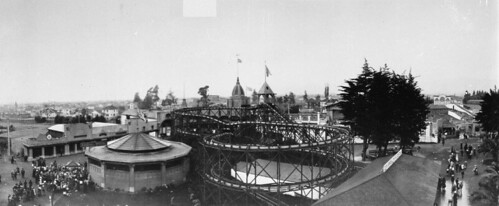
Idora Park.jpeg
Idora Park in Oakland, 1910 (?). From the Oakland History Room, Oakland Public Library.


Finals are over (thank the maker) and apparently, some guy named Jesus was born today. Seems like the right time to talk about boozing, gambling, and flipping upside-down on roller coasters. Here goes: Before TiVo, iPods, or Guitar Hero, when folks had to leave the house for a little something exciting, the Bay Area was peppered with amusement parks. The parks incorporated natural beauty along with human-made entertaiments like junk food, race-tracks and shooting ranges.

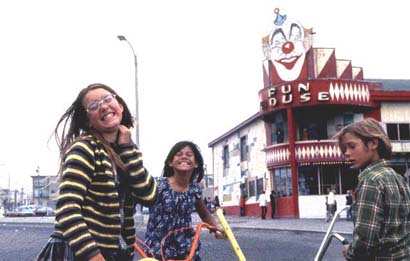
Playland at the Beach is the most well known of our lost parks. It started as a disorganized collection of concessions and rides at Ocean Beach in the late 1800s and only shut down in the early 1970s. At one point it spanned three city blocks and included roller coasters, merry-go-rounds, five restaurants, and eventually the Sutro Baths and the Cliff House restaurant which to this day traps tourists before they fall off the edge of San Francisco and onto Seal Rock in the Pacific. Outsidelands.org collects photos and stories of Playland and wikipedia has a pretty thorough entry including descriptions of the various rides nausea inducing rides like the Aeroplane Swing, the Whip, and Dodg-em.
Funhouse-70s.jpg
Chelle and Noelle Beloy in front of the Fun House at Playland at the Beach.
Copyright Dennis O'Rorke, early 1970s from outsidelands.org.


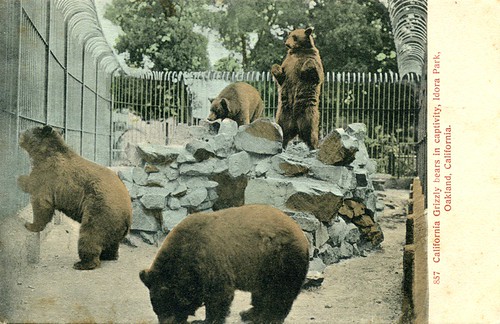
From 1904 until 1929, Idora Park in the present day Oakland neighborhood of Temescal was home to a miniature railway, a car race track, the Illusion Theater, a successful opera house, and a skating rink that billed itself as the largest in the world. The park also housed a number of caged animal displays and served as a temporary home of the Oakland Oaks baseball team. This postcard set provides some images of that disappeared park.
Grizzlies.jpg
Grizzlies caged at Idora Park on Oakland, from Alameda Info


Shellmound Park in Emeryville lasted from 1876 to 1924. It was built, morbidly, on the lopped off top of the Bay Area's largest indigenous Shellmound. The best online resource about the park is this PDF from the Emeryville Historical Society. You can read there about the pleasant picnic grounds, the shooting range, bowling alley, bicycle and horse racing and two dance pavilions that were part of this destination for San Franciscans who wanted panoramic Bay views and a getaway from city hustle. The picnic grounds in particular were utilized by all types of local civic groups, ranging from the Household of Ruth, a Black women's chapter of the Odd Fellows, to the notoriously racist Workingmen's Party. Local anti-gambling ordinances and the new national alcohol prohibition killed Shellmound Park. There's no point in picnics and horse races without booze, apparently.
Boxing kids.jpg
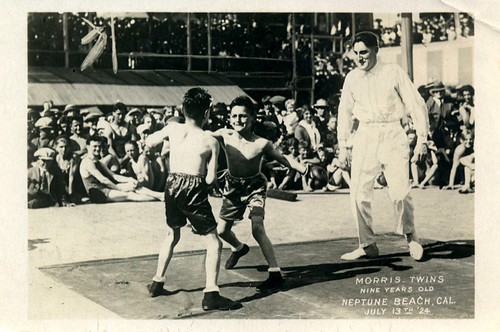
Boxing kids at Neptune Beach, 1924, from Alameda Info.


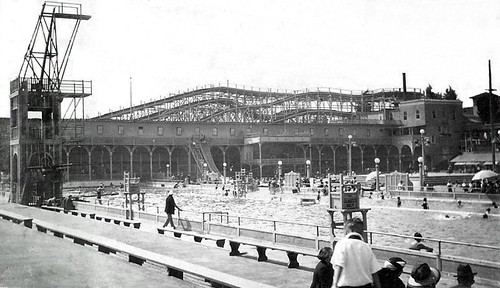
Neptune Beach didn't open until 1917, late compared to other Bay Area parks, and it lasted until 1939 when the depression and increasing car use spurred in part by the recently completed San Francisco Bay Bridge made Alameda a less appealing destination for Bay Area funseekers. While it lasted it contained a giant swimming area, prime beach land, snacks, concessions, and a roller coaster that offered views across the Bay to San Francisco.
Neptune_Beach_Roller_Coaster.jpg
Neptune Beach Roller Coaster 1922, postcard from Alameda Info.


Amusement parks were popular around the country in the early 20th century. Most started as Trolley Parks, created by the streetcar companies as a destination for trolley lines. The parks were often built at beaches or, as in Idora Park, at locations that otherwise showed off nature's lovelier features. The natural features were eventually obscured by the gaudy rides that were installed later. The parks patterned themselves after each other and tended to rip off rides and even their names from larger or more successful parks elsewhere in the country. You might recognize the name "Playland" for example from the more famous Long Island park of the same name. Like the streetcar companies that built these places, the parks themselves were killed by the rise of car culture – not to mention the Great Depression and then television. Although as in the case of Playland, there were some late holdouts. Amusement Park fans are quite loyal. Besides lovingly maintained memorial websites to the various amusement parks, the Neptune Beach Amusement Museum is trying to build a physical space in the old location of Neptune Beach.
playland-crane.jpg
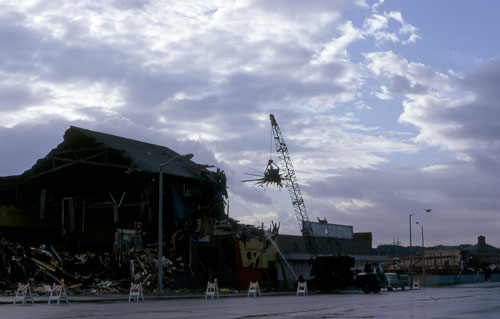
The destruction of Playland at the Beach,
copyright Dennis O'Rorke, 1972, from outsidelands.org.


(Thanks so much to peacay at the beautiful bibliodyssey for giving me the Cliff House link that started me on this post.)

6.04.2007

Hometown


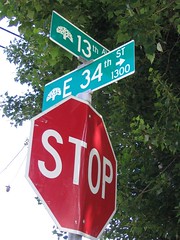
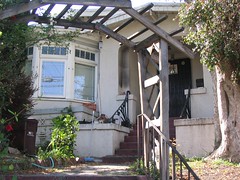
On the corner of East 34th and 13th Avenue is the house I grew up in. If you drive by now you'll find graying paint covering the pink that I remember, and the owners have replaced the wooden window frames; some were rotting even when I lived there. They've cut back the ivy in the front yard and put up some chain link. Otherwise, it's pretty much the same old house it was when my family left 20 years ago, surrounded by a bunch of other little family houses, all looking pretty similar but cozy.


The house was built in 1921, part of a construction boom that was still reverberating through Oakland 15 years after the San Francisco earthquake. When the city burned, residents turned to less developed or agricultural land in the East Bay where forward thinking real estate developers had already bought up (or squatted) massive tracts in hopes of making a lot of cash. After buying the land, the developers would generally build a few impressive houses, and then run a streetcar to the new 'neighborhood' to bring people in.


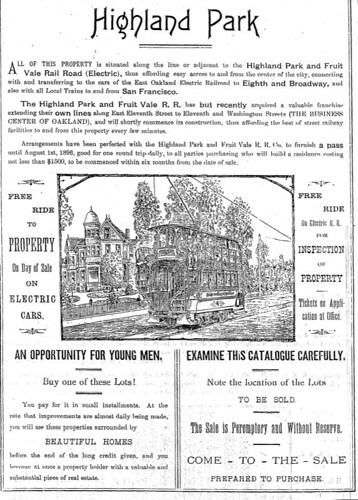
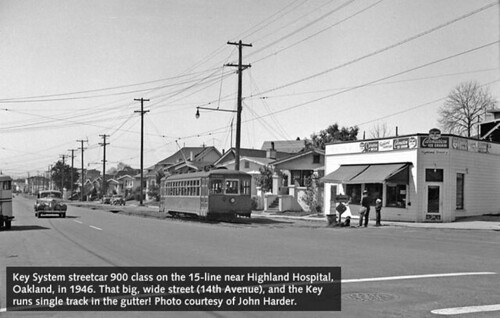
My old neighborhood, including the lot my house was built on, were initially owned by banker E.C. Sessions who envisioned high-class, wide lotted properties gathered around the central hill that is now under Highland Hospital. His double-deckered horse-drawn street cars traveled up 14th Avenue (called "Commerce" at the time) and then cut over to Fruitvale.

Unfortunately for E.C., he was ahead of his time, and ended up selling off his land in small parcels before the neighborhood took off in the 20s. (Highland Hospital, a few blocks away, and the beloved Parkway Theatre down the street on Park Blvd. were built in the '20s too.)

My parents moved to the house around 1970, and paid $200 a month for three bedrooms, a living room, formal (if small) dining room, and a rumpus room downstairs, along with the backyard and its decrepit gazebo. Oakland had changed a lot from the pastoral (and profitable) oasis that developers like E.C. Sessions had imagined. In my neighborhood, the two story streetcars had long been replaced by more uniform Key System trains, which subsequently disappeared too. The city as a whole had never fully recovered from a post-WWII economic downturn, and because of the efforts of dozens of civil rights groups, it was just beginning to grow out of long-standing policies of racial discrimination.

By the time I was school aged, Oakland had a reputation as a crime center. Crack was beginning its ascent, and I'm sure even my not-so-deep section of East Oakland was impacted. But my sense of my home was that it was safe and that it was stable. My young neighbors and I hid in the bushes of my house to throw berries at passing cars, played football in the parking lot around the corner, and walked back and forth to the liquor store up the street for Now-and-Laters and Chick-o-Sticks.

Like anybody's hometown anywhere, Oakland is, to me, the place I know in and out, the place I can tell my kids about when I'm trying to help them understand my sense of the world. Lucky for me, and for them, they live here too, so they can compare their stories to my stories, and find their own adventures in a spot where they have roots.


I'm wanting to understand the history of this place in part because I'm a parent, and getting how things happened seems more important now, so I can do things right for them. I want to get the things that people did right, and avoid the things folks did wrong. And I want to be able to thank the people who gave me all the things I love about this city and this world. So I'm mostly going to write about activists and radicals and movements. Since I'm not any kind of expert, I'll just be writing as I'm learning. If you've got something to share about the activist history of the Bay Area, I'd love to hear from you. Thanks for reading.


Thanks too for photos on this site: the Highland Park advertisement is from the Oakland History Room, and the Key Line streetcar came from keyrailpics.org, an awesome photo site full of Bay Area streetcar photos.
 
Creative Commons License
Some Rights Reserved.