Showing posts with label Oakland. Show all posts
Showing posts with label Oakland. Show all posts
5.23.2008
Stripped
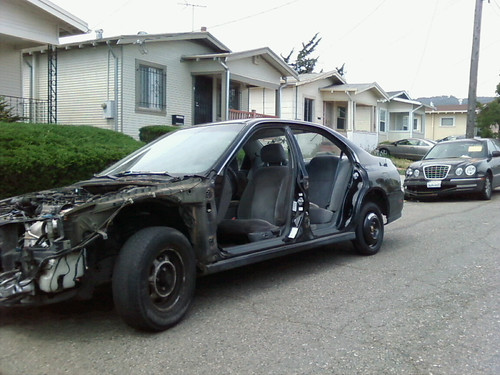
My cute little street in the Allendale has recently become a popular dumping spot for stripped cars. I was impressed with the latest dump - someone took stripping to a new level. Note that the car parked behind this one is also a dumped, presumably stolen ride. If you recognize it, please come pick it up!


5.19.2008
Thought Balloons Deployed for Good and Evil
On Broadway and Grand today, two billboards unintentionally echo each other:
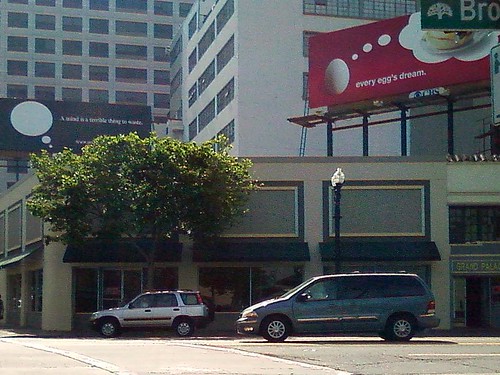
United Negro College Fund: A Mind is a Terrible Thing to Waste
vs. McDonalds: Eat This Garbage
United Negro College Fund: A Mind is a Terrible Thing to Waste
vs. McDonalds: Eat This Garbage
5.16.2008
Community History at the AAMLO
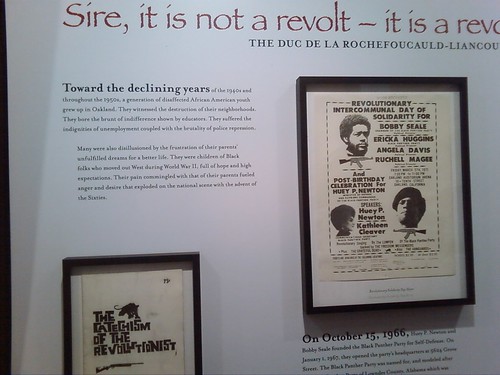
Recommended: The African American Museum and Library is hosting a lovely exhibit right now called The African American Community in Oakland. Photographs, ephemera, and video presentations of oral histories give a well-rounded picture of the history of Oakland's black neighborhoods and communities.
4.07.2008
3.31.2008
Scraper Bike
Scraper Bike from Da Trunk Boiz:
What does this have to do with history? Not much. But check out ghost ridin' the trike!
What does this have to do with history? Not much. But check out ghost ridin' the trike!
2.29.2008
Educate to Liberate
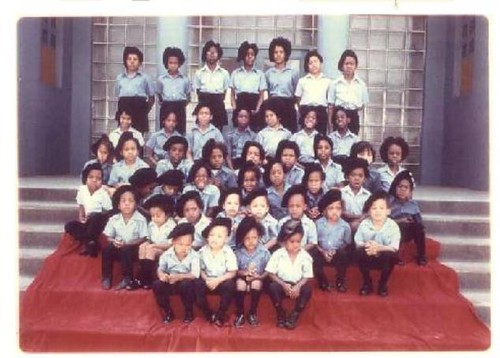
I finally got down to the Oakland History Room to check out Billy X. Jennings' exhibit on the Black Panther Party children's schools. You'll never see more adorable pictures of revolutionary education.
There are a few photos downstairs and more upstairs in front of the elevator and inside the Oakland History Room. I was especially into the shots of the kids doing Karate.
2.12.2008
Oakland Memorials
This project ended with the close of the year but it's worth checking into: blogger nic b. documented the site of every homicide in Oakland in 2007 on his site Oakland Makeshift Memorials. Especially heartbreaking are the comments left by loved ones of the deceased.
12.28.2007
Community Clinics
Over the last few days I've learned some exciting new facts about scabies. Shall I share?

The Scabies Mite: as ugly as it is unpleasant
1) The first and most exciting fact I've learned about scabies is that I DO NOT HAVE IT. It took two visits to my friend the PA who works in an STD clinic, a phone call to the craigslist date who could have given it to me, and finally, my own admission that I don't actually have scabies symptoms to convince me, but I'm now sure that I do not have a communicable disease, at least not one involving tiny mites that cause uncontrolled itching by shitting underneath the skin.
2) If I did have scabies, or any other disease for that matter, I would be 100% reliant on my saint-like friend the PA who works in an STD clinic to care for me because actually, as it turns out, having no health insurance and living in the East Bay = having almost no medical care at all. I called three or four local low-income clinics and they all told me that they only do intake for new patients ONCE A MONTH. So in other words, keep scratching for a couple weeks until we can see you. The exception is the Berkeley Free Clinic, but their hours are limited as is the range of care available there.
3) Even if they take forever to see you, the folks who run the Bay Area's community clinics still rock. I spent 15 or 20 minutes on the phone with a nice gentleman at the Free Clinic who failed to scream and hang up when I said I thought I had a social disease and then shared his recommendation for best East Bay community health clinic (LifeLong Medical Care). The person answering the phone at Lyon-Martin was also patient and kind even as she was telling me that their next appointment for new patients wasn't until January 18th.
I'm a former radical health care provider and I've got a very big and very special spot in my heart for community health care of all types. The Bay Area is home to a number of community clinics that grew out of a part of late-60s history where folks believed that health care was a basic human right and also that people could and should control their own care. If I ever get my shit together to write a book about Bay Area history, it'll be about the history of the Bay Area community health movement, but its going to take a lot of research because I don't know much beyond the skeleton. I can tell you about a few of the local community clinics though.
La Clinica de la Raza was founded in 1971 by Chicano students and doctors and community folks to provide community-based care in the Fruitvale neighborhood of Oakland. Now that La Clinica is one of the largest non-profits in the East Bay, it doesn't quite have the homemade community feel that started things off. On the other hand, they now provide health care for thousands of uninsured folks from South East Asia, all over Latin America, and all over East Oakland. Similarly, the Native American Health Center started in '72 when Indian activists and allies, post-Alcatraz occupation, called for a self-directed clinic for Native folks.
The way I heard the story of the Berkeley Free Clinic was that it was founded during the People's Park Riot by medic veterans of the Vietnam War. I can't recall the details of that story so I'll have to go with the vague history they have up on their site.
The BFC is especially close to my radical health care heart because they primarily use lay medical workers – non-professionals who undergo a rigorous in-house training program. A trip to the BFC often involves a discussion with the staff medic in front of an open medical textbook, with both of you trying to figure out what's bugging you.
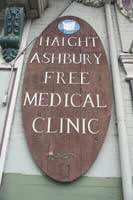
The Haight Ashbury Free Clinic is the most famous of our clinics. As I understand it, they were among the first medical clinics to treat drug addicts like human beings, and they still specialize in treating addiction and caring for addicts. I liked this free-association piece about their history from David Smith, the clinic founder.
Thanks clinics. I'm going to celebrate my lack of scabies by signing up to become a patient somewheres.
The Scabies Mite: as ugly as it is unpleasant
1) The first and most exciting fact I've learned about scabies is that I DO NOT HAVE IT. It took two visits to my friend the PA who works in an STD clinic, a phone call to the craigslist date who could have given it to me, and finally, my own admission that I don't actually have scabies symptoms to convince me, but I'm now sure that I do not have a communicable disease, at least not one involving tiny mites that cause uncontrolled itching by shitting underneath the skin.
2) If I did have scabies, or any other disease for that matter, I would be 100% reliant on my saint-like friend the PA who works in an STD clinic to care for me because actually, as it turns out, having no health insurance and living in the East Bay = having almost no medical care at all. I called three or four local low-income clinics and they all told me that they only do intake for new patients ONCE A MONTH. So in other words, keep scratching for a couple weeks until we can see you. The exception is the Berkeley Free Clinic, but their hours are limited as is the range of care available there.
3) Even if they take forever to see you, the folks who run the Bay Area's community clinics still rock. I spent 15 or 20 minutes on the phone with a nice gentleman at the Free Clinic who failed to scream and hang up when I said I thought I had a social disease and then shared his recommendation for best East Bay community health clinic (LifeLong Medical Care). The person answering the phone at Lyon-Martin was also patient and kind even as she was telling me that their next appointment for new patients wasn't until January 18th.
I'm a former radical health care provider and I've got a very big and very special spot in my heart for community health care of all types. The Bay Area is home to a number of community clinics that grew out of a part of late-60s history where folks believed that health care was a basic human right and also that people could and should control their own care. If I ever get my shit together to write a book about Bay Area history, it'll be about the history of the Bay Area community health movement, but its going to take a lot of research because I don't know much beyond the skeleton. I can tell you about a few of the local community clinics though.
La Clinica de la Raza was founded in 1971 by Chicano students and doctors and community folks to provide community-based care in the Fruitvale neighborhood of Oakland. Now that La Clinica is one of the largest non-profits in the East Bay, it doesn't quite have the homemade community feel that started things off. On the other hand, they now provide health care for thousands of uninsured folks from South East Asia, all over Latin America, and all over East Oakland. Similarly, the Native American Health Center started in '72 when Indian activists and allies, post-Alcatraz occupation, called for a self-directed clinic for Native folks.
The way I heard the story of the Berkeley Free Clinic was that it was founded during the People's Park Riot by medic veterans of the Vietnam War. I can't recall the details of that story so I'll have to go with the vague history they have up on their site.
The BFC is especially close to my radical health care heart because they primarily use lay medical workers – non-professionals who undergo a rigorous in-house training program. A trip to the BFC often involves a discussion with the staff medic in front of an open medical textbook, with both of you trying to figure out what's bugging you.
The Haight Ashbury Free Clinic is the most famous of our clinics. As I understand it, they were among the first medical clinics to treat drug addicts like human beings, and they still specialize in treating addiction and caring for addicts. I liked this free-association piece about their history from David Smith, the clinic founder.
Thanks clinics. I'm going to celebrate my lack of scabies by signing up to become a patient somewheres.
12.25.2007
Lost Amusement
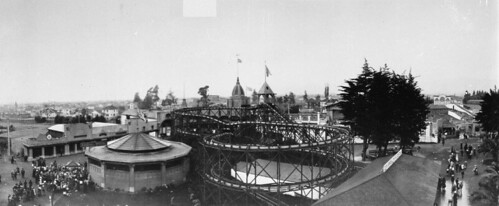
Idora Park in Oakland, 1910 (?). From the Oakland History Room, Oakland Public Library.
Finals are over (thank the maker) and apparently, some guy named Jesus was born today. Seems like the right time to talk about boozing, gambling, and flipping upside-down on roller coasters. Here goes: Before TiVo, iPods, or Guitar Hero, when folks had to leave the house for a little something exciting, the Bay Area was peppered with amusement parks. The parks incorporated natural beauty along with human-made entertaiments like junk food, race-tracks and shooting ranges.
Playland at the Beach is the most well known of our lost parks. It started as a disorganized collection of concessions and rides at Ocean Beach in the late 1800s and only shut down in the early 1970s. At one point it spanned three city blocks and included roller coasters, merry-go-rounds, five restaurants, and eventually the Sutro Baths and the Cliff House restaurant which to this day traps tourists before they fall off the edge of San Francisco and onto Seal Rock in the Pacific. Outsidelands.org collects photos and stories of Playland and wikipedia has a pretty thorough entry including descriptions of the various rides nausea inducing rides like the Aeroplane Swing, the Whip, and Dodg-em.
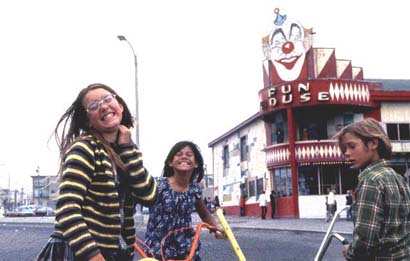
Chelle and Noelle Beloy in front of the Fun House at Playland at the Beach.
Copyright Dennis O'Rorke, early 1970s from outsidelands.org.
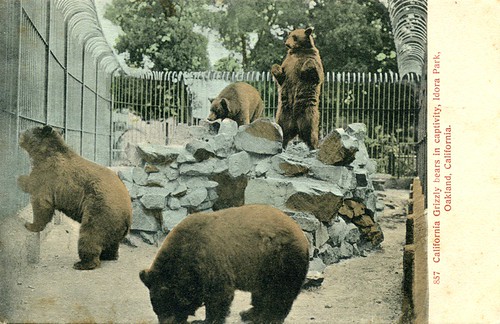
From 1904 until 1929, Idora Park in the present day Oakland neighborhood of Temescal was home to a miniature railway, a car race track, the Illusion Theater, a successful opera house, and a skating rink that billed itself as the largest in the world. The park also housed a number of caged animal displays and served as a temporary home of the Oakland Oaks baseball team. This postcard set provides some images of that disappeared park.
Shellmound Park in Emeryville lasted from 1876 to 1924. It was built, morbidly, on the lopped off top of the Bay Area's largest indigenous Shellmound. The best online resource about the park is this PDF from the Emeryville Historical Society. You can read there about the pleasant picnic grounds, the shooting range, bowling alley, bicycle and horse racing and two dance pavilions that were part of this destination for San Franciscans who wanted panoramic Bay views and a getaway from city hustle. The picnic grounds in particular were utilized by all types of local civic groups, ranging from the Household of Ruth, a Black women's chapter of the Odd Fellows, to the notoriously racist Workingmen's Party. Local anti-gambling ordinances and the new national alcohol prohibition killed Shellmound Park. There's no point in picnics and horse races without booze, apparently.
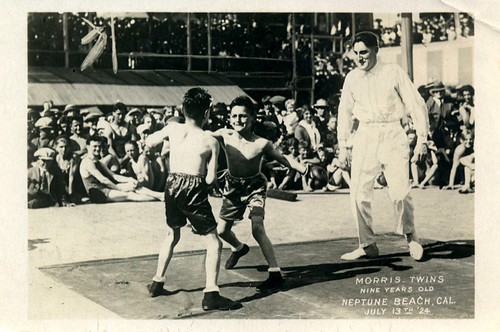
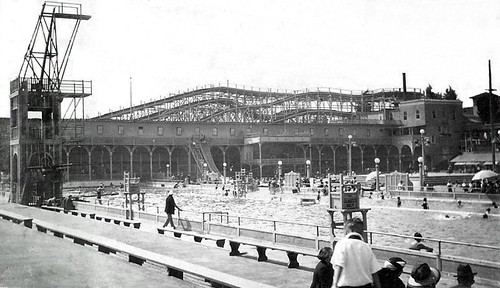
Neptune Beach didn't open until 1917, late compared to other Bay Area parks, and it lasted until 1939 when the depression and increasing car use spurred in part by the recently completed San Francisco Bay Bridge made Alameda a less appealing destination for Bay Area funseekers. While it lasted it contained a giant swimming area, prime beach land, snacks, concessions, and a roller coaster that offered views across the Bay to San Francisco.
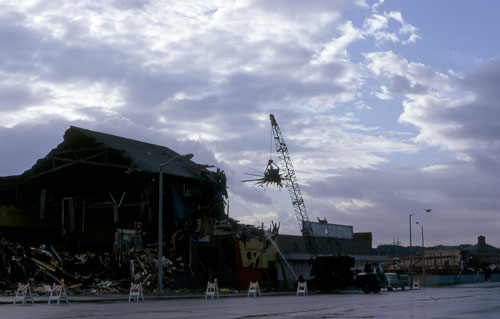
Amusement parks were popular around the country in the early 20th century. Most started as Trolley Parks, created by the streetcar companies as a destination for trolley lines. The parks were often built at beaches or, as in Idora Park, at locations that otherwise showed off nature's lovelier features. The natural features were eventually obscured by the gaudy rides that were installed later. The parks patterned themselves after each other and tended to rip off rides and even their names from larger or more successful parks elsewhere in the country. You might recognize the name "Playland" for example from the more famous Long Island park of the same name. Like the streetcar companies that built these places, the parks themselves were killed by the rise of car culture – not to mention the Great Depression and then television. Although as in the case of Playland, there were some late holdouts. Amusement Park fans are quite loyal. Besides lovingly maintained memorial websites to the various amusement parks, the Neptune Beach Amusement Museum is trying to build a physical space in the old location of Neptune Beach.
(Thanks so much to peacay at the beautiful bibliodyssey for giving me the Cliff House link that started me on this post.)
11.27.2007
Books and Bún
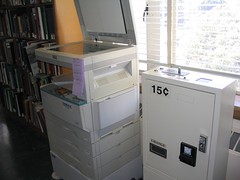
Photocopier at the History Room:
My Best Friend.
My Best Friend.
Today I treated myself to an afternoon at the Oakland History Room - my last trip there for a while I’m afraid; I need to spend my limited childcare time studying for impending finals.
The History Room houses rotating exhibits and the current display about Emeryville's sports and gambling history should be of interest to those who want to learn more about the Emeryville Shellmound. It features a few pictures of the old Shellmound Park amusement area including photos of the dance pavilions, the shooting range, and the racetrack that were all there from the late 1800s through the 1920s.

Mmmm… Bún.
When the library closed I treated myself again, this time to vegetarian* bún at Kim Huong on 10th Street. Since having kids I've come to treasure meals eaten alone, and quietly reading a book while eating something prepared by someone else is a special treat. I'd rather the book hadn't been my microbiology textbook, and to tell you the truth, I've had much better bûn, but I'll take my treats where and when I can get them.
*(this is only true if you, like me, believe that fish are vegetables.)
10.26.2007
Sister Comrade
You don't want to miss this one: Sister Comrade, a celebration of the lives of poet activists Audre Lorde and Pat Parker:

9.23.2007
Two Bookstores
I've had a pretty stressful few months, and unfortunately for my generally overdrawn bank account, I've been pacifying myself by buying a lot of used furniture and new books. Yesterday I found myself twice unable to resist the temptation of bookstores.
Laurel Bookstore on MacArthur and 39th is now (since I moved a couple weeks ago) my neighborhood bookstore. They mostly carry new books, with a large children's section and a nice mix of other topics. I spent some time talking to the owner and she was especially warm and helpful. The place generally has a friendly, happy, neighborhoody feeling that I liked. When I was there yesterday I found a copy of Storybook Strings and a new history of the Laurel District by Oakland lover Dennis Evanosky. Turns out he'll be doing a reading at Laurel Bookstore next month, so I'll be back!
Then last night, after filling up on injira at Cafe Colucci I stopped into Book Zoo on Telegraph at Alcatraz and found a couple used Arcadia history books and a well-preserved first edition of If They Come in the Morning from the National United Committee to Free Angela Davis and Other Political Prisoners. I don't care about the first edition thing, I just want to read it, but I was impressed that the Book Zoo folks only charged four bucks. Their prices are all very reasonable and the store is beautiful, with lovely old hardbacks shelved almost to the ceiling. Very worth a visit.
I really wanted to close this with a link to John and Yoko singing Angela, but I couldn't find a copy online, so you'll have to content yourself with reading the lyrics.
Laurel Bookstore on MacArthur and 39th is now (since I moved a couple weeks ago) my neighborhood bookstore. They mostly carry new books, with a large children's section and a nice mix of other topics. I spent some time talking to the owner and she was especially warm and helpful. The place generally has a friendly, happy, neighborhoody feeling that I liked. When I was there yesterday I found a copy of Storybook Strings and a new history of the Laurel District by Oakland lover Dennis Evanosky. Turns out he'll be doing a reading at Laurel Bookstore next month, so I'll be back!
Then last night, after filling up on injira at Cafe Colucci I stopped into Book Zoo on Telegraph at Alcatraz and found a couple used Arcadia history books and a well-preserved first edition of If They Come in the Morning from the National United Committee to Free Angela Davis and Other Political Prisoners. I don't care about the first edition thing, I just want to read it, but I was impressed that the Book Zoo folks only charged four bucks. Their prices are all very reasonable and the store is beautiful, with lovely old hardbacks shelved almost to the ceiling. Very worth a visit.
I really wanted to close this with a link to John and Yoko singing Angela, but I couldn't find a copy online, so you'll have to content yourself with reading the lyrics.
8.24.2007
Sink or Swim and How Did We Get Here?
Two of my favorite Bay Area history books are designed for kids. I always prefer books that are written simply and clearly, and both of these fit that description.
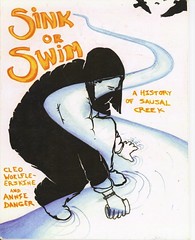
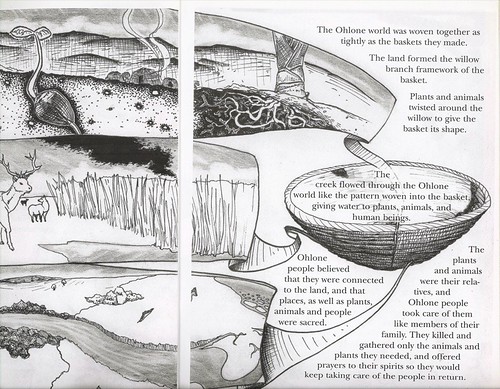
Sink or Swim was written and illustrated by water activists Cleo Woelfle-Erskine and Annie Danger (who, full disclosure, gave me one of my tattoos – but that's for a different post). I emailed Cleo to ask if there were any more copies of Sink or Swim available and he hasn't gotten back to me. I bet he's super-busy right now since he just finished another book that's been getting well-deserved national attention. (There's more on that book at the Greywater Guerrillas site.) I'm not sure if it's possible to find this book anymore, but if you can track one down, your efforts will be worthwhile. Sink or Swim is a short history of Sausal Creek, the creek that runs from the Oakland Hills, through Dimond Park, and underneath Fruitvale. Although Cleo and Annie document a huge loss for the natural and human environment, the tone is compassionate and optimistic. It would be a great resource for an older child to learn about both local history and the international issue of environmental destruction. Here's an excerpt from the introductory material:
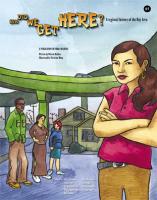
Another excellent resource for kids and adults is How Did We Get Here by Miriam Walden and the staff of Urban Habitat. This comic tells the history of Bay Area land use with an emphasis on the history of urban renewal and gentrification, and the impact of those phenomenon on communities of color in particular. Illustrator Christine Wong Yap brings the history alive, showing grim, grey freeways snaking through once vibrant communities, but also the human faces of displacement and struggle. The story is narrated by young people, and emphasizes the role of elders, youth, and everyday people in protecting their own communities. You can read another review at tolerance.org.
I'm always interested in suggestions for reading more. If you have a favorite book for kids about history, or a book that deals with a history in a new or different way, I'd love to hear about it.
I'm always interested in suggestions for reading more. If you have a favorite book for kids about history, or a book that deals with a history in a new or different way, I'd love to hear about it.
8.17.2007
More endorsements: The Organic City & Deep Oakland
While I deal with moving, starting my fall semester (I'm taking microbiology – wish me luck!), and helping my kids transition into a new school too, I'll be mostly reviewing other people's Bay history resources. Look for research-based posts from me again starting mid-or-late-September (hopefully including info on the farmworkers movement, underground queer scenes, and more on the Panthers). But for now, here are two of my favorite sites dealing with my favorite town:
The Organic City is some kind of awesome hybrid of mapping software and community blog. Or something. Clearly, I don't understand the technicalities, but I can tell you that the heart of the site is an interactive map which you can click on to hear, read, or watch stories based in corresponding Oakland neighborhoods. Part of the charm is the brevity of the stories – each small enough to give you a flavor, an impression. This home movie of bird-chasing at Lake Merritt is one of the best examples. I can almost feel my Oakland childhood in some of those shots. (Although mine was probably much less-hip than the little girl in the clips - her name is Song, and actually, I even knew another kid named Song when I was growing up here!) There are also some fine videos of Oakland history walking tours. William Wong, who has his own great Oakland Chinatown History site is a featured 'tour guide'. Here's a clip.
In a similar vein is Deep Oakland. Also organized by neighborhood (but including a wider range of 'hoods), and with a beautiful interface, Deep Oakland includes stories, photos, and audio clips. There are some real gems – particularly the interviews with long-time Oaklanders. My favorites so far is the snipped of an interview with Lewis Mahlmann, the now-retired master puppeteer at Children's Fairlyland. If you haven't had the chance to take in a show at Fairyland, here's a taste – with Mahlmann voicing the greedy Oswald Bear (warning: intense moralism ahead):
Next up: local history zines!
The Organic City is some kind of awesome hybrid of mapping software and community blog. Or something. Clearly, I don't understand the technicalities, but I can tell you that the heart of the site is an interactive map which you can click on to hear, read, or watch stories based in corresponding Oakland neighborhoods. Part of the charm is the brevity of the stories – each small enough to give you a flavor, an impression. This home movie of bird-chasing at Lake Merritt is one of the best examples. I can almost feel my Oakland childhood in some of those shots. (Although mine was probably much less-hip than the little girl in the clips - her name is Song, and actually, I even knew another kid named Song when I was growing up here!) There are also some fine videos of Oakland history walking tours. William Wong, who has his own great Oakland Chinatown History site is a featured 'tour guide'. Here's a clip.
In a similar vein is Deep Oakland. Also organized by neighborhood (but including a wider range of 'hoods), and with a beautiful interface, Deep Oakland includes stories, photos, and audio clips. There are some real gems – particularly the interviews with long-time Oaklanders. My favorites so far is the snipped of an interview with Lewis Mahlmann, the now-retired master puppeteer at Children's Fairlyland. If you haven't had the chance to take in a show at Fairyland, here's a taste – with Mahlmann voicing the greedy Oswald Bear (warning: intense moralism ahead):
Next up: local history zines!
8.08.2007
Hi there Bay Radicals,
The next few weeks promise to be pretty overwhelming for me, so I won't be doing any research or major posts. I do want to use this time to point you to some other great resources about Bay history though. To start with, I'd recommend that you come down to Mama Buzz café for some granola with soymilk and fair trade coffee and most especially, for their current photo exhibit and installation about Chester Street in West Oakland.
Julie Plasencia, a photojournalist and now freelancer has created a very sweet portrait of the people and architecture of a neighborhood. I think you'll like it.
The next few weeks promise to be pretty overwhelming for me, so I won't be doing any research or major posts. I do want to use this time to point you to some other great resources about Bay history though. To start with, I'd recommend that you come down to Mama Buzz café for some granola with soymilk and fair trade coffee and most especially, for their current photo exhibit and installation about Chester Street in West Oakland.
Julie Plasencia, a photojournalist and now freelancer has created a very sweet portrait of the people and architecture of a neighborhood. I think you'll like it.
7.09.2007
Issues, J's, and Rocky Baird
Next time you're in the Piedmont Avenue neighborhood, I suggest you visit the new and wonderful Issues.
I'm not just saying it's wonderful because the proprietors happen to be friends of mine. That fact only coincides nicely with the simple truth: Issues is rivaled only by DeLauer's on Broadway (which is in fact also super, but which actually doesn't carry a bunch of the magazines that I actually like to read), for the title of "Best East Bay Newsstand Evar". As far as I can tell, they carry every magazine known to humankind including Male Nurse, XLR8R, and the usual Family Circle etc. They have newspapers in many languages, 80s buttons, 70s t-shirts, and did I mention the charming staff (owners Joe and Noella)?
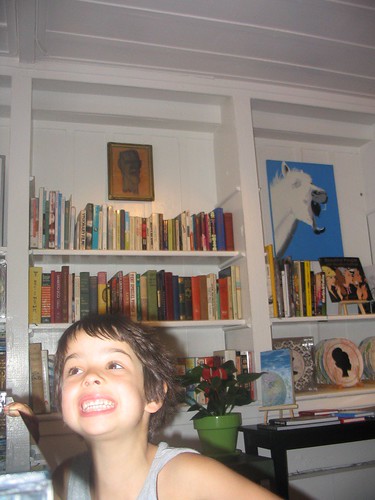
I like Issues so much that I brought my kids there the other day, and let them photograph it for you. So ya, Issues isn't actually dimly lit, out-of-focus, or (generally) full of preschool kids. Enjoy!
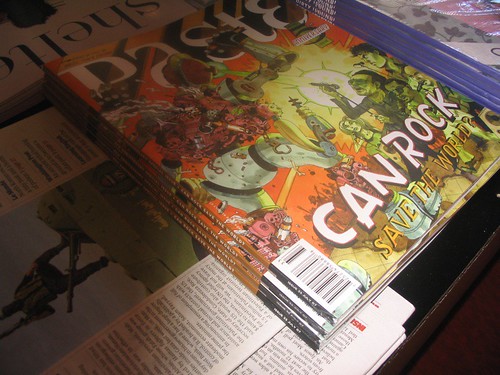
This appears to be some sort of hip music magazine. I wouldn't know, I only bought copies of Vegetarian Times and Sheep! The voice of the independent flock master.
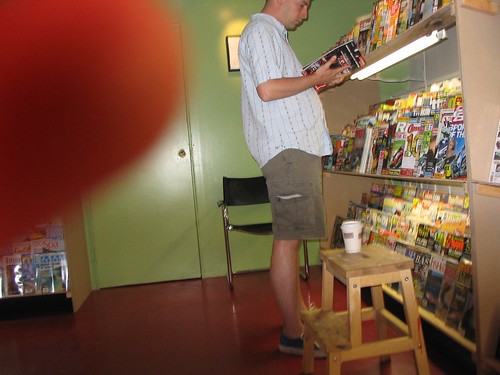
Coffee is welcome at Issues. As are 4 year old members of the Paparazzi.
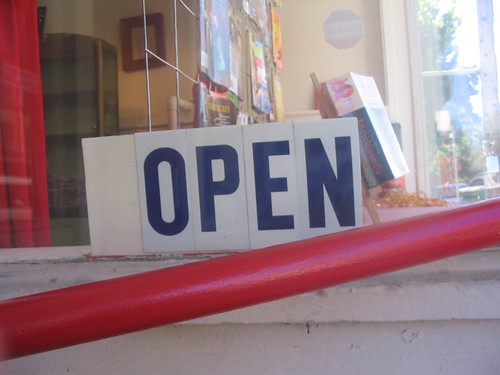
They're open from 7 to 7!
After you get your copy of Bitch or Bust or whatever, I suggest you bring your reading material over to the last normal restaurant on Piedmont Avenue – J's. Only two doors away from the recently arrived Cesar (tapas and fancy drinks for a lot of dough), J's is an old-fashioned burger joint. Since I'm a vegetarian (well, except for that whole 'fish aren't a vegetable' thing) I suggest going for breakfast. Mexican breakfast will run you about 8 bucks. American the same or cheaper depending on what you get. The portions are big and the coffee refills are free.
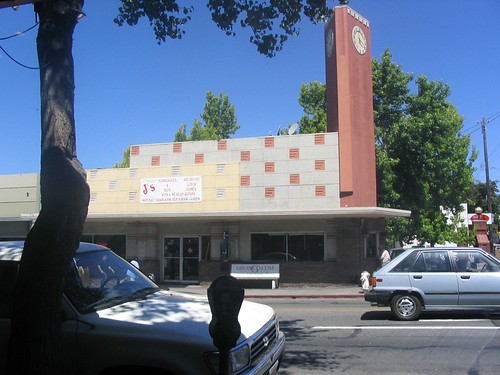
J's.
The best thing about J's though is the historical details. (You were wondering when I was going to get to the history bit weren't you?)
J's used to be a station house for the streetcars that stopped right outside, in what is now a large parking lot. There is still a semi-train-related theme, with clocks representing various time zones and photos of old Key line trains and stations on the walls. Wood paneling lines the walls, and about half-the seating is on rotating bar stools. The stained glass lamp covers add to the warm and low-key feeling.
Once you're full up, head out back to look at Rocky Baird's mural of the Key trains through Oakland's history. I love this mural; it's a much better historical marker than the old-school metal plaque that explains when the last train stopped there (1958).
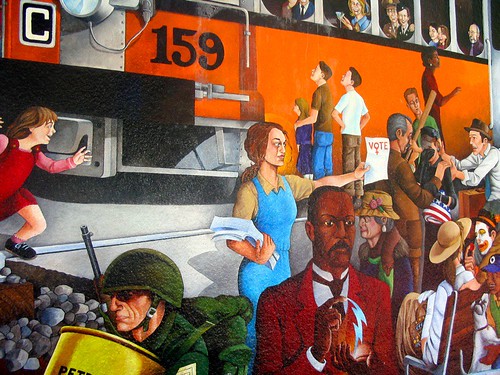
If you want to see more of Baird's work, head down to Gaylord's and get a view of his moving interpretation of the loss of Ohlone culture and land here in Oakland: The Capture of the Solid. The Escape of the Soul.
Then take yourself home to read your magazines. And take care.
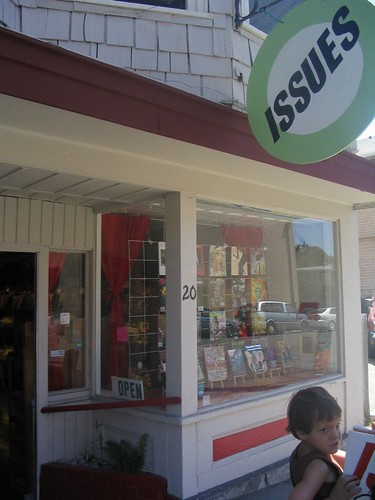
I'm not just saying it's wonderful because the proprietors happen to be friends of mine. That fact only coincides nicely with the simple truth: Issues is rivaled only by DeLauer's on Broadway (which is in fact also super, but which actually doesn't carry a bunch of the magazines that I actually like to read), for the title of "Best East Bay Newsstand Evar". As far as I can tell, they carry every magazine known to humankind including Male Nurse, XLR8R, and the usual Family Circle etc. They have newspapers in many languages, 80s buttons, 70s t-shirts, and did I mention the charming staff (owners Joe and Noella)?
I like Issues so much that I brought my kids there the other day, and let them photograph it for you. So ya, Issues isn't actually dimly lit, out-of-focus, or (generally) full of preschool kids. Enjoy!
This appears to be some sort of hip music magazine. I wouldn't know, I only bought copies of Vegetarian Times and Sheep! The voice of the independent flock master.
Coffee is welcome at Issues. As are 4 year old members of the Paparazzi.
They're open from 7 to 7!
After you get your copy of Bitch or Bust or whatever, I suggest you bring your reading material over to the last normal restaurant on Piedmont Avenue – J's. Only two doors away from the recently arrived Cesar (tapas and fancy drinks for a lot of dough), J's is an old-fashioned burger joint. Since I'm a vegetarian (well, except for that whole 'fish aren't a vegetable' thing) I suggest going for breakfast. Mexican breakfast will run you about 8 bucks. American the same or cheaper depending on what you get. The portions are big and the coffee refills are free.
J's.
The best thing about J's though is the historical details. (You were wondering when I was going to get to the history bit weren't you?)
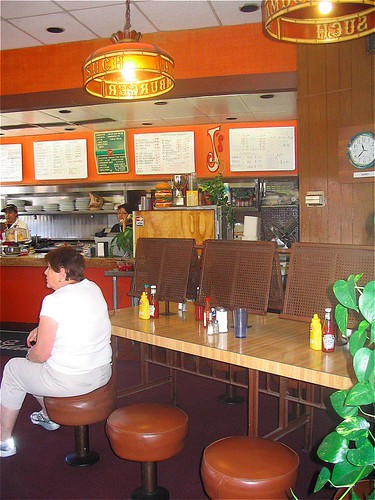
J's used to be a station house for the streetcars that stopped right outside, in what is now a large parking lot. There is still a semi-train-related theme, with clocks representing various time zones and photos of old Key line trains and stations on the walls. Wood paneling lines the walls, and about half-the seating is on rotating bar stools. The stained glass lamp covers add to the warm and low-key feeling.
Once you're full up, head out back to look at Rocky Baird's mural of the Key trains through Oakland's history. I love this mural; it's a much better historical marker than the old-school metal plaque that explains when the last train stopped there (1958).
If you want to see more of Baird's work, head down to Gaylord's and get a view of his moving interpretation of the loss of Ohlone culture and land here in Oakland: The Capture of the Solid. The Escape of the Soul.
Then take yourself home to read your magazines. And take care.
6.12.2007
Oakland General Strike Part II
Read Part I
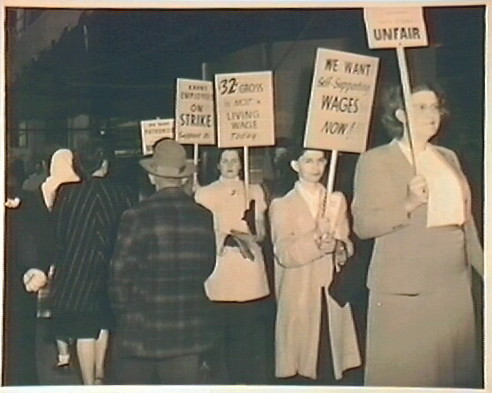
Striking department store clerks, photo from the Oakland Museum of California.
In the first few days of December 1946, retail workers at Hastings' and Kahn's department stores, across the street from each other where Broadway meets Telegraph, had been on strike for more than a month. Most of the workers were women. Their pay was shitty, less than $16 a week, and worse, they were subjected to an absurd procedure where they had to show up to work first thing in the morning, and then wait in the basement (unpaid), until they were called to the floor to work. A clerk could easily be stuck in the basement all morning, or even all day.
The Teamsters local had supported the retail workers strike from the beginning. They refused to deliver anything to the struck stores. (When I was at the Labor Archives, I even saw minutes from the Teamsters Local 70 meeting showing a member being expelled for trying to deliver to Kahn's in November.) The local NAACP and National Negro Congress publicly supported the striking workers. And union laborers had stopped painting and construction of a new elevator at Kahn's in solidarity.
On the business side, the Oakland Tribune, then run by republican powerhouse Joe Knowland, advocated a citywide ban of pickets. According to Albert Lannon's Fight or Be Slaves, right-wing city council members were publicly objecting to the use of the word 'scab'. Most detrimentally, the city agreed to send out the police force to escort delivery trucks to the stores, so they could keep stock for the Christmas shopping season.
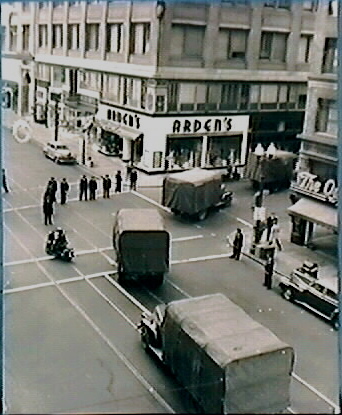
OPD escorting delivery trucks from the notoriously anti-union company G.I. Trucking. From the Oakland Museum of California.
That move was too much for the local labor council. The night of December 1st, a Saturday, Teamsters patrolled every roadway into Oakland to keep the delivery trucks away, and the labor council organized members to use their cars to block the parking spaces surrounding the effected stores. Several hundred picketers came out in the middle of the night to keep the scabs out.
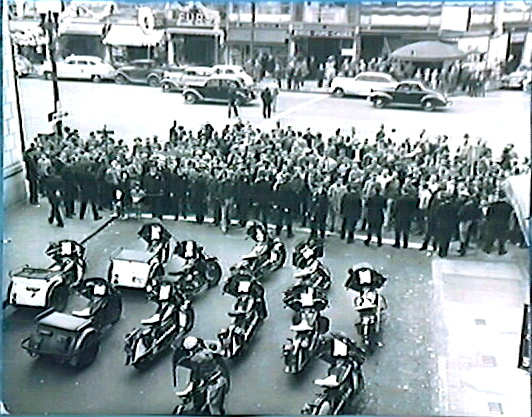
Cops block the street to keep strikers out. From the Oakland Museum of California
At 4 in the morning the cops started towing the strikers cars and blocking off sections of Broadway, Telegraph, and San Pablo. When they waved the streetcars through their police line at 6:30 Sunday morning, a driver told the cops that he'd never crossed a picket line, got out of the car and removed its control box, causing an immovable backup along the streetcar line. The general strike was on, although it was another day before the whole city was out.
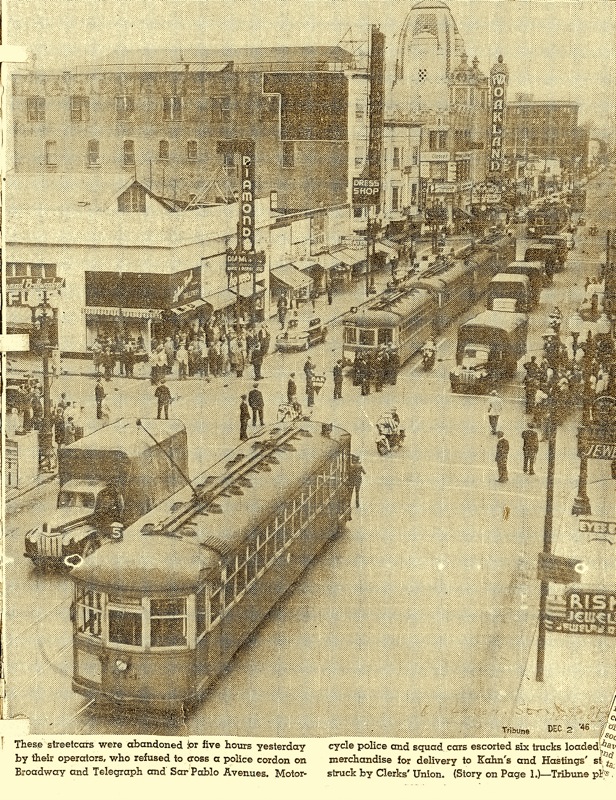
Tribune clipping from the Oakland History Room.
At a long and fevered meeting of various local AFL union leaders Sunday afternoon (the clerks were affiliated with the AFL), Teamsters pledged that because of the strikebreaking deliveries, they would shut down work in the East Bay starting Monday. Every other union but the milk truck drivers' agreed, and the milk truck drivers only insisted on working in order to get milk to local hospitals. Labor leaders went on the radio to declare Monday a 'work holiday' and to call everyone downtown, to the center of the strike, to show their support.
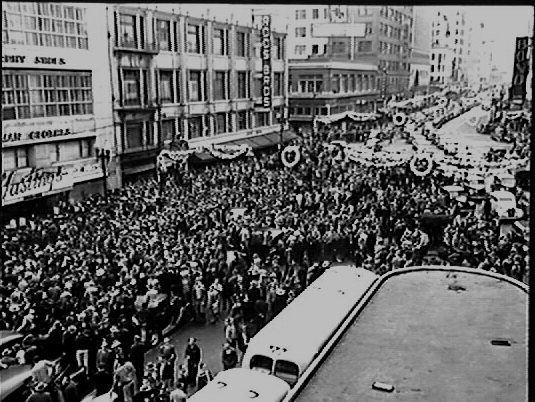
From the Oakland Museum of California.
At the peak, as many as 30,000 people were packed into the rainy downtown streets. The mood was excited to say the least. Bars were allowed to stay open, but they were only allowed to serve beer, and were told to turn their jukeboxes out to face the street, where people were literally dancing. All AFL building trades were shut down. All East Bay newspapers were shut down. Buses, streetcars, greyhounds, taxis, and trucking were stopped. Gas stations were closed too. Hotels, movie theaters, and larger restaurants and grocery stores were shut.
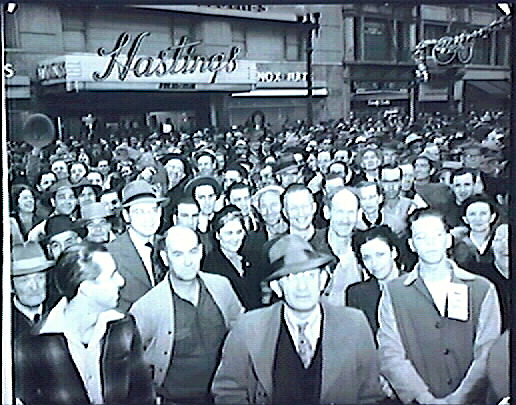
The picture's pretty blurry, but can you make out those huge grins? From the Oakland Museum again.
I've read conflicting stories on this, but from what I understand, the CIO, the second-largest umbrella union organization in Oakland, had offered their support the night before the strike. They were patently turned down. AFL leaders didn't want to be associated with the CIO whose on-the-ground organizers were largely communist. Robert Ash, the head of the labor council was quite progressive, but balked at working together, imagining headlines in the paper saying "Reds cause Anarchy Downtown" and so forth. Besides the communist associations, the AFL and CIO were rivals not comrades. Working directly with the CIO would have brought about ugly repercussions from national AFL leadership. The CIO honored picket lines anyway, and finally, on the third day of the strike, called for a general meeting to vote on whether to walk out themselves. A CIO walkout would have cut off gas and electricity to most of the city. At this suggestion, Oakland's city manager was ready to settle.
But the unions had lost the upper hand. The national vice president of the Teamsters, Dave Beck, told the local to withdraw from the general strike. He didn't support revolution, and apparently, the strike was developing that flavor. Rumors circulated that Governor Earl Warren was going to send in the National Guard, and the mayor had declared a state of emergency.
Instead of holding their ground, the union negotiated with Oakland's city manager only for an agreement that police would not be used to break strikes. There was no settlement for the department store clerks (who stayed on strike for eight more months, and then had to settle for a weak contract before they finally negotiated a better deal and a closed union shop in May of '47). There was certainly no attempt to make structural change in the city. Robert Ash from the Labor Council admitted later, in retrospect, that had they held out, they could have had more. Maybe they could have gotten the whole right-wing city leadership to resign.
But even that laudable goal suffers from a failure of imagination. Workers owned the city for those three days. They could have done anything. On the other hand, what can you do when you suddenly control your own world? When you have the power to rearrange everything, if only you can agree with tens of thousands of others who share that power? Who knew what to do with complete worker control of a city?
A year later that kind of question hardly mattered anyway. In 1947, congress passed the Taft-Hartley Act outlawing secondary boycotts (boycotts of union companies that do business with a struck company), removing government protection for wildcat (unofficial) strikers, and allowing the president to force workers back to their jobs if he feels that their strike "imperils the national health". The phenomenon of the General Strike came to an abrupt end.
In the aftermath, the Teamsters local withdrew from the central labor council (and not long after, the national Teamsters withdrew from the AFL). Voters elected a labor slate of candidates for the City Council in '47, but not enough to get a majority, and the winners didn't work very well as a team, and were voted out a few years later. Oakland changed dramatically after the war, demographics changed, the beginnings of civil right struggles emerged, but worker control was not on the agenda.
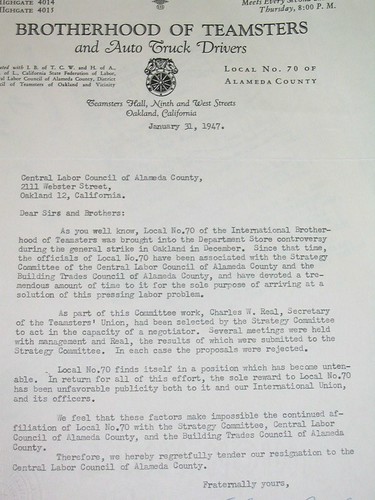
Found at the Oakland History Room.
If you're interested in the Oakland general strike, I'd recommend Chris Rhomberg's No There There. Online you can listen to a nice KPFA documentary on the strike that features interviews with participants and more on the historical context that led to the strike. Also, check out longshoreman and publisher Stan Weir's account of the strike at the very cool libcom.org or Dick Meister's summery on ZNet.
Striking department store clerks, photo from the Oakland Museum of California.
In the first few days of December 1946, retail workers at Hastings' and Kahn's department stores, across the street from each other where Broadway meets Telegraph, had been on strike for more than a month. Most of the workers were women. Their pay was shitty, less than $16 a week, and worse, they were subjected to an absurd procedure where they had to show up to work first thing in the morning, and then wait in the basement (unpaid), until they were called to the floor to work. A clerk could easily be stuck in the basement all morning, or even all day.
The Teamsters local had supported the retail workers strike from the beginning. They refused to deliver anything to the struck stores. (When I was at the Labor Archives, I even saw minutes from the Teamsters Local 70 meeting showing a member being expelled for trying to deliver to Kahn's in November.) The local NAACP and National Negro Congress publicly supported the striking workers. And union laborers had stopped painting and construction of a new elevator at Kahn's in solidarity.
On the business side, the Oakland Tribune, then run by republican powerhouse Joe Knowland, advocated a citywide ban of pickets. According to Albert Lannon's Fight or Be Slaves, right-wing city council members were publicly objecting to the use of the word 'scab'. Most detrimentally, the city agreed to send out the police force to escort delivery trucks to the stores, so they could keep stock for the Christmas shopping season.
OPD escorting delivery trucks from the notoriously anti-union company G.I. Trucking. From the Oakland Museum of California.
That move was too much for the local labor council. The night of December 1st, a Saturday, Teamsters patrolled every roadway into Oakland to keep the delivery trucks away, and the labor council organized members to use their cars to block the parking spaces surrounding the effected stores. Several hundred picketers came out in the middle of the night to keep the scabs out.
Cops block the street to keep strikers out. From the Oakland Museum of California
At 4 in the morning the cops started towing the strikers cars and blocking off sections of Broadway, Telegraph, and San Pablo. When they waved the streetcars through their police line at 6:30 Sunday morning, a driver told the cops that he'd never crossed a picket line, got out of the car and removed its control box, causing an immovable backup along the streetcar line. The general strike was on, although it was another day before the whole city was out.
Tribune clipping from the Oakland History Room.
At a long and fevered meeting of various local AFL union leaders Sunday afternoon (the clerks were affiliated with the AFL), Teamsters pledged that because of the strikebreaking deliveries, they would shut down work in the East Bay starting Monday. Every other union but the milk truck drivers' agreed, and the milk truck drivers only insisted on working in order to get milk to local hospitals. Labor leaders went on the radio to declare Monday a 'work holiday' and to call everyone downtown, to the center of the strike, to show their support.
From the Oakland Museum of California.
At the peak, as many as 30,000 people were packed into the rainy downtown streets. The mood was excited to say the least. Bars were allowed to stay open, but they were only allowed to serve beer, and were told to turn their jukeboxes out to face the street, where people were literally dancing. All AFL building trades were shut down. All East Bay newspapers were shut down. Buses, streetcars, greyhounds, taxis, and trucking were stopped. Gas stations were closed too. Hotels, movie theaters, and larger restaurants and grocery stores were shut.
The picture's pretty blurry, but can you make out those huge grins? From the Oakland Museum again.
I've read conflicting stories on this, but from what I understand, the CIO, the second-largest umbrella union organization in Oakland, had offered their support the night before the strike. They were patently turned down. AFL leaders didn't want to be associated with the CIO whose on-the-ground organizers were largely communist. Robert Ash, the head of the labor council was quite progressive, but balked at working together, imagining headlines in the paper saying "Reds cause Anarchy Downtown" and so forth. Besides the communist associations, the AFL and CIO were rivals not comrades. Working directly with the CIO would have brought about ugly repercussions from national AFL leadership. The CIO honored picket lines anyway, and finally, on the third day of the strike, called for a general meeting to vote on whether to walk out themselves. A CIO walkout would have cut off gas and electricity to most of the city. At this suggestion, Oakland's city manager was ready to settle.
But the unions had lost the upper hand. The national vice president of the Teamsters, Dave Beck, told the local to withdraw from the general strike. He didn't support revolution, and apparently, the strike was developing that flavor. Rumors circulated that Governor Earl Warren was going to send in the National Guard, and the mayor had declared a state of emergency.
Instead of holding their ground, the union negotiated with Oakland's city manager only for an agreement that police would not be used to break strikes. There was no settlement for the department store clerks (who stayed on strike for eight more months, and then had to settle for a weak contract before they finally negotiated a better deal and a closed union shop in May of '47). There was certainly no attempt to make structural change in the city. Robert Ash from the Labor Council admitted later, in retrospect, that had they held out, they could have had more. Maybe they could have gotten the whole right-wing city leadership to resign.
But even that laudable goal suffers from a failure of imagination. Workers owned the city for those three days. They could have done anything. On the other hand, what can you do when you suddenly control your own world? When you have the power to rearrange everything, if only you can agree with tens of thousands of others who share that power? Who knew what to do with complete worker control of a city?
A year later that kind of question hardly mattered anyway. In 1947, congress passed the Taft-Hartley Act outlawing secondary boycotts (boycotts of union companies that do business with a struck company), removing government protection for wildcat (unofficial) strikers, and allowing the president to force workers back to their jobs if he feels that their strike "imperils the national health". The phenomenon of the General Strike came to an abrupt end.
In the aftermath, the Teamsters local withdrew from the central labor council (and not long after, the national Teamsters withdrew from the AFL). Voters elected a labor slate of candidates for the City Council in '47, but not enough to get a majority, and the winners didn't work very well as a team, and were voted out a few years later. Oakland changed dramatically after the war, demographics changed, the beginnings of civil right struggles emerged, but worker control was not on the agenda.
Found at the Oakland History Room.
If you're interested in the Oakland general strike, I'd recommend Chris Rhomberg's No There There. Online you can listen to a nice KPFA documentary on the strike that features interviews with participants and more on the historical context that led to the strike. Also, check out longshoreman and publisher Stan Weir's account of the strike at the very cool libcom.org or Dick Meister's summery on ZNet.
6.07.2007
THIS IS A STRIKE support our CAUSE - The Oakland General Strike
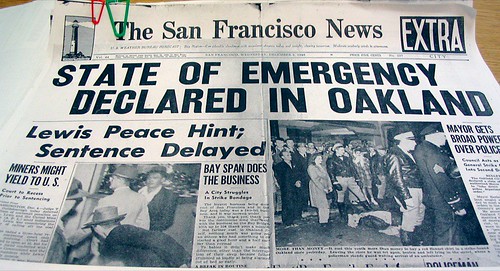
General Strike! The photo at right shows police milling around an injured shopper in front of a struck Oakland department store. Headline at left refers to a nationwide coal miners strike. This clipping is from the Labor Archives and Research Center at SFSU.
Someone with my politics (anarchist, idealist) tends to think of the general strike as a kind of labor-movement Excalibur, whose ass-kicking powers were so great that it could blind King Arthur's enemies simply by being drawn from its scabbard. (In this problematic analogy, King Arthur = The People.)
A general strike is the ultimate exercise of worker solidarity and worker power and basically, it happens like this: everyone (well, almost everyone), in every industry, stops working until their collective demands are met. One hopes that their demands go beyond asking for better pay or other simple benefits, and begin to address the big problems that go with a society where a few people own everything and do nothing, and others own nothing and do all the work.
And if that is your idea of the purpose and potential of general strikes, then it's clear that they haven't been very successful. Part of the problem though might be that there isn't always a clear purpose, even if there is a lot of potential. In the case of Oakland's 1946 general strike, we had an unbelievable potential power. I'm not so clear on the purpose.
I have so much to say about the Oakland strike, I'm going to split this into a few entries. Here's part 1, the context:
The Bay Area had gained half a million people between 1940 and 1945, when immigrants from around the country flooded in to find work in the war industries (mostly shipbuilding) centered here. The East Bay was so packed, there was nowhere to put everyone. I love the image in Marilyn S. Johnson's book The Second Gold Rush, a quote from an Oakland police captain saying in 1942, "Hundreds of men, women, and children [are] sleeping nightly on outdoor benches in public parks, in chairs in all night restaurants, in theatres, in halls of rooming houses, in automobiles, even in the City Hall corridors." Even with so many people, there were labor shortages. Between the shipyards and the businesses that supported them, there was an almost insatiable need for workers.
But a year after WWII ended, Oakland's economy had already started to wobble. Soldiers came back to a new and newly crowded Bay Area looking for jobs just as the war industries were beginning to contract. And the population boom and economic stressors weren't the only pressures. The need for labor had overruled some long standing social and political rules here and everywhere, most obviously, many more women, including for the first time middle class women, started working in factories and other industries. And Black immigrants to the Bay started to integrate the segregated neighborhoods and jobs here. Returning soldiers too had been transformed by their battlefield experiences. Maybe they expected to be able to make changes that hadn't seemed possible before.
Working conditions hadn't been great during the war, but most unions had signed patriotic No Strike pledges. After the war, business leaders and government officials found it impossible to stuff a broadening political agenda back into a box. In '46, a massive strike wave spread around the country (and internationally). The rail and coal mining industries were debilitated by strikes that year, and a number of cities held general strikes.
I found a newsreel that nicely captures the panic that industrialists felt about the rail strike at archive.org.
In this context, of a country and world that was changing by the second, where worker power seemed possible and real, and let's face it, where communists were all over the place, the idea of shutting down a city wasn't just a fantasy. At least, that's what I understand from what I've read.
Next time I'll post about the strike itself. I've got some links to original accounts and a nice documentary too. Stay tuned.
6.04.2007
Hometown
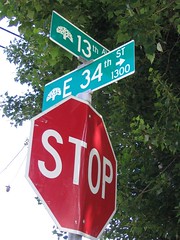
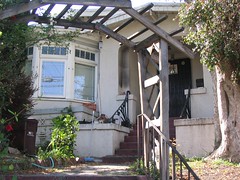
The house was built in 1921, part of a construction boom that was still reverberating through Oakland 15 years after the San Francisco earthquake. When the city burned, residents turned to less developed or agricultural land in the East Bay where forward thinking real estate developers had already bought up (or squatted) massive tracts in hopes of making a lot of cash. After buying the land, the developers would generally build a few impressive houses, and then run a streetcar to the new 'neighborhood' to bring people in.
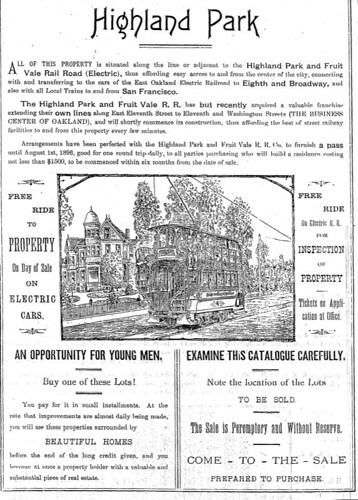
Unfortunately for E.C., he was ahead of his time, and ended up selling off his land in small parcels before the neighborhood took off in the 20s. (Highland Hospital, a few blocks away, and the beloved Parkway Theatre down the street on Park Blvd. were built in the '20s too.)
My parents moved to the house around 1970, and paid $200 a month for three bedrooms, a living room, formal (if small) dining room, and a rumpus room downstairs, along with the backyard and its decrepit gazebo. Oakland had changed a lot from the pastoral (and profitable) oasis that developers like E.C. Sessions had imagined. In my neighborhood, the two story streetcars had long been replaced by more uniform Key System trains, which subsequently disappeared too. The city as a whole had never fully recovered from a post-WWII economic downturn, and because of the efforts of dozens of civil rights groups, it was just beginning to grow out of long-standing policies of racial discrimination.
By the time I was school aged, Oakland had a reputation as a crime center. Crack was beginning its ascent, and I'm sure even my not-so-deep section of East Oakland was impacted. But my sense of my home was that it was safe and that it was stable. My young neighbors and I hid in the bushes of my house to throw berries at passing cars, played football in the parking lot around the corner, and walked back and forth to the liquor store up the street for Now-and-Laters and Chick-o-Sticks.
Like anybody's hometown anywhere, Oakland is, to me, the place I know in and out, the place I can tell my kids about when I'm trying to help them understand my sense of the world. Lucky for me, and for them, they live here too, so they can compare their stories to my stories, and find their own adventures in a spot where they have roots.
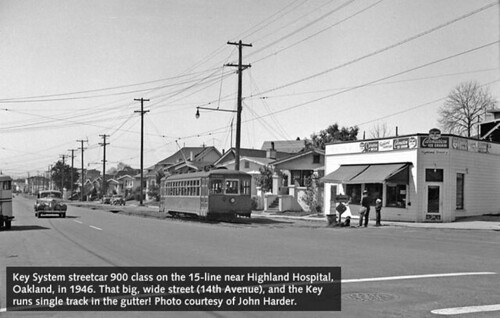
Thanks too for photos on this site: the Highland Park advertisement is from the Oakland History Room, and the Key Line streetcar came from keyrailpics.org, an awesome photo site full of Bay Area streetcar photos.
Subscribe to:
Posts (Atom)
