Showing posts with label 1800s. Show all posts

4.19.2008

The 1858 Black Exodus

Mifflin.jpg
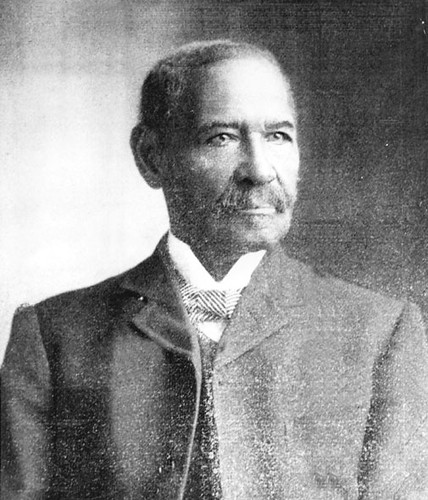
Mifflin Wistar Gibbs: founded the first black newspaper in California, joined hundreds of his peers in leaving San Francisco to find his fortune in Canada, became the first black man to join the Victoria city council and eventually returned to the US where he served as the first elected African American municipal judge in the country.


This week, San Franciscans will observe the 150th anniversary of an exodus of hundreds of free black Californians to Canada in order to escape an increasingly racist state government and fugitive slave laws that endangered their lives and to join a more welcoming community in Victoria, British Columbia. A list of commemorative events is available here. Learn more about African American civil rights struggles during the gold rush era at sfmuseum.org.

1.15.2008

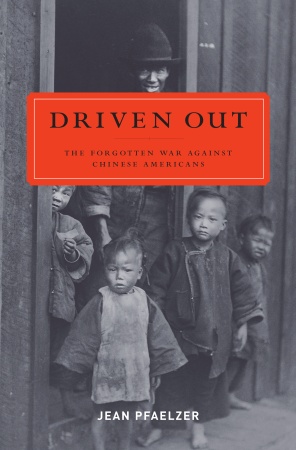
Driven Out


driven out

Since I started tracking visits to this site I’ve noticed one post gets more visits than any other. I wanted to pass on a related resource for folks who came here to read about the violence that Chinese-Americans faced in the Western United States throughout the 19th and early 20th centuries.

Driven Out is the deepest, most thorough examination of that shameful piece of history that I’ve found. I’ll display a rare moment of agreement with the New York Times in saying that the book contains an unfortunate lack of analysis and narrative that would have made it better reading, but I still recommend this to anyone looking for more on the issue. Pfaelzer's research is strong and she looks unflinchingly at what she rightly calls pogroms of Chinese-Americans, citing case after case after case of legal and extra-legal violence and expulsion of Chinese immigrants. Its difficult reading, but worthwhile for the sake of understanding a long-suppressed history.

12.30.2007

Primary sources, baby!

I've been digging a new collection on the Library of Congress' American Memory site about early California history.

It only includes works in English which excludes material from the Spanish speakers who had been running the place when it was a colony of Spain and then later when it was the most Northern province of Mexico. Also missing are voices from members of California's 70+ native tribes which used spoken but not written languages, and from the thousands of international gold seekers who came from China and Chile, and from all over the rest of the world, leaving an emphasis on adventuring Anglo-American men. As limited as adventuring Anglo-American men can be, I like the first-person accounts of California history. Here's a passage from San Francisco bartender John H. Brown, recalling the Anglo-American seizure of California from Mexico. At that time, those "rising up" were attempting to found an independent Republic of California until the Navy sailed into Monterey Bay and occupied California in the name of the United States, quickly quashing that idea. Note that the then-sleepy pre-Gold Rush city of San Francisco was still called Yerba Buena at the time:

Things went on as usual in the city until the latter part of May, when a report reached the city, that trouble was expected. A party at Sutter's Fort were raising a company to take possession of the upper part of California. In the early part of June, a boat arrived from Martinez, with the news that Sonoma was taken, and a proclamation, with Mr. Hyde's signature, was posted in a prominent place which announced that General Vallejo and Timothy Murphy, of San Rafael, with many others, were taken prisoners... A few days after, General Castro issued a proclamation, commanding all Mexican citizens to meet him at Santa Clara for orders. The only foreigners who left the city for Santa Clara, were Captain William Hinckley and Robert T. Ridley. They were ordered to stop all boats and prevent all persons from landing in Yerba Buena. On their return home, Hinckley was taken sick and died, on Burnell's Ranch, and was buried in the church at Mission Dolores.

Robert T. Ridley returned to the city to carry out the orders of General Castro, but could not find anyone to assist him, as there was not one Mexican citizen to be found in Yerba Buena, and the few foreigners who were here, were in favor of the ''Bear Flag,'' as it was called. This flag was made at Sutter's Fort, of bunting, and had the picture of a grizzly bear painted in the center, as the parties making the flag had no paint on hand, they used some blackberry juice, which answered the purpose very well. (The flag can still be seen at the Pioneer's Hall, in San Francisco). But they did not take up arms until the American Flag was raised.

6.26.2007

S.F. Shootout


I'm glad that I'm not a professional historian because if I were, I might have to find some other way to express this: Dennis Kearney* was an utter ass-wipe. An immigrant himself, Kearney founded California's briefly influential (and highly racist) Workingman's Party. He made a political career out of the thoughtful slogan, "The Chinese Must Go". His fiery speeches were quite radical – he advocated lynching of wealthy business owners – but he wasn't marginal. His political ally, Isaac Kalloch, became San Francisco's mayor in 1879.

That is disturbing, but not surprising. Here's the crazy part: in the 1870s, the founder and editor of the Chronicle, Charles de Young, railed against Kearney and Kalloch (then only a mayoral candidate) in his paper. I haven't read the editorials directly – anyone know of where I can find those archives online? But from what I understand, de Young wasn't particularly concerned with Kalloch's racism, but more with his popularity. Trying to undermine the mayoral candidate, he publicly exposed a sex scandal that Kalloch (a Baptist minister) had been involved with in another state. Kalloch ridiculed de Young right back and from the pulpit, calling de Young's mother "whore-mongering", and then in retaliation de Young, the editor of the Chronicle, shot Kalloch, the mayoral candidate!

Kalloch survived, and won the election in part because of the sympathy he garnered for his injury, but a year later his son, defending the family honor, fatally shot de Young. He admitted to the shooting but got off free. Fortunately, Kearney's Workingman's Party faded shortly thereafter, but Kalloch did fine, serving two years as mayor.


*Note that Wikipedia reveals that Kearny Street, which runs right through Chinatown in SF is not actually named after Dennis Kearney. This information comes as a relief, but I wasn't too excited to learn who it was named after: Stephen Kearny, who founded of the US Cavalry and used those troops to expand white US occupation into Native American homelands in the Western part of the continent. He went on to command a number of battalions in the Mexican-American War, winning California for the US of A, which, I imagine, is why he got a street named after him in San Francisco. Related: we can also breathe a sigh of relief that Geary street is named after a former postmaster, not California Congressman Thomas Geary, who wrote an 1892 law extending the Chinese Exclusion Act, and expanding it to require Chinese-Americans to carry permits at all times, or risk deportation or punishment by hard labor. His act also denied habeus corpus to imprisoned Chinese-Americans, removing their rights to ask a judge to review the legality of their detentions. If you want to know who any other SF streets are not named for, look at this site.

6.25.2007

Anti-Chinese violence

I’m going to do a few entries about the history Chinese-Americans in the Bay Area, and the relationship between the white labor movement and Chinese workers. It's been pretty disturbing reading about this stuff. I had a sense of some of the racism that was historically directed at Chinese immigrants, but I certainly didn't understand the scale. The most appropriate word to describe what happened to Chinese people here is probably 'pogroms'. I grew up here in California, and I definitely didn't learn about any of this in school. Anyway, here's the first post – about labor:

During the Gold Rush, prospectors, mostly men, flooded into San Francisco from all over the world. Most came from the Eastern United States, but also from outside of the country, especially Chile and China. Chinese gold-seekers made up a significant portion of the new 'settlers', setting up communities in San Francisco and in rural areas too.
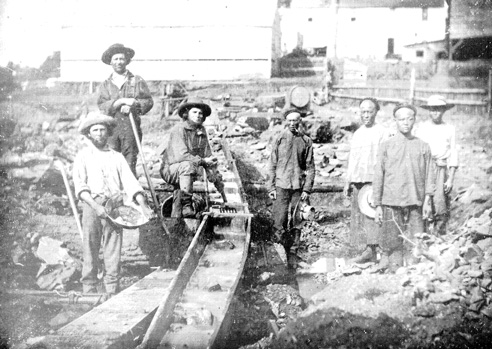

chinese miners.jpg
This 1852 photo by J. B. Starkweather shows a rare site: Chinese and European Americans working together in a gold mining operation.


Over the next few decades, Chinese immigrants became involved in a wide-range of work: Rurally, Chinese settlers created the fishing industry here, established agriculture in the Central Valley, and worked as laborers building the levee systems on the Delta, almost always living in isolated, Chinese-only communities. By the 1860s, 2/3 of the laborers building the Western portion of the transcontinental railroad were Chinese men.
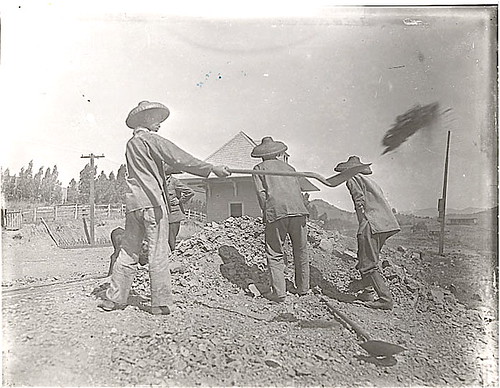

Chinese Rail workers.jpg
Chinese rail workers in 1898, from the California Historical Society, San Francisco


In urban settings, Chinese workers took jobs in just about every trade: manufacturing, building, and running small businesses including laundries, restaurants, markets, and repair shops. Around the Bay Area, traveling Chinese peddlers sold fresh produce out of large baskets that they'd carry from house to house, and later from the back of horse-drawn produce carts.
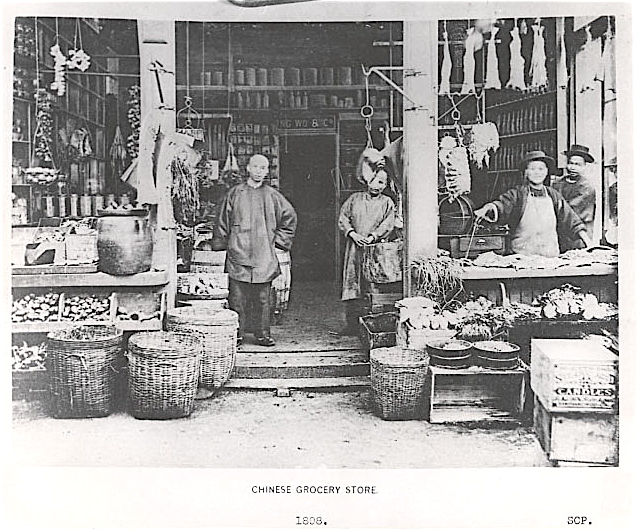

chinese grocery store.jpg
1898 – a produce market. Photo by Roy Graves


Like many immigrants, new arrivals from China tended to stick together in the same neighborhoods, seeking out and forming supportive associations with people who came from their same regions and extended families back home. But the segregation of Chinese men and women into Chinatowns wasn't just a preference of the residents there. It was mandated by law and required for safety.

It would be difficult to exaggerate the level of hostility and violence directed towards Chinese-Americans in the late 19th century. Before I started reading about this a few weeks ago, I had no idea how overwhelming and horrific this bit of history was: white Americans, encouraged by labor leaders and sometimes officially sanctioned by local governments, perpetrated a series of pogroms against Chinese communities throughout the late 1800s. A few examples:
- In 1871 in Los Angeles a brutal race riot left roughly 20 Chinese men dead, after white residents ransacked Chinatown there.
- In 1885, in Wyoming, European immigrant mine workers rioted against Chinese workers (who were paid less than white workers and who had historically been recruited as strikebreakers), killing 28 Chinese miners and destroying 75 of their homes.
- In 1886, virtually every Chinese resident of Seattle was rounded up in an attempt to remove them from the city.
- In 1887, 31 Chinese gold miners were murdered by bandits in Oregon, and no one was prosecuted for the murders.
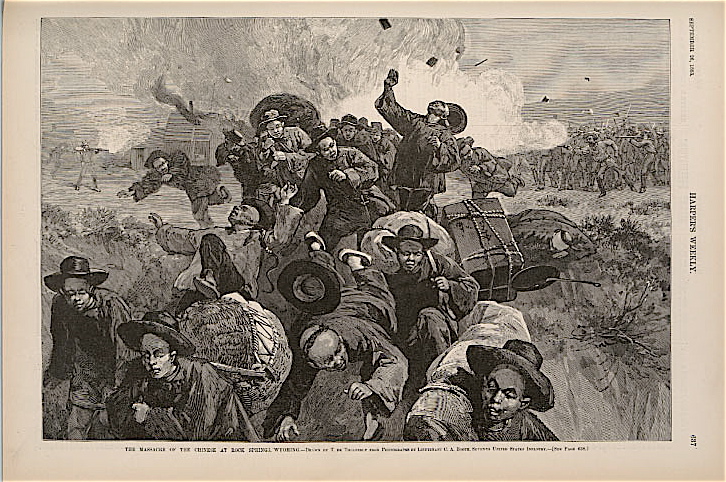

harpers.jpg
"Massacre of the Chinese at Rock Springs, Wyoming" From Harper's Weekly housed at the Bancroft Library, University of California, Berkeley


Legal repression of Chinese immigrants escalated dramatically as the years progressed: By 1852, Chinese gold miners were subject to a significant foreigner tax that no other international miners were required to pay. Two years later, the Supreme Court of California extended to Chinese people a ban already in place prohibiting 'Negroes' and 'Indians' from testifying for or against white people. In 1872, Chinese people were barred from owning real estate or business licenses in California. And devastatingly, in 1882, Congress enacted the Chinese Exclusion Act, barring Chinese laborers from entering the country. This ban was generally applied to almost every Chinese person, making it impossible for example for Chinese men already living in the US to bring their families here to join them. (And because the immigrants who came here from China were almost exclusively male, and because the Exclusion Act prohibited anyone else from coming, the Chinese community dwindled as its bachelor class aged without raising children.) The Chinese Exclusion Act wasn't repealed until the 1940s and the severe immigration quotas reserved only for Chinese immigrants weren't ended until 1965. 1965!

Theorists and intellectuals fell over each other advocating for the removal of Chinese people from this country. Here's a fairly typical anti-Chinese screed of the time, devoted to the "Chinese Question". I confess, I didn't read this whole steaming pile of garbage, and instead skipped to the final chapter (starts on 196) titled "One course, and one course only, can stay the Eastward migration of the yellow race, and its gradual conquest of the land." You can guess what course that is. 'Progressive' non-Chinese thinkers tended to advocate for Chinese immigrants solely on the basis that they were willing to do the tedious, humiliating, or back-breaking work that white people were refusing to take. Hmm, sounds familiar.

Government leaders and others in the mainstream were certainly responsible for the legal sanction of racism here, but labor leaders in particular should be held culpable for the anti-Chinese hysteria of that time. By the 1870s, the country was experiencing a post-Civil War economic downturn. Jobs were hard to come by. In California, the gold that so many people had flooded in to find was already mostly gone by the early 1850s. Meanwhile, the monopolistic railway companies (and most other industries), exploited Chinese workers by paying them less than the going wage for white workers. Instead of directing their hatred solely at the Goliath-like industrial giants, white labor turned to a seemingly easier target. A couple quick examples:

Samuel Gompers, founder of the AFL, co-authored a paper entitled, "Some Reasons for Chinese Exclusion. Meat vs. Rice. American Manhood against Asiatic Coolieism. Which Shall Survive?"

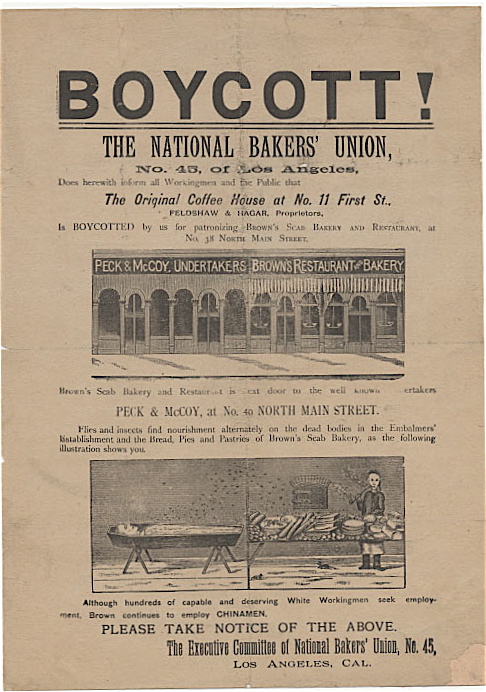
I'm not going to reproduce the most grossly offensive posters, pamphlets, and cartoons I've found that were produced by labor advocates in opposition to the Chinese, but here's a typically racist 1889 poster promoting a boycott of a business that was rumored to have hired Chinese workers: It's from the California Historical Society.


bakers union.jpg


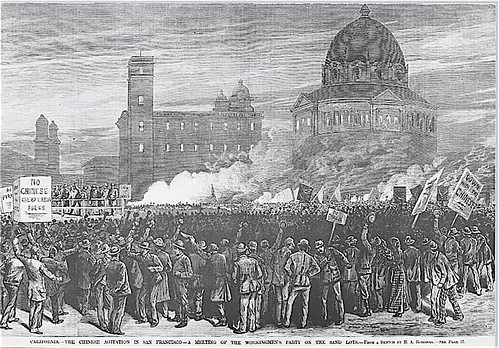
In San Francisco, anti-Chinese sentiment was common. The city's most famous anti-Chinese 'advocate' was Dennis Kearney publicly advocated rioting against both bosses and Chinese people at the old Sand Lot near City Hall.


sand lots.jpg


White labor's anti-Chinese hysteria was horrifying, and it was also a missed opportunity. Directing rage towards immigrants (rather than business owners) didn't change labor conditions, or make workers wealthier. As usual, bigotry trumped solidarity.

Anti-Chinese violence peaked in the 1880s, but it's probably obvious that anti-Chinese sentiment (and legislation) wasn't over. It wasn't until WWII that there were significant improvements in legal and living conditions for Chinese people living here. And of course, racism directed at Chinese-American's is still a major issue. A 2001 phone study indicated that one in four Americans has 'strong negative feelings' towards Chinese Americans.

I'm going to close this out for now. Next week I should have some more on Chinese resistance to racism.

Signing off,
6.19.2007

Some self indulgence

My next topic – Chinese-American workers and the relationship of the white labor movement to the Chinese community of the Bay Area is kind of enormous. While I continue my 'research' (mostly late night googling), you can tide yourself over with documentation of my efforts.


aryan youth?


Friday afternoon: our intrepid blogger sets off for a research mission.


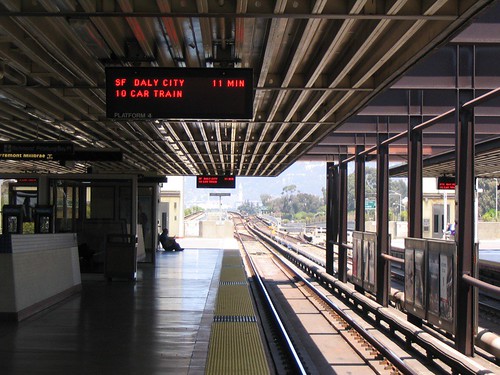
shit, I missed my train


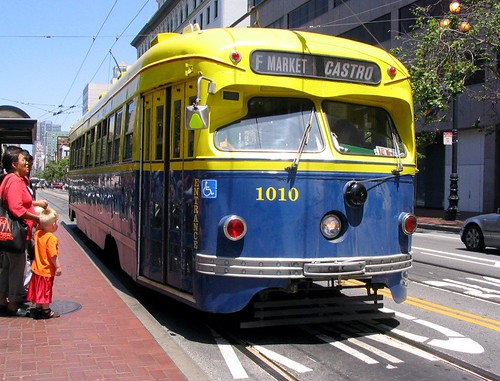
Damn. Missed my train. Yet, in less time than it takes me to answer my emails, I made it to San Francisco. Near, and yet far from my provincial home in Oak Land. First attraction in SF, the F line.


f line


It's designed for the enjoyment of history nerds like me! And of course to attract tourist dollars. But so what! It's so shiney!


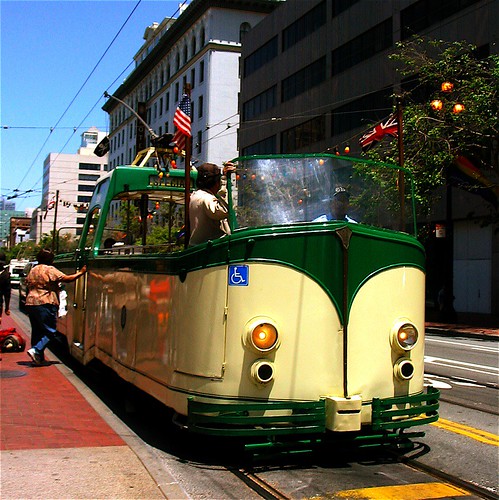
f line boat!


Woo-hoo! Boat train!

OK, time to go to the library. Every time I come to the San Francisco Main branch I play "Where are the books?"


boring library


Nope, not here:


yet more


Not here either.


library 1


None here either. Oh well, who has time for books anyway - time is limited when you've got to think about childcare. I quickly move on to the hallowed grounds of the SF History Center! Here, you must check your bags, sign in at the front desk, and walk silently among the softly-lit shelves.


in the history center


It's best to speak in hushed tones around the historians - they scare easily. And frankly, I was kind of sweaty and incoherent when I arrived. I cornered a soft-spoken librarian and described my blog project to him in detail. When I was finished he nodded helpfully and then said, "It would be easier if you put your request in the form of a question."

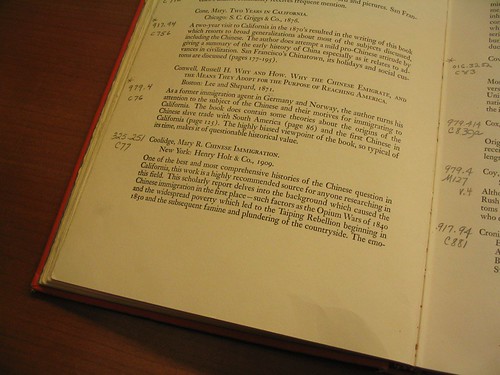
He was able to assist me though by piling a large stack of bibliographies in front of me. Since I've never done academic research of any kind, I'm not sure if that's the best place to start, but at least I now know what to look up when I go back.


biblio


I really hit pay dirt with this bibliography about Chinese American's in California. I love picturing the poor soul (or enthusiastic obsessive compulsive) who hand wrote the dewey decimal number for each entry into the margins.

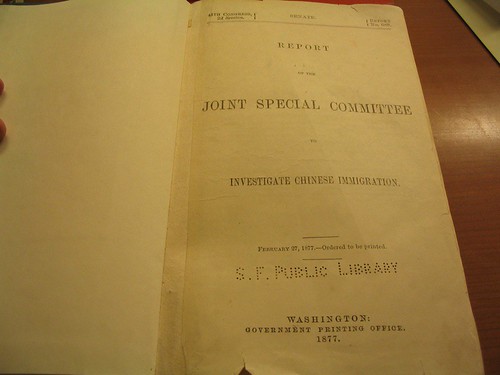
I spent most of the afternoon reading from this congressional report on Chinese Immigration – a nauseating foundation for the Chinese Exclusion Act of 1882.


joint special committee two


I found out later that the whole ugly thing is digitized. So if I can make it through hundreds of pages of the white men of business and congress falling over each other to present Chinese immigrants as gamblers, prostitutes, and disease vectors, I'll be able to complete it at my leisure.

Several hours later, my childcare was about to run out. I collected my backpack from the quiet librarian, and as I left, he mentioned that perhaps I should check the Chinese Center on the third floor. WTF?! I should have been there in the first place!

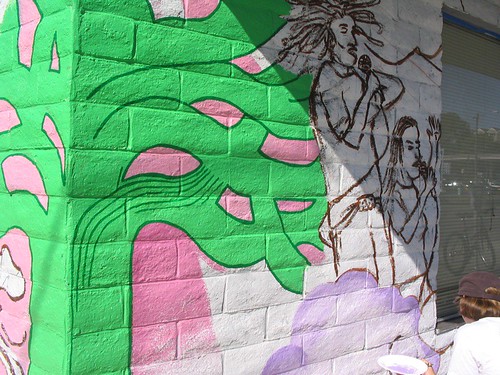
Still, I was in a good mood – a history junkie happily fixed – the whole way home. I even stopped to say hello to the folks painting a new mural on the Ella Baker Center. Good luck muralists! Way to represent for Oakland!


Ella Baker Center Mural
 
Creative Commons License
Some Rights Reserved.