Showing posts with label general strike. Show all posts
Showing posts with label general strike. Show all posts
1.01.2008
General Strike Heads Up
The Davis Radio Theater will be premiering a new radio play about the Oakland General Strike on KDVS tonight at six. You can stream it live from the KDVS site. Enjoy!


6.13.2007
South African strike
Speaking of general strikes, South African public sector workers are all out this week, with support from some private sector unions as well.
More at the Mail and Guardian and the BBC
More at the Mail and Guardian and the BBC
6.12.2007
Oakland General Strike Part II
Read Part I
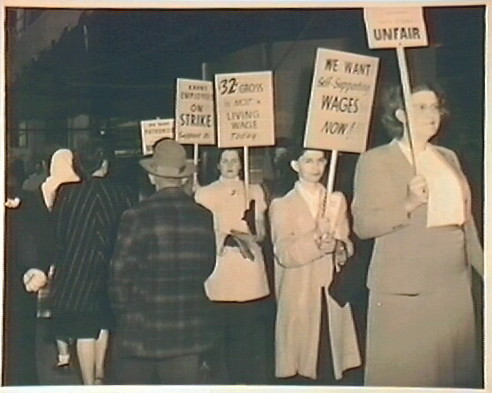
Striking department store clerks, photo from the Oakland Museum of California.
In the first few days of December 1946, retail workers at Hastings' and Kahn's department stores, across the street from each other where Broadway meets Telegraph, had been on strike for more than a month. Most of the workers were women. Their pay was shitty, less than $16 a week, and worse, they were subjected to an absurd procedure where they had to show up to work first thing in the morning, and then wait in the basement (unpaid), until they were called to the floor to work. A clerk could easily be stuck in the basement all morning, or even all day.
The Teamsters local had supported the retail workers strike from the beginning. They refused to deliver anything to the struck stores. (When I was at the Labor Archives, I even saw minutes from the Teamsters Local 70 meeting showing a member being expelled for trying to deliver to Kahn's in November.) The local NAACP and National Negro Congress publicly supported the striking workers. And union laborers had stopped painting and construction of a new elevator at Kahn's in solidarity.
On the business side, the Oakland Tribune, then run by republican powerhouse Joe Knowland, advocated a citywide ban of pickets. According to Albert Lannon's Fight or Be Slaves, right-wing city council members were publicly objecting to the use of the word 'scab'. Most detrimentally, the city agreed to send out the police force to escort delivery trucks to the stores, so they could keep stock for the Christmas shopping season.
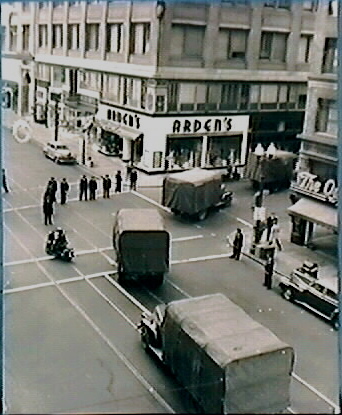
OPD escorting delivery trucks from the notoriously anti-union company G.I. Trucking. From the Oakland Museum of California.
That move was too much for the local labor council. The night of December 1st, a Saturday, Teamsters patrolled every roadway into Oakland to keep the delivery trucks away, and the labor council organized members to use their cars to block the parking spaces surrounding the effected stores. Several hundred picketers came out in the middle of the night to keep the scabs out.
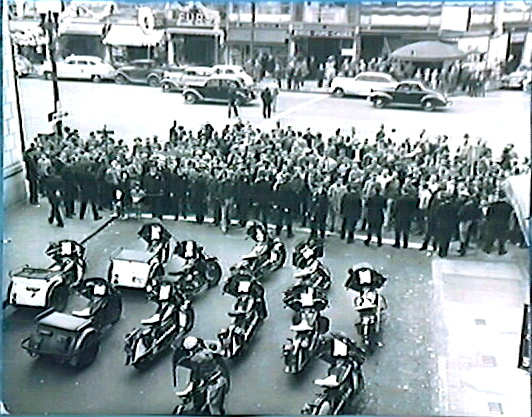
Cops block the street to keep strikers out. From the Oakland Museum of California
At 4 in the morning the cops started towing the strikers cars and blocking off sections of Broadway, Telegraph, and San Pablo. When they waved the streetcars through their police line at 6:30 Sunday morning, a driver told the cops that he'd never crossed a picket line, got out of the car and removed its control box, causing an immovable backup along the streetcar line. The general strike was on, although it was another day before the whole city was out.
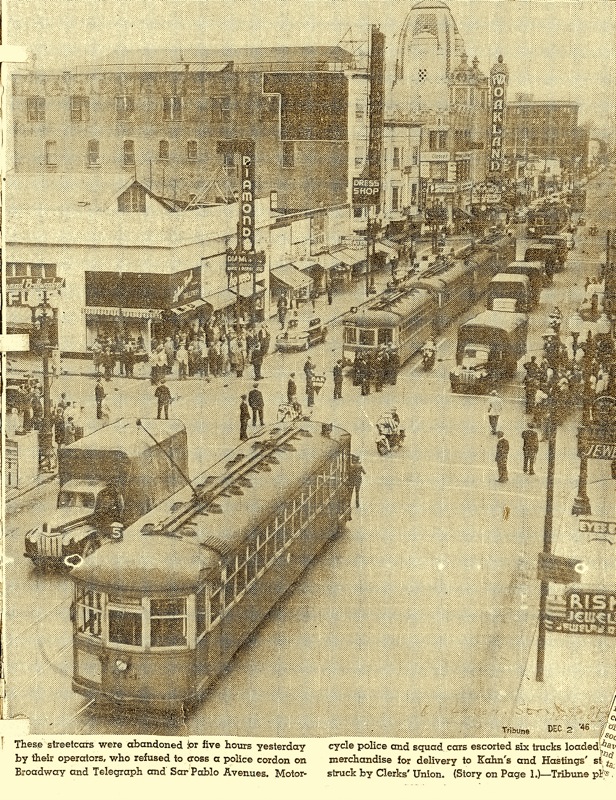
Tribune clipping from the Oakland History Room.
At a long and fevered meeting of various local AFL union leaders Sunday afternoon (the clerks were affiliated with the AFL), Teamsters pledged that because of the strikebreaking deliveries, they would shut down work in the East Bay starting Monday. Every other union but the milk truck drivers' agreed, and the milk truck drivers only insisted on working in order to get milk to local hospitals. Labor leaders went on the radio to declare Monday a 'work holiday' and to call everyone downtown, to the center of the strike, to show their support.
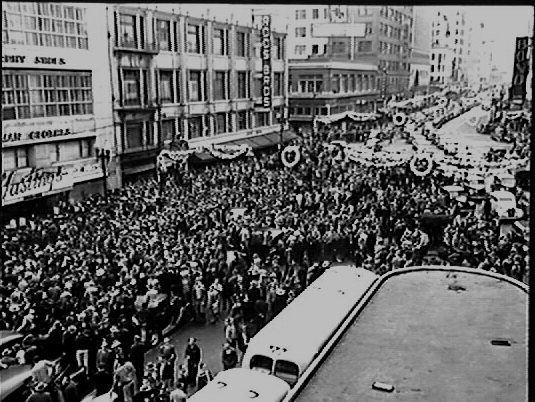
From the Oakland Museum of California.
At the peak, as many as 30,000 people were packed into the rainy downtown streets. The mood was excited to say the least. Bars were allowed to stay open, but they were only allowed to serve beer, and were told to turn their jukeboxes out to face the street, where people were literally dancing. All AFL building trades were shut down. All East Bay newspapers were shut down. Buses, streetcars, greyhounds, taxis, and trucking were stopped. Gas stations were closed too. Hotels, movie theaters, and larger restaurants and grocery stores were shut.
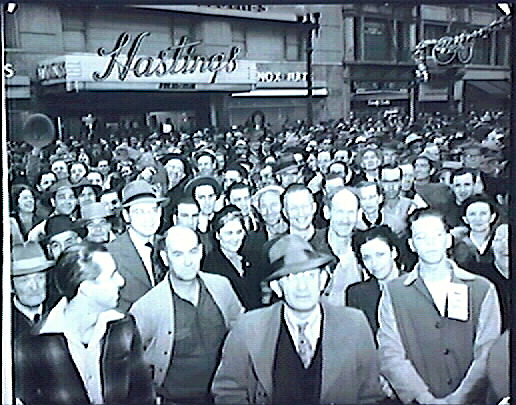
The picture's pretty blurry, but can you make out those huge grins? From the Oakland Museum again.
I've read conflicting stories on this, but from what I understand, the CIO, the second-largest umbrella union organization in Oakland, had offered their support the night before the strike. They were patently turned down. AFL leaders didn't want to be associated with the CIO whose on-the-ground organizers were largely communist. Robert Ash, the head of the labor council was quite progressive, but balked at working together, imagining headlines in the paper saying "Reds cause Anarchy Downtown" and so forth. Besides the communist associations, the AFL and CIO were rivals not comrades. Working directly with the CIO would have brought about ugly repercussions from national AFL leadership. The CIO honored picket lines anyway, and finally, on the third day of the strike, called for a general meeting to vote on whether to walk out themselves. A CIO walkout would have cut off gas and electricity to most of the city. At this suggestion, Oakland's city manager was ready to settle.
But the unions had lost the upper hand. The national vice president of the Teamsters, Dave Beck, told the local to withdraw from the general strike. He didn't support revolution, and apparently, the strike was developing that flavor. Rumors circulated that Governor Earl Warren was going to send in the National Guard, and the mayor had declared a state of emergency.
Instead of holding their ground, the union negotiated with Oakland's city manager only for an agreement that police would not be used to break strikes. There was no settlement for the department store clerks (who stayed on strike for eight more months, and then had to settle for a weak contract before they finally negotiated a better deal and a closed union shop in May of '47). There was certainly no attempt to make structural change in the city. Robert Ash from the Labor Council admitted later, in retrospect, that had they held out, they could have had more. Maybe they could have gotten the whole right-wing city leadership to resign.
But even that laudable goal suffers from a failure of imagination. Workers owned the city for those three days. They could have done anything. On the other hand, what can you do when you suddenly control your own world? When you have the power to rearrange everything, if only you can agree with tens of thousands of others who share that power? Who knew what to do with complete worker control of a city?
A year later that kind of question hardly mattered anyway. In 1947, congress passed the Taft-Hartley Act outlawing secondary boycotts (boycotts of union companies that do business with a struck company), removing government protection for wildcat (unofficial) strikers, and allowing the president to force workers back to their jobs if he feels that their strike "imperils the national health". The phenomenon of the General Strike came to an abrupt end.
In the aftermath, the Teamsters local withdrew from the central labor council (and not long after, the national Teamsters withdrew from the AFL). Voters elected a labor slate of candidates for the City Council in '47, but not enough to get a majority, and the winners didn't work very well as a team, and were voted out a few years later. Oakland changed dramatically after the war, demographics changed, the beginnings of civil right struggles emerged, but worker control was not on the agenda.
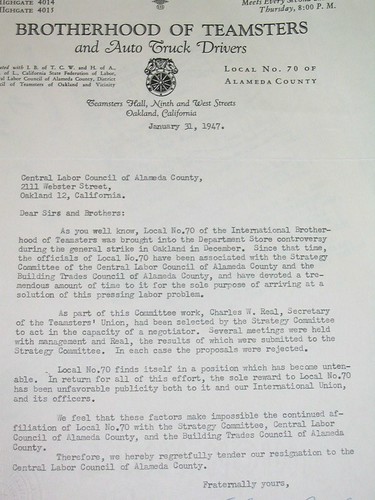
Found at the Oakland History Room.
If you're interested in the Oakland general strike, I'd recommend Chris Rhomberg's No There There. Online you can listen to a nice KPFA documentary on the strike that features interviews with participants and more on the historical context that led to the strike. Also, check out longshoreman and publisher Stan Weir's account of the strike at the very cool libcom.org or Dick Meister's summery on ZNet.
Striking department store clerks, photo from the Oakland Museum of California.
In the first few days of December 1946, retail workers at Hastings' and Kahn's department stores, across the street from each other where Broadway meets Telegraph, had been on strike for more than a month. Most of the workers were women. Their pay was shitty, less than $16 a week, and worse, they were subjected to an absurd procedure where they had to show up to work first thing in the morning, and then wait in the basement (unpaid), until they were called to the floor to work. A clerk could easily be stuck in the basement all morning, or even all day.
The Teamsters local had supported the retail workers strike from the beginning. They refused to deliver anything to the struck stores. (When I was at the Labor Archives, I even saw minutes from the Teamsters Local 70 meeting showing a member being expelled for trying to deliver to Kahn's in November.) The local NAACP and National Negro Congress publicly supported the striking workers. And union laborers had stopped painting and construction of a new elevator at Kahn's in solidarity.
On the business side, the Oakland Tribune, then run by republican powerhouse Joe Knowland, advocated a citywide ban of pickets. According to Albert Lannon's Fight or Be Slaves, right-wing city council members were publicly objecting to the use of the word 'scab'. Most detrimentally, the city agreed to send out the police force to escort delivery trucks to the stores, so they could keep stock for the Christmas shopping season.
OPD escorting delivery trucks from the notoriously anti-union company G.I. Trucking. From the Oakland Museum of California.
That move was too much for the local labor council. The night of December 1st, a Saturday, Teamsters patrolled every roadway into Oakland to keep the delivery trucks away, and the labor council organized members to use their cars to block the parking spaces surrounding the effected stores. Several hundred picketers came out in the middle of the night to keep the scabs out.
Cops block the street to keep strikers out. From the Oakland Museum of California
At 4 in the morning the cops started towing the strikers cars and blocking off sections of Broadway, Telegraph, and San Pablo. When they waved the streetcars through their police line at 6:30 Sunday morning, a driver told the cops that he'd never crossed a picket line, got out of the car and removed its control box, causing an immovable backup along the streetcar line. The general strike was on, although it was another day before the whole city was out.
Tribune clipping from the Oakland History Room.
At a long and fevered meeting of various local AFL union leaders Sunday afternoon (the clerks were affiliated with the AFL), Teamsters pledged that because of the strikebreaking deliveries, they would shut down work in the East Bay starting Monday. Every other union but the milk truck drivers' agreed, and the milk truck drivers only insisted on working in order to get milk to local hospitals. Labor leaders went on the radio to declare Monday a 'work holiday' and to call everyone downtown, to the center of the strike, to show their support.
From the Oakland Museum of California.
At the peak, as many as 30,000 people were packed into the rainy downtown streets. The mood was excited to say the least. Bars were allowed to stay open, but they were only allowed to serve beer, and were told to turn their jukeboxes out to face the street, where people were literally dancing. All AFL building trades were shut down. All East Bay newspapers were shut down. Buses, streetcars, greyhounds, taxis, and trucking were stopped. Gas stations were closed too. Hotels, movie theaters, and larger restaurants and grocery stores were shut.
The picture's pretty blurry, but can you make out those huge grins? From the Oakland Museum again.
I've read conflicting stories on this, but from what I understand, the CIO, the second-largest umbrella union organization in Oakland, had offered their support the night before the strike. They were patently turned down. AFL leaders didn't want to be associated with the CIO whose on-the-ground organizers were largely communist. Robert Ash, the head of the labor council was quite progressive, but balked at working together, imagining headlines in the paper saying "Reds cause Anarchy Downtown" and so forth. Besides the communist associations, the AFL and CIO were rivals not comrades. Working directly with the CIO would have brought about ugly repercussions from national AFL leadership. The CIO honored picket lines anyway, and finally, on the third day of the strike, called for a general meeting to vote on whether to walk out themselves. A CIO walkout would have cut off gas and electricity to most of the city. At this suggestion, Oakland's city manager was ready to settle.
But the unions had lost the upper hand. The national vice president of the Teamsters, Dave Beck, told the local to withdraw from the general strike. He didn't support revolution, and apparently, the strike was developing that flavor. Rumors circulated that Governor Earl Warren was going to send in the National Guard, and the mayor had declared a state of emergency.
Instead of holding their ground, the union negotiated with Oakland's city manager only for an agreement that police would not be used to break strikes. There was no settlement for the department store clerks (who stayed on strike for eight more months, and then had to settle for a weak contract before they finally negotiated a better deal and a closed union shop in May of '47). There was certainly no attempt to make structural change in the city. Robert Ash from the Labor Council admitted later, in retrospect, that had they held out, they could have had more. Maybe they could have gotten the whole right-wing city leadership to resign.
But even that laudable goal suffers from a failure of imagination. Workers owned the city for those three days. They could have done anything. On the other hand, what can you do when you suddenly control your own world? When you have the power to rearrange everything, if only you can agree with tens of thousands of others who share that power? Who knew what to do with complete worker control of a city?
A year later that kind of question hardly mattered anyway. In 1947, congress passed the Taft-Hartley Act outlawing secondary boycotts (boycotts of union companies that do business with a struck company), removing government protection for wildcat (unofficial) strikers, and allowing the president to force workers back to their jobs if he feels that their strike "imperils the national health". The phenomenon of the General Strike came to an abrupt end.
In the aftermath, the Teamsters local withdrew from the central labor council (and not long after, the national Teamsters withdrew from the AFL). Voters elected a labor slate of candidates for the City Council in '47, but not enough to get a majority, and the winners didn't work very well as a team, and were voted out a few years later. Oakland changed dramatically after the war, demographics changed, the beginnings of civil right struggles emerged, but worker control was not on the agenda.
Found at the Oakland History Room.
If you're interested in the Oakland general strike, I'd recommend Chris Rhomberg's No There There. Online you can listen to a nice KPFA documentary on the strike that features interviews with participants and more on the historical context that led to the strike. Also, check out longshoreman and publisher Stan Weir's account of the strike at the very cool libcom.org or Dick Meister's summery on ZNet.
6.07.2007
THIS IS A STRIKE support our CAUSE - The Oakland General Strike
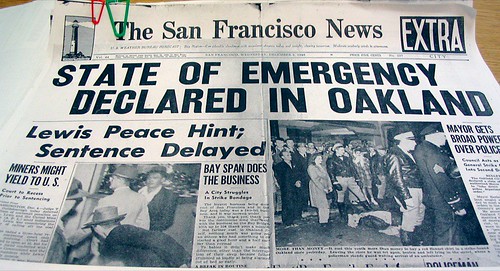
General Strike! The photo at right shows police milling around an injured shopper in front of a struck Oakland department store. Headline at left refers to a nationwide coal miners strike. This clipping is from the Labor Archives and Research Center at SFSU.
Someone with my politics (anarchist, idealist) tends to think of the general strike as a kind of labor-movement Excalibur, whose ass-kicking powers were so great that it could blind King Arthur's enemies simply by being drawn from its scabbard. (In this problematic analogy, King Arthur = The People.)
A general strike is the ultimate exercise of worker solidarity and worker power and basically, it happens like this: everyone (well, almost everyone), in every industry, stops working until their collective demands are met. One hopes that their demands go beyond asking for better pay or other simple benefits, and begin to address the big problems that go with a society where a few people own everything and do nothing, and others own nothing and do all the work.
And if that is your idea of the purpose and potential of general strikes, then it's clear that they haven't been very successful. Part of the problem though might be that there isn't always a clear purpose, even if there is a lot of potential. In the case of Oakland's 1946 general strike, we had an unbelievable potential power. I'm not so clear on the purpose.
I have so much to say about the Oakland strike, I'm going to split this into a few entries. Here's part 1, the context:
The Bay Area had gained half a million people between 1940 and 1945, when immigrants from around the country flooded in to find work in the war industries (mostly shipbuilding) centered here. The East Bay was so packed, there was nowhere to put everyone. I love the image in Marilyn S. Johnson's book The Second Gold Rush, a quote from an Oakland police captain saying in 1942, "Hundreds of men, women, and children [are] sleeping nightly on outdoor benches in public parks, in chairs in all night restaurants, in theatres, in halls of rooming houses, in automobiles, even in the City Hall corridors." Even with so many people, there were labor shortages. Between the shipyards and the businesses that supported them, there was an almost insatiable need for workers.
But a year after WWII ended, Oakland's economy had already started to wobble. Soldiers came back to a new and newly crowded Bay Area looking for jobs just as the war industries were beginning to contract. And the population boom and economic stressors weren't the only pressures. The need for labor had overruled some long standing social and political rules here and everywhere, most obviously, many more women, including for the first time middle class women, started working in factories and other industries. And Black immigrants to the Bay started to integrate the segregated neighborhoods and jobs here. Returning soldiers too had been transformed by their battlefield experiences. Maybe they expected to be able to make changes that hadn't seemed possible before.
Working conditions hadn't been great during the war, but most unions had signed patriotic No Strike pledges. After the war, business leaders and government officials found it impossible to stuff a broadening political agenda back into a box. In '46, a massive strike wave spread around the country (and internationally). The rail and coal mining industries were debilitated by strikes that year, and a number of cities held general strikes.
I found a newsreel that nicely captures the panic that industrialists felt about the rail strike at archive.org.
In this context, of a country and world that was changing by the second, where worker power seemed possible and real, and let's face it, where communists were all over the place, the idea of shutting down a city wasn't just a fantasy. At least, that's what I understand from what I've read.
Next time I'll post about the strike itself. I've got some links to original accounts and a nice documentary too. Stay tuned.
Subscribe to:
Posts (Atom)
