Scraper Bike from Da Trunk Boiz:
What does this have to do with history? Not much. But check out ghost ridin' the trike!
3.31.2008


3.26.2008
Suffled How It Gush: Old News Book Reviews
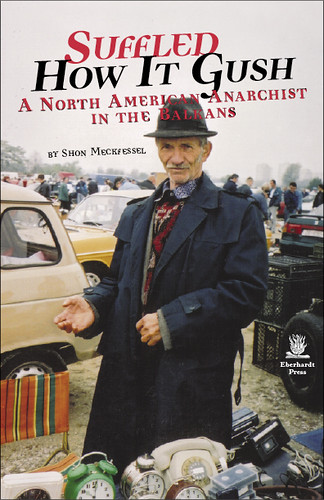
Shon Meckfessel's Suffled How it Gush tells the story of the Balkans from the perspective of Beckett-quoting street kids, hard-luck drunks, black-eyed fighters, squatters, singers, and protesters. It's part punk travelogue, part history lesson, part anarchist theory. Fortunately it's also very good, which is why I'm posting about it here despite its tenuous connection to Bay Area radical history.
Shon happens to have been my high school boyfriend. I hope he doesn't mind my saying that we had a very sweet if chaste relationship. I recall many happy drives in his old Jetta, his right hand holding mine across the emergency brake, his left hand crossing himself when he needed to change gears. While I'm revealing Shon's secrets I'll also mention that he was the first bass player for Cake. I seem to remember he did a stint trucking tomatoes around the Central Valley too. In any case, he has found himself in writing. Suffled How it Gush is poignant, often funny, never sentimental. Reading it made me feel smarter. I love how Shon quotes his favorite hardcore bands and Hannah Arendt within pages of each other. I loved following his drunken travels among the disaffected of post-Communist Eastern Europe, even as I was grateful not to be sharing a train car with him and his satchel of dirty laundry.
Shon gives Balkan history lessons without resorting to nostalgia and describes contemporary life there without choosing national or ethnic loyalties. His friends are Serbian, Croatian, Romani, Muslims, Jews, travelers from around the world who optimistically refer to themselves as 'penguins' – those who refuse to define themselves by the nations where they were born. I hope I'm getting this right when I say that Shon's thesis comes down to the idea that nationalism and neo-liberal economics, not supposedly deep-seated ethnic hatreds, are the causes of crises in Serbia, Croatia, Cyprus, etc. War is shown to be both immoral and absurd through his friends' matter-of-fact stories of survival and tenacity amid NATO bombings and genocidal ethnic purges. Despite the built-in cynicism required of any self-respecting punk boy abroad, Shon shows a certain cheerful optimism, happily reveling in the chaos of the Eastern European Third World and dreaming of a kinder, stateless world. If you can find it, I hope you'll read it.
3.18.2008
Stop the War
Holy cow have I ever gotten behind on blogging! Forgive me; I'm a single, working mom and I've been trying to get into nursing school, so unfortunately I can't always make enough time to post regularly, but I believe things have calmed down enough for me to get back in the saddle a bit. I'm putting the finishing touches on a post for next week. In the mean time, it’s the five year anniversary of this war in Iraq, and there's a big demo in the city tomorrow. (Direct action info here.)
Forty-one years ago 100,000 people marched from Second and Market to Kezar Stadium to protest the war in Vietnam. It took 8 years after that march, but we ended that war. Let's not have 8 more years of this one.
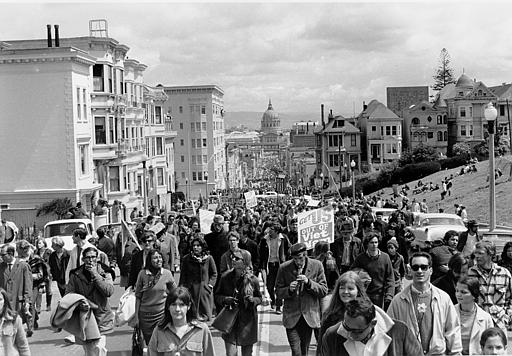
Forty-one years ago 100,000 people marched from Second and Market to Kezar Stadium to protest the war in Vietnam. It took 8 years after that march, but we ended that war. Let's not have 8 more years of this one.
3.01.2008
History Carnival
A blog carnival is a collection of blog posts on a given subject. This month's history blog carnival is up and full of interesting links worth clicking.
2.29.2008
Educate to Liberate
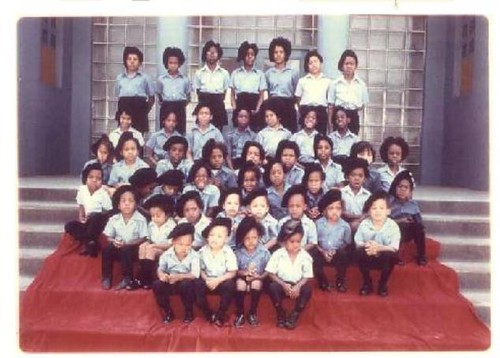
I finally got down to the Oakland History Room to check out Billy X. Jennings' exhibit on the Black Panther Party children's schools. You'll never see more adorable pictures of revolutionary education.
There are a few photos downstairs and more upstairs in front of the elevator and inside the Oakland History Room. I was especially into the shots of the kids doing Karate.
2.27.2008
RIP William Buckley
Old-school conservative windbag William Buckley Jr. died today. Bankrolled by the ill-gotten wealth of his oil-speculator daddy, Bill Jr. can be remembered for his bold pro-segregation stance and his innovative ideas on public health (he stated in a New York Times OpEd that, “Everyone detected with AIDS should be tattooed in the upper forearm to prevent common needle users, and on the buttocks, to prevent the victimization of homosexuals"). Let's look back at Buckley's glory days as he gets his rhetorical butt kicked by a youthful Noam Chomsky:
2.23.2008
Books for Kids
I try not to be too heavy-handed about politics with my kids but I do hope they will get some basics about how we are where we are. Here are two "messagy" books I've been reading to them lately:
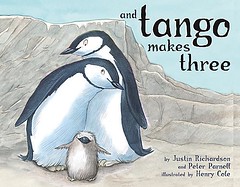
And Tango Makes Three by Justin Richardson and Peter Parnell and illustrated by Henry Cole is the sweetest little bit of gay propaganda you could possibly read to your children. It's the true story of two male penguins in the Central Park Zoo who entwined necks, vocalized together, had sex with each other (OK, that part's not in the kids book), and were finally given the opportunity to raise an adopted penguin chick. You have to be a truly homophobic grinch to remain untouched by what sweet dads the gay penguin pair made. And the story is not too preachy feeling - what kid doesn't want to hear about penguins?
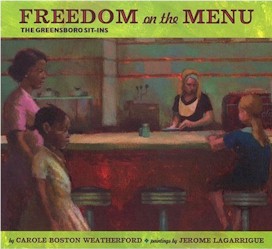
Freedom on the Menu by Carole Weatherford and illustrated by Jerome Lagarrigue tells the story of the 1960 Greensboro lunch counter sit-ins that led to the desegregation of Woolworths' and other restaurants throughout the South. I love how Freedom on the Menu emphasizes community action instead of just one or two key leaders. And even though it deals with the painful topic of segregation, it feels optimistic and hopeful about the power of collective action. The lunch counter sit-ins were started and led by college students and the book is told from a child's eye view which makes it easier for a five year old to connect with.
Bring on your suggestions for kids' books about activism and history folks!
And Tango Makes Three by Justin Richardson and Peter Parnell and illustrated by Henry Cole is the sweetest little bit of gay propaganda you could possibly read to your children. It's the true story of two male penguins in the Central Park Zoo who entwined necks, vocalized together, had sex with each other (OK, that part's not in the kids book), and were finally given the opportunity to raise an adopted penguin chick. You have to be a truly homophobic grinch to remain untouched by what sweet dads the gay penguin pair made. And the story is not too preachy feeling - what kid doesn't want to hear about penguins?
Freedom on the Menu by Carole Weatherford and illustrated by Jerome Lagarrigue tells the story of the 1960 Greensboro lunch counter sit-ins that led to the desegregation of Woolworths' and other restaurants throughout the South. I love how Freedom on the Menu emphasizes community action instead of just one or two key leaders. And even though it deals with the painful topic of segregation, it feels optimistic and hopeful about the power of collective action. The lunch counter sit-ins were started and led by college students and the book is told from a child's eye view which makes it easier for a five year old to connect with.
Bring on your suggestions for kids' books about activism and history folks!
2.12.2008
Oakland Memorials
This project ended with the close of the year but it's worth checking into: blogger nic b. documented the site of every homicide in Oakland in 2007 on his site Oakland Makeshift Memorials. Especially heartbreaking are the comments left by loved ones of the deceased.
2.06.2008
Happy New Year!
East Oakland is snapping with fireworks and standing on my back porch I can smell the sharp warm smoke that's everywhere in this little town tonight.
It's the Year of the Rat folks! Happy New Year!
It's the Year of the Rat folks! Happy New Year!
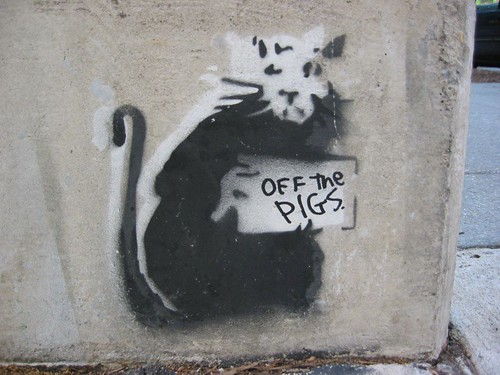
Milk
In case you, like me, fail to keep up with Hollywood, I'll fill you in that Milk, a biopic about this country's first openly gay politician, has been shooting in the Castro this week. Unfortunately, I snoozed on my opportunity to serve as an extra in the movie but because I'm a sour grapes type, I'll go ahead and say that I have a hard time picturing Sean Penn as the charming and sexy, Jewish and gay Harvey Milk. Castro Shopper has good photos of the current Castro 70s Makeover, but if you want to get to know Harvey, I suggest tracking down the moving documentary The Times of Harvey Milk. Here's an excerpt:
2.02.2008
More Carolina Chocolate Drops
A couple weeks ago I posted some videos from the adorably old-timey Carolina Chocolate Drops. Today blogger Undercover Black Man posted about them including a link to their cover of Hit 'Em Up Style.
And speaking of Undercover Black Man aka: David Mills, writer from some of TVs most favorites including The Wire, he's promised to do a bunch of Black History Month posts and if you're interested in good writing and history I suggest checking him out. He's never shy about addressing controversy, as his inaugural Black History Month post demonstrates.
And speaking of Undercover Black Man aka: David Mills, writer from some of TVs most favorites including The Wire, he's promised to do a bunch of Black History Month posts and if you're interested in good writing and history I suggest checking him out. He's never shy about addressing controversy, as his inaugural Black History Month post demonstrates.
2.01.2008
Friday Night Videos
I said I was going to start posting videos on Fridays, and then I kinda bailed, but now I'm back with the classic/ultimate in Bay Area Radical Music. In fact, they've been around long enough now that they're kinda historical too. Ladies, gentlemen, and none-of-the-above: The Coup!
Giant Burger represent!
Oakland, California 94610
Smash up the place
(I picked old ones for the history angle folks)
Giant Burger represent!
Oakland, California 94610
Smash up the place
(I picked old ones for the history angle folks)
1.30.2008
the Library of Congress on Flickr
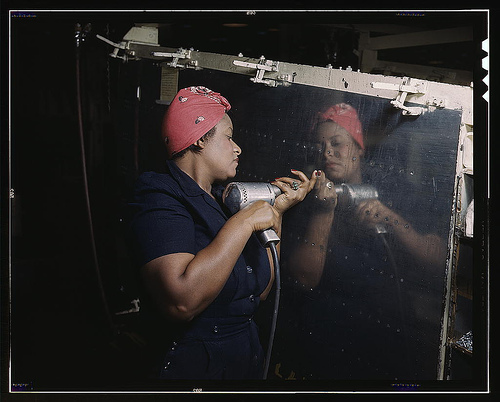
Operating a hand drill at Vultee-Nashville, woman is working on a "Vengeance" dive bomber, Alfred Palmer, photographer, 1943
In fun Flickr news, the Library of Congress has a new Flickr page where they'll be posting some of their enormous catalog of public domain photos. Well worth a visit.
1.25.2008
Point Pinole
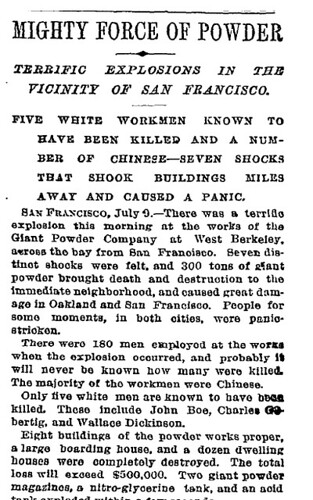
The typically racist New York Times
In July of 1892, an enormous explosion in what was then West Berkeley rocked so hard that windows across the bay on Nob Hill crashed to the ground. An unknown number of people died and many more were injured. The blast wasn't the first to destroy a factory of the Giant Powder Company – the first company licensed to use Alfred Nobel's recipe for dynamite. They'd already blown themselves out of locations in Oakland and San Francisco. After this explosion they relocated to the most distant Bay Area spot they could find – Point Pinole in what is now Richmond, but what they then dubbed Giant, California – a company town now totally disappeared.
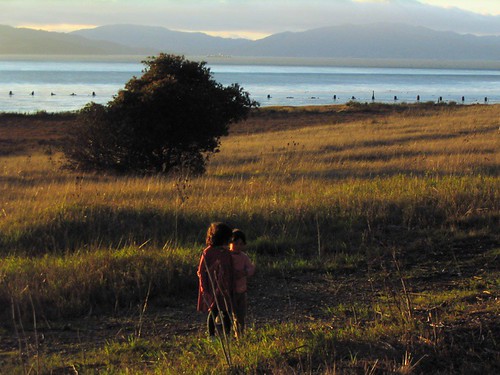
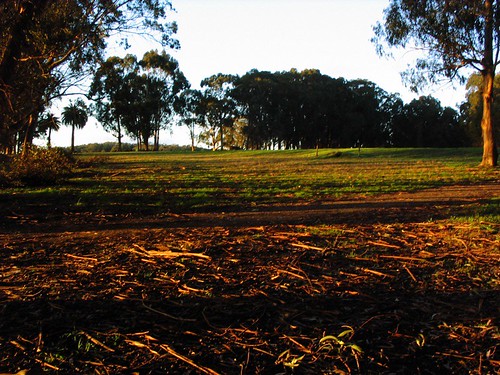
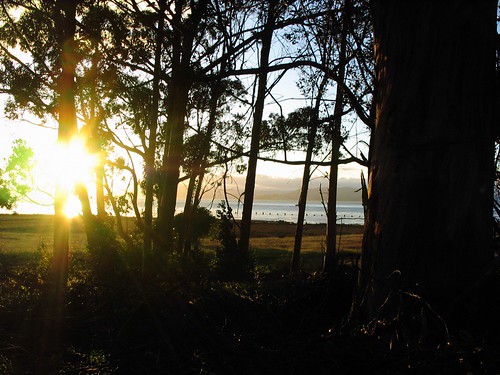
There's a lot to say about this bit of history: about how Nobel tried to tame his own guilt for inventing Dynamite by establishing the Nobel Prizes in his will (and what a joke those prizes have become ever since one went to Henry Kissinger); about the life-threatening work of running a dynamite factory, and the mostly Chinese workforce, hired by white bosses who knew they could exploit local xenophobia and pay Chinese workers less to do one of the most dangerous jobs possible; about the sulfur mining in the Oakland hills that supplied the dynamite factories and that left a superfund site that still drains sulfuric acid downhill into a pretty little pond at Mills College. But instead of all that, I'm posting to say that Point Pinole is an absolutely lovely spot for a hike. Almost all the trails are flat and much is wheelchair accessible, the fishing is, apparently, not bad, and if you don't mind walking around directly on top of a major earthquake fault, the views are lovely.
There's not much left of the explosives factories. Apparently the old narrow gauge railway that moved explosives around the premises was purchased for use at Disneyland. Most of the buildings were destroyed. Bethlehem Steel bought the land to build a steel plant, but nothing came of it and finally the East Bay Regional Parks acquired the land in the early '70s. It's a lovely place to take a walk, whether you care to nerd-out about history or not. Point Pinole, here's a little of what it looks like:
1.21.2008
Martin Luther King Jr.
...A true revolution of values will lay hand on the world order and say of war, This way of settling differences is not just. This business of burning human beings with napalm, of filling our nation's homes with orphans and widows, of injecting poisonous drugs of hate into the veins of peoples normally humane, of sending men home from dark and bloody battlefields physically handicapped and psychologically deranged, cannot be reconciled with wisdom, justice, and love. A nation that continues year after year to spend more money on military defense than on programs of social uplift is approaching spiritual death...
Full text and audio of Martin Luther King Jr.'s speech, Beyond Vietnam, is available here.
1.15.2008
Driven Out
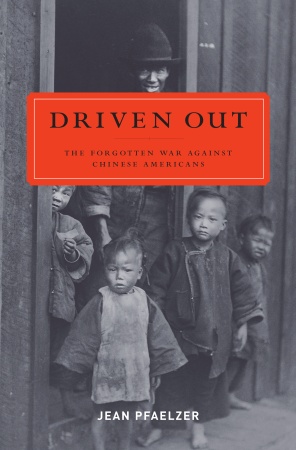
Since I started tracking visits to this site I’ve noticed one post gets more visits than any other. I wanted to pass on a related resource for folks who came here to read about the violence that Chinese-Americans faced in the Western United States throughout the 19th and early 20th centuries.
Driven Out is the deepest, most thorough examination of that shameful piece of history that I’ve found. I’ll display a rare moment of agreement with the New York Times in saying that the book contains an unfortunate lack of analysis and narrative that would have made it better reading, but I still recommend this to anyone looking for more on the issue. Pfaelzer's research is strong and she looks unflinchingly at what she rightly calls pogroms of Chinese-Americans, citing case after case after case of legal and extra-legal violence and expulsion of Chinese immigrants. Its difficult reading, but worthwhile for the sake of understanding a long-suppressed history.
1.11.2008
Friday Night Videos
I've been wanting to launch a Friday music feature here on Bay Rad and I guess I'm finally getting around to it. Mostly I'll be posting explicitly political music and activist soundtracks but I couldn't resist the adorable and historical Carolina Chocolate Drops for an opening act. I chose the first video because it starts with a history lesson:
1.08.2008
Cliopatra Awards
Forget the Oscars, the Emmys and the Darwin Awards. The real news is finally in: here are this year's winners of the history blogging awards! Oddly, they don't have a category for screeds by crotchety leftists, otherwise I would have been a shoe-in.
1.07.2008
Bay Area Directory of COLLECTIVES
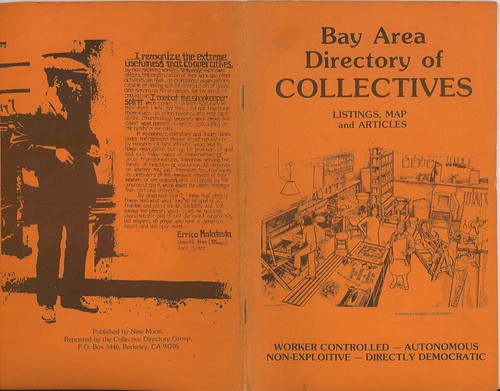
My dad just dug this handy guide to Bay Area collectives out of some long-buried filing cabinet. It looks to have been printed in 1980. I note with some amusement and some sadness that several pages of the booklet are taken up by a critique and rebuttal of itself. For some obsessive-compulsive reason I decided to scan the whole thing, so if you'd like to find out where you could have purchased collectively produced bagels in 1980, or if you want to know where Lilith, A Woman's Theater was located, feel free to click here for the full set of scans.
(Look, they've got it at Bolerium for $15 bucks!)
1.02.2008
Freedom of Information Act
Unbelievably, Bush just signed a bill that will reform the Freedom of Information Act (FOIA) to reduce some of the bureaucracy that comes with requesting government records and to create accountability for delays in processing those requests. These reforms should allow the public and the media better access to government records, although they won't require any more actual openness on the government's part. In other words, if the FBI crossed out large portions of your grandmother the communist labor organizer's record before sending you a copy, they can still do that. Bummer.
Still, there's no better time than now to request your FBI file, or if your life hasn't been interesting enough, get your grandpa's.
Still, there's no better time than now to request your FBI file, or if your life hasn't been interesting enough, get your grandpa's.
1.01.2008
General Strike Heads Up
The Davis Radio Theater will be premiering a new radio play about the Oakland General Strike on KDVS tonight at six. You can stream it live from the KDVS site. Enjoy!
12.31.2007
The Murder of Fred Hampton
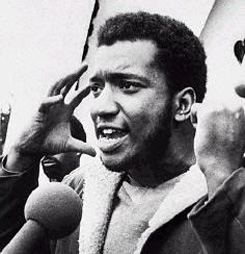
Thanks to Axis of Evel Knievel I found the classic documentary about the life and death of Chicago Black Panther Fred Hampton online. Everyone says that Fred was special. He'd get up at dawn to rally his recruits, then go off to cook in the free breakfast program, and spend his days on other programs, meetings and coalition work. Its no secret that there were guns in his house when he died, but there's also no longer any controversy that he was murdered in his sleep by a dozen Chicago cops. He was 21.
The film came out before certain details of the case were understood. For example, his close comrade William O'Neil who was with him the night before he was killed turns out to have been an FBI informant. Still, the movie is well worth watching. Here's the link.
12.30.2007
Primary sources, baby!
I've been digging a new collection on the Library of Congress' American Memory site about early California history.
It only includes works in English which excludes material from the Spanish speakers who had been running the place when it was a colony of Spain and then later when it was the most Northern province of Mexico. Also missing are voices from members of California's 70+ native tribes which used spoken but not written languages, and from the thousands of international gold seekers who came from China and Chile, and from all over the rest of the world, leaving an emphasis on adventuring Anglo-American men. As limited as adventuring Anglo-American men can be, I like the first-person accounts of California history. Here's a passage from San Francisco bartender John H. Brown, recalling the Anglo-American seizure of California from Mexico. At that time, those "rising up" were attempting to found an independent Republic of California until the Navy sailed into Monterey Bay and occupied California in the name of the United States, quickly quashing that idea. Note that the then-sleepy pre-Gold Rush city of San Francisco was still called Yerba Buena at the time:
It only includes works in English which excludes material from the Spanish speakers who had been running the place when it was a colony of Spain and then later when it was the most Northern province of Mexico. Also missing are voices from members of California's 70+ native tribes which used spoken but not written languages, and from the thousands of international gold seekers who came from China and Chile, and from all over the rest of the world, leaving an emphasis on adventuring Anglo-American men. As limited as adventuring Anglo-American men can be, I like the first-person accounts of California history. Here's a passage from San Francisco bartender John H. Brown, recalling the Anglo-American seizure of California from Mexico. At that time, those "rising up" were attempting to found an independent Republic of California until the Navy sailed into Monterey Bay and occupied California in the name of the United States, quickly quashing that idea. Note that the then-sleepy pre-Gold Rush city of San Francisco was still called Yerba Buena at the time:
Things went on as usual in the city until the latter part of May, when a report reached the city, that trouble was expected. A party at Sutter's Fort were raising a company to take possession of the upper part of California. In the early part of June, a boat arrived from Martinez, with the news that Sonoma was taken, and a proclamation, with Mr. Hyde's signature, was posted in a prominent place which announced that General Vallejo and Timothy Murphy, of San Rafael, with many others, were taken prisoners... A few days after, General Castro issued a proclamation, commanding all Mexican citizens to meet him at Santa Clara for orders. The only foreigners who left the city for Santa Clara, were Captain William Hinckley and Robert T. Ridley. They were ordered to stop all boats and prevent all persons from landing in Yerba Buena. On their return home, Hinckley was taken sick and died, on Burnell's Ranch, and was buried in the church at Mission Dolores.
Robert T. Ridley returned to the city to carry out the orders of General Castro, but could not find anyone to assist him, as there was not one Mexican citizen to be found in Yerba Buena, and the few foreigners who were here, were in favor of the ''Bear Flag,'' as it was called. This flag was made at Sutter's Fort, of bunting, and had the picture of a grizzly bear painted in the center, as the parties making the flag had no paint on hand, they used some blackberry juice, which answered the purpose very well. (The flag can still be seen at the Pioneer's Hall, in San Francisco). But they did not take up arms until the American Flag was raised.
12.28.2007
Community Clinics
Over the last few days I've learned some exciting new facts about scabies. Shall I share?

The Scabies Mite: as ugly as it is unpleasant
1) The first and most exciting fact I've learned about scabies is that I DO NOT HAVE IT. It took two visits to my friend the PA who works in an STD clinic, a phone call to the craigslist date who could have given it to me, and finally, my own admission that I don't actually have scabies symptoms to convince me, but I'm now sure that I do not have a communicable disease, at least not one involving tiny mites that cause uncontrolled itching by shitting underneath the skin.
2) If I did have scabies, or any other disease for that matter, I would be 100% reliant on my saint-like friend the PA who works in an STD clinic to care for me because actually, as it turns out, having no health insurance and living in the East Bay = having almost no medical care at all. I called three or four local low-income clinics and they all told me that they only do intake for new patients ONCE A MONTH. So in other words, keep scratching for a couple weeks until we can see you. The exception is the Berkeley Free Clinic, but their hours are limited as is the range of care available there.
3) Even if they take forever to see you, the folks who run the Bay Area's community clinics still rock. I spent 15 or 20 minutes on the phone with a nice gentleman at the Free Clinic who failed to scream and hang up when I said I thought I had a social disease and then shared his recommendation for best East Bay community health clinic (LifeLong Medical Care). The person answering the phone at Lyon-Martin was also patient and kind even as she was telling me that their next appointment for new patients wasn't until January 18th.
I'm a former radical health care provider and I've got a very big and very special spot in my heart for community health care of all types. The Bay Area is home to a number of community clinics that grew out of a part of late-60s history where folks believed that health care was a basic human right and also that people could and should control their own care. If I ever get my shit together to write a book about Bay Area history, it'll be about the history of the Bay Area community health movement, but its going to take a lot of research because I don't know much beyond the skeleton. I can tell you about a few of the local community clinics though.
La Clinica de la Raza was founded in 1971 by Chicano students and doctors and community folks to provide community-based care in the Fruitvale neighborhood of Oakland. Now that La Clinica is one of the largest non-profits in the East Bay, it doesn't quite have the homemade community feel that started things off. On the other hand, they now provide health care for thousands of uninsured folks from South East Asia, all over Latin America, and all over East Oakland. Similarly, the Native American Health Center started in '72 when Indian activists and allies, post-Alcatraz occupation, called for a self-directed clinic for Native folks.
The way I heard the story of the Berkeley Free Clinic was that it was founded during the People's Park Riot by medic veterans of the Vietnam War. I can't recall the details of that story so I'll have to go with the vague history they have up on their site.
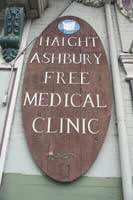
The BFC is especially close to my radical health care heart because they primarily use lay medical workers – non-professionals who undergo a rigorous in-house training program. A trip to the BFC often involves a discussion with the staff medic in front of an open medical textbook, with both of you trying to figure out what's bugging you.
The Haight Ashbury Free Clinic is the most famous of our clinics. As I understand it, they were among the first medical clinics to treat drug addicts like human beings, and they still specialize in treating addiction and caring for addicts. I liked this free-association piece about their history from David Smith, the clinic founder.
Thanks clinics. I'm going to celebrate my lack of scabies by signing up to become a patient somewheres.
The Scabies Mite: as ugly as it is unpleasant
1) The first and most exciting fact I've learned about scabies is that I DO NOT HAVE IT. It took two visits to my friend the PA who works in an STD clinic, a phone call to the craigslist date who could have given it to me, and finally, my own admission that I don't actually have scabies symptoms to convince me, but I'm now sure that I do not have a communicable disease, at least not one involving tiny mites that cause uncontrolled itching by shitting underneath the skin.
2) If I did have scabies, or any other disease for that matter, I would be 100% reliant on my saint-like friend the PA who works in an STD clinic to care for me because actually, as it turns out, having no health insurance and living in the East Bay = having almost no medical care at all. I called three or four local low-income clinics and they all told me that they only do intake for new patients ONCE A MONTH. So in other words, keep scratching for a couple weeks until we can see you. The exception is the Berkeley Free Clinic, but their hours are limited as is the range of care available there.
3) Even if they take forever to see you, the folks who run the Bay Area's community clinics still rock. I spent 15 or 20 minutes on the phone with a nice gentleman at the Free Clinic who failed to scream and hang up when I said I thought I had a social disease and then shared his recommendation for best East Bay community health clinic (LifeLong Medical Care). The person answering the phone at Lyon-Martin was also patient and kind even as she was telling me that their next appointment for new patients wasn't until January 18th.
I'm a former radical health care provider and I've got a very big and very special spot in my heart for community health care of all types. The Bay Area is home to a number of community clinics that grew out of a part of late-60s history where folks believed that health care was a basic human right and also that people could and should control their own care. If I ever get my shit together to write a book about Bay Area history, it'll be about the history of the Bay Area community health movement, but its going to take a lot of research because I don't know much beyond the skeleton. I can tell you about a few of the local community clinics though.
La Clinica de la Raza was founded in 1971 by Chicano students and doctors and community folks to provide community-based care in the Fruitvale neighborhood of Oakland. Now that La Clinica is one of the largest non-profits in the East Bay, it doesn't quite have the homemade community feel that started things off. On the other hand, they now provide health care for thousands of uninsured folks from South East Asia, all over Latin America, and all over East Oakland. Similarly, the Native American Health Center started in '72 when Indian activists and allies, post-Alcatraz occupation, called for a self-directed clinic for Native folks.
The way I heard the story of the Berkeley Free Clinic was that it was founded during the People's Park Riot by medic veterans of the Vietnam War. I can't recall the details of that story so I'll have to go with the vague history they have up on their site.
The BFC is especially close to my radical health care heart because they primarily use lay medical workers – non-professionals who undergo a rigorous in-house training program. A trip to the BFC often involves a discussion with the staff medic in front of an open medical textbook, with both of you trying to figure out what's bugging you.
The Haight Ashbury Free Clinic is the most famous of our clinics. As I understand it, they were among the first medical clinics to treat drug addicts like human beings, and they still specialize in treating addiction and caring for addicts. I liked this free-association piece about their history from David Smith, the clinic founder.
Thanks clinics. I'm going to celebrate my lack of scabies by signing up to become a patient somewheres.
12.25.2007
Lost Amusement
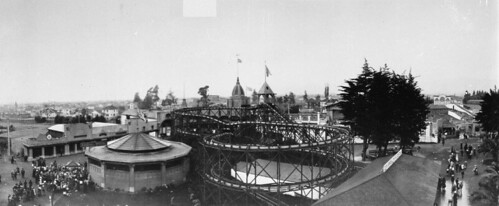
Idora Park in Oakland, 1910 (?). From the Oakland History Room, Oakland Public Library.
Finals are over (thank the maker) and apparently, some guy named Jesus was born today. Seems like the right time to talk about boozing, gambling, and flipping upside-down on roller coasters. Here goes: Before TiVo, iPods, or Guitar Hero, when folks had to leave the house for a little something exciting, the Bay Area was peppered with amusement parks. The parks incorporated natural beauty along with human-made entertaiments like junk food, race-tracks and shooting ranges.
Playland at the Beach is the most well known of our lost parks. It started as a disorganized collection of concessions and rides at Ocean Beach in the late 1800s and only shut down in the early 1970s. At one point it spanned three city blocks and included roller coasters, merry-go-rounds, five restaurants, and eventually the Sutro Baths and the Cliff House restaurant which to this day traps tourists before they fall off the edge of San Francisco and onto Seal Rock in the Pacific. Outsidelands.org collects photos and stories of Playland and wikipedia has a pretty thorough entry including descriptions of the various rides nausea inducing rides like the Aeroplane Swing, the Whip, and Dodg-em.
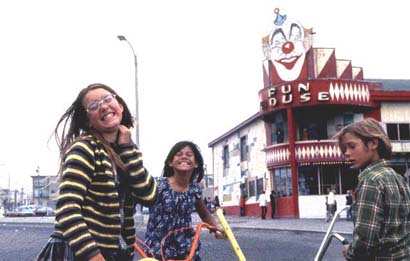
Chelle and Noelle Beloy in front of the Fun House at Playland at the Beach.
Copyright Dennis O'Rorke, early 1970s from outsidelands.org.
From 1904 until 1929, Idora Park in the present day Oakland neighborhood of Temescal was home to a miniature railway, a car race track, the Illusion Theater, a successful opera house, and a skating rink that billed itself as the largest in the world. The park also housed a number of caged animal displays and served as a temporary home of the Oakland Oaks baseball team. This postcard set provides some images of that disappeared park.
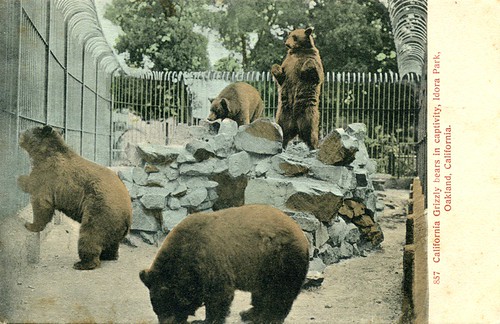
Shellmound Park in Emeryville lasted from 1876 to 1924. It was built, morbidly, on the lopped off top of the Bay Area's largest indigenous Shellmound. The best online resource about the park is this PDF from the Emeryville Historical Society. You can read there about the pleasant picnic grounds, the shooting range, bowling alley, bicycle and horse racing and two dance pavilions that were part of this destination for San Franciscans who wanted panoramic Bay views and a getaway from city hustle. The picnic grounds in particular were utilized by all types of local civic groups, ranging from the Household of Ruth, a Black women's chapter of the Odd Fellows, to the notoriously racist Workingmen's Party. Local anti-gambling ordinances and the new national alcohol prohibition killed Shellmound Park. There's no point in picnics and horse races without booze, apparently.
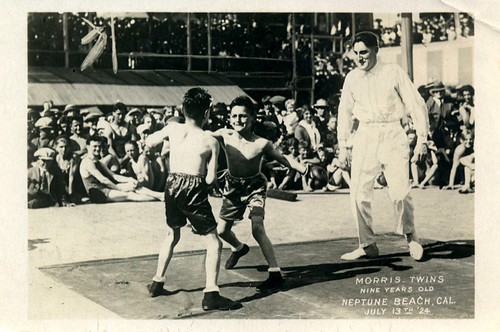
Neptune Beach didn't open until 1917, late compared to other Bay Area parks, and it lasted until 1939 when the depression and increasing car use spurred in part by the recently completed San Francisco Bay Bridge made Alameda a less appealing destination for Bay Area funseekers. While it lasted it contained a giant swimming area, prime beach land, snacks, concessions, and a roller coaster that offered views across the Bay to San Francisco.
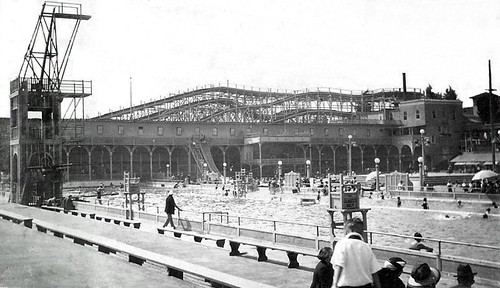
Amusement parks were popular around the country in the early 20th century. Most started as Trolley Parks, created by the streetcar companies as a destination for trolley lines. The parks were often built at beaches or, as in Idora Park, at locations that otherwise showed off nature's lovelier features. The natural features were eventually obscured by the gaudy rides that were installed later. The parks patterned themselves after each other and tended to rip off rides and even their names from larger or more successful parks elsewhere in the country. You might recognize the name "Playland" for example from the more famous Long Island park of the same name. Like the streetcar companies that built these places, the parks themselves were killed by the rise of car culture – not to mention the Great Depression and then television. Although as in the case of Playland, there were some late holdouts. Amusement Park fans are quite loyal. Besides lovingly maintained memorial websites to the various amusement parks, the Neptune Beach Amusement Museum is trying to build a physical space in the old location of Neptune Beach.

(Thanks so much to peacay at the beautiful bibliodyssey for giving me the Cliff House link that started me on this post.)
12.16.2007
Borax
Hi Folks!
I'm still here, just severely weakened by a massive pile of biology homework until Wednesday. I might as well shout out the New Earth Artists Cafe where I'm finishing my microbiology papers and enjoying a Jill Scott (grits and eggs) and coffee and the view of basketball players and martial artists at the F.M. Smith rec center and playground. He was a classic robber baron and exploited Chinese workers in his Death Valley borax mines, but for those of us who live in The Town Frances Marion Smith is our robber baron, and we've got a corner of his once enormous estate as a cute little neighborhood park where I grew up playing and where my little Ru is playing with her Auntie today so I can get some work done. Speaking of which...
I'm still here, just severely weakened by a massive pile of biology homework until Wednesday. I might as well shout out the New Earth Artists Cafe where I'm finishing my microbiology papers and enjoying a Jill Scott (grits and eggs) and coffee and the view of basketball players and martial artists at the F.M. Smith rec center and playground. He was a classic robber baron and exploited Chinese workers in his Death Valley borax mines, but for those of us who live in The Town Frances Marion Smith is our robber baron, and we've got a corner of his once enormous estate as a cute little neighborhood park where I grew up playing and where my little Ru is playing with her Auntie today so I can get some work done. Speaking of which...
12.07.2007
Dogpatch
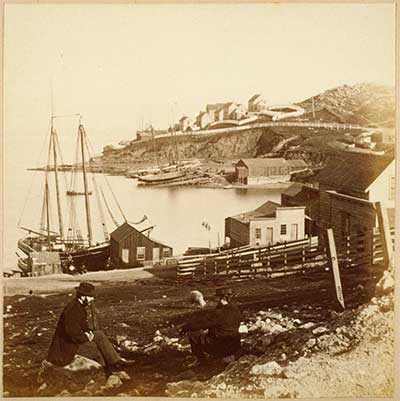
Illinois St. and 19th at the Eastern edge of Dogpatch.
An 1862 photo by Eadward Muybridge. From pier70sf.org
Hey, look at that: The Dogpatch has a website! Nice work. More cool stuff about Pier 70 elsewhere on the same site.
12.06.2007
Bearings Blog
I'm pretty much out of commission research-wise until my finals are over in two weeks. In the meantime, I'll keep up the links to sites that are a)Bay Area related, b)history related, c)activist related, and/or d)just really awesome.
Under the heading of Just Really Awesome and Bay Area History Related: Bearings A Geographers Blog. Bearings looks at our "built environment", often at the portions of that environment which have been abandoned in our ever forward moving rush towards wealth and progress. There's a strong emphasis on the West and on history, and there are lots of beautiful photos, both historical and contemporary. I was extra interested in a recent series of Bearings posts about sugar beet factories in Colorado because I watched Burn! last night, and now I want to learn everything I can about the changes and tragedies of the sugar industry.
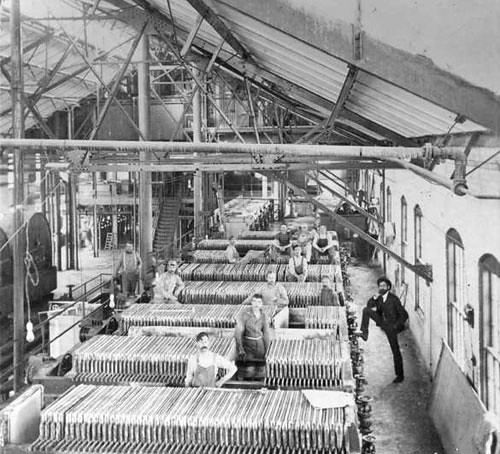
Filter presses to purify liquid beet sugar, from Bearings.
Bearings is the creation of author and photographer Jon Haeber. He's got a great Flickr page too (recently profiled on Boing Boing). Maybe if I'm very nice he'll be my new best friend.
Under the heading of Just Really Awesome and Bay Area History Related: Bearings A Geographers Blog. Bearings looks at our "built environment", often at the portions of that environment which have been abandoned in our ever forward moving rush towards wealth and progress. There's a strong emphasis on the West and on history, and there are lots of beautiful photos, both historical and contemporary. I was extra interested in a recent series of Bearings posts about sugar beet factories in Colorado because I watched Burn! last night, and now I want to learn everything I can about the changes and tragedies of the sugar industry.
Filter presses to purify liquid beet sugar, from Bearings.
Bearings is the creation of author and photographer Jon Haeber. He's got a great Flickr page too (recently profiled on Boing Boing). Maybe if I'm very nice he'll be my new best friend.
12.01.2007
Letters from a Concentration Camp
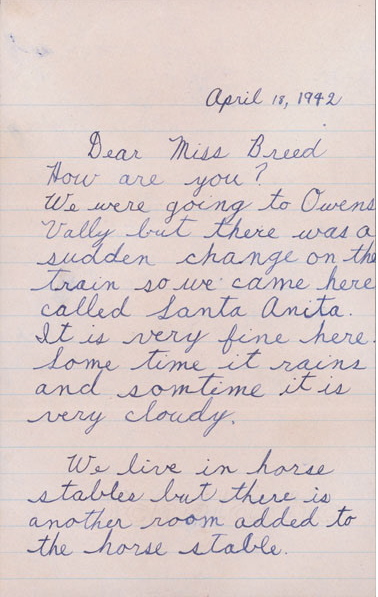
Clara Estelle Breed, a San Diego children's librarian, was outraged by the WWII era policy of internment for Japanese Americans. In response, she met Japanese American families as they were being sent away by train and distributed stamped and addressed postcards to the children, asking them to write to her and describe life in the camps. Her papers, including cards sent by interned adults and children are now collected at the Japanese American National Museum.
Thanks to amyms on metafilter for this find.
11.30.2007
Guerrilla Oil Spill Cleanup

The humble oyster mushroom.
I've been following the efforts of Bay Area guerrilla oil spill cleaner upers, mostly because I get regular updates from a friend who's been out there on the beaches picking the toxic stuff up with human hair mats and now as she and her comrades prepare to inoculate the oily mats with oyster mushroom spawn which will, apparently, break the oil down into harmless compost.
Today the project got covered in the Chron. It's worth noting that this work is not endorsed or assisted by the city, and especially not by the EPA. This is just regular folks with a little bit of knowledge and a lot of commitment, doing what needs to be done.
Makes me proud...
Subscribe to:
Posts (Atom)
