In case you haven't noticed, I've been on a bit of a hiatus which I expect will continue at least through the summer. I've gotten busy with some other projects and am - temporarily at least - signing off.
Love,
Bay Radical
6.13.2008


5.23.2008
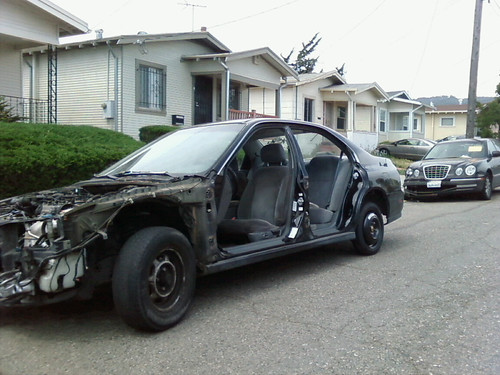
Stripped
My cute little street in the Allendale has recently become a popular dumping spot for stripped cars. I was impressed with the latest dump - someone took stripping to a new level. Note that the car parked behind this one is also a dumped, presumably stolen ride. If you recognize it, please come pick it up!
5.21.2008
5.19.2008
Thought Balloons Deployed for Good and Evil
On Broadway and Grand today, two billboards unintentionally echo each other:
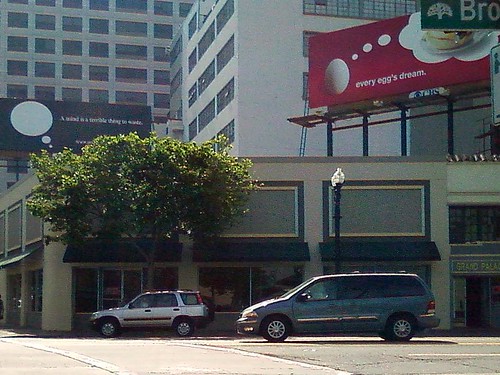
United Negro College Fund: A Mind is a Terrible Thing to Waste
vs. McDonalds: Eat This Garbage
United Negro College Fund: A Mind is a Terrible Thing to Waste
vs. McDonalds: Eat This Garbage
5.16.2008
Community History at the AAMLO
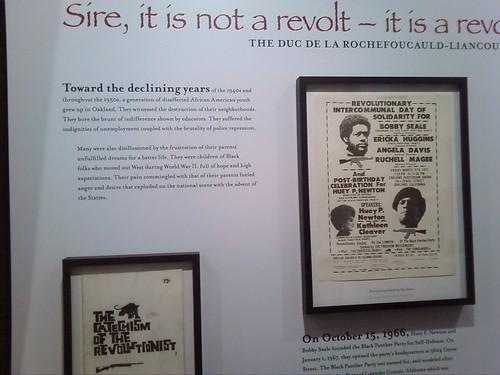
Recommended: The African American Museum and Library is hosting a lovely exhibit right now called The African American Community in Oakland. Photographs, ephemera, and video presentations of oral histories give a well-rounded picture of the history of Oakland's black neighborhoods and communities.
5.12.2008
Chagoya at the BAM
A friend and I took my five year old to the Enrique Chagoya exhibit at the Berkeley Art Museum. She was riveted by the gory reinterpretations of pop-culture imagery. So was I! The dude is a brilliant artist and social critic. Here’s the five year old interpretation:
The exhibit is running for a few more days in the main gallery space.
While you’re there, check out the photo exhibit of Paris 1968, running in their free, downstairs gallery until June 1st.
The exhibit is running for a few more days in the main gallery space.
While you’re there, check out the photo exhibit of Paris 1968, running in their free, downstairs gallery until June 1st.
5.01.2008
History Carnival
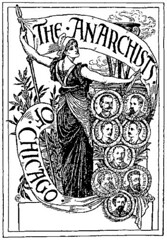
Since 1890, workers around the world have taken May 1st off for parading, celebrating, and demonstrating - first in support of the eight hour day, and still in support of fair conditions for working people. May 1st was chosen to commemorate the conviction of eight men accused of throwing a bomb at a May 1886 Chicago rally for the eight hour workday. (A reasonably good history of the affair can be found here.) This May Day if you're here in the San Francisco Bay Area, you're invited to celebrate with your fellow workers (and students) by joining the International Longshore Workers Union who are shutting down 29 West Coast ports in protest of the wars in Iraq and Afghanistan or by joining the immigrant rights marches and rallies happening in San Francisco, Oakland, San Jose, and elsewhere. If your boss won't give you the day off, call in sick! And when you get home from all those marches please take a look at the rest of this post:

I'm please to present this month's History Carnival. A blog carnival is a collection of posts aggregated into one and rotated periodically among various blogs. I'm hosting this month and you can check out the next one at Progressive Historians on June 1st.
I'm opening this carnival with the music history posts I've been feeling: Comb and Razor introduces guitarist and producer Jake Sollo, a major figure in 80s Nigerian pop music, crud crud gives a brief history of bootlegs, and Soul Detective seems to have closed the case of Six James Duncan.
Moving on, here are my overall favorite history posts this month:
Axis of Evel Knievel posts about the Civil War era bread riots, when a crowd of women armed with clubs, rocks and guns took to the streets of the Confederate capital and demanded “bread or blood".
Zenobia: Empress of the East presents an eye opening portrait of the 19th Century lesbian sculptor Harriet Hosmer, complete with a cool photo of Hosmer made miniature in contrast to one of her enormous sculptures.
On Military History and Warfare you can read about the bloody incursion of Mongol armies into Europe during the mid-1200s. The key pull quote here is: After the battle, the Mongols cut off an ear from every fallen Christian warrior to make an accurate body count. Nine bags of ears were eventually sent to Batu as tribute.
Edge of the West revisits a horrific massacre of Apaches in 1871 and explores how even contemporary non-Indian historians fail to acknowledge the bloody history of manifest destiny.
Undercover Black Man posts a series of audio and video clips showing period reaction to the Martin Luther King assassination: Robert Kennedy's speech, Walter Cronkite's report, Jesse Jackson's reaction (when interviewed about the murder in 1976), and James Brown's April 5th, 1968 show which purportedly helped cool the rage in Boston's black communities.
Some of this month's other very readable history posts include:
Yonkerman's amazing Tuberculosis cure wasn't amazing nor was it a cure, but it did come with some aggressive and impressive marketing. Read about it on the Virtual Dime Museum.
Abnormal Diversity has begun translating Hans Asperger's 1944 description of autism and finds some of herself in his descriptions.
In his post, The Goddess of Mount Tai, The China Beat explores a transformation in popular Chinese spiritually 1,000 years ago.
Rustbelt Intellectual theorizes that the mostly unrecognized history of working class feminism might explain why working class white women gravitate towards Hillary Clinton. And while you're on the subject, find an illuminating if depressing breakdown of how Bill Clinton's administration ended the Democratic Party as we knew it at Progressive Historians. And don't miss Part II.
Peripherally connected, Tenured Radical reviews WACK! Art and the Feminist Revolution, an exhibit of visual art borne from the women's movement and on exhibit in Long Island City until May 12th.
The execution of Alexander Arbuthnot and Richard Ambrister as ordered by general and future president Andrew Jackson is recounted at executed today. Arbuthnot and Ambrister, a Scotsman and an Englishman, were accused of collaborating with Creek and Seminole fighters and were executed without much of a trial. Sounds familiar.
History is Elementary discovers some history beneath the Augusta National Golf Tournament: and to think this ground has been lying here all these years waiting for someone to come along and lay a golf course upon it.
The Picket Line presents a history of Quaker war tax resistance, excerpting from Isaac Sharpless’s 1898 book A Quaker Experiment in Government. But April 15th is not just for taxes: trivial, yet historical events also transpired on this day as you can see at Our Great Southern Land.
If you thought the Great Exhibition of 1851 (housed in London's incomparable Crystal Palace) was cool, you should check out the competition at the Victorian Peeper. A much more recent bit of the English experience is described at Scandalous Women where you can read about a notorious British sex scandal.
Rwarrr!! Lycanthropy on Providentia.
View a pictoral history of computer data storage from pingdom. (I liked the enormous 10 kb drum memory machine!) And metafilter links to a history of recording technologies.
Also geeky in the best sense, Language Log introduces us to Dr. Syntax and in a totally different vein, Appalachian History has a short and sweet post about Hobo Nickels.
So what? you ask? Easily Distracted suggests some historians' answers.
Thanks for all your submissions folks and also thanks to Sharon Howard for keeping this project together. Submit your history posts for next month's carnival here.
I'm please to present this month's History Carnival. A blog carnival is a collection of posts aggregated into one and rotated periodically among various blogs. I'm hosting this month and you can check out the next one at Progressive Historians on June 1st.
I'm opening this carnival with the music history posts I've been feeling: Comb and Razor introduces guitarist and producer Jake Sollo, a major figure in 80s Nigerian pop music, crud crud gives a brief history of bootlegs, and Soul Detective seems to have closed the case of Six James Duncan.
Moving on, here are my overall favorite history posts this month:
Axis of Evel Knievel posts about the Civil War era bread riots, when a crowd of women armed with clubs, rocks and guns took to the streets of the Confederate capital and demanded “bread or blood".
Zenobia: Empress of the East presents an eye opening portrait of the 19th Century lesbian sculptor Harriet Hosmer, complete with a cool photo of Hosmer made miniature in contrast to one of her enormous sculptures.
On Military History and Warfare you can read about the bloody incursion of Mongol armies into Europe during the mid-1200s. The key pull quote here is: After the battle, the Mongols cut off an ear from every fallen Christian warrior to make an accurate body count. Nine bags of ears were eventually sent to Batu as tribute.
Edge of the West revisits a horrific massacre of Apaches in 1871 and explores how even contemporary non-Indian historians fail to acknowledge the bloody history of manifest destiny.
Undercover Black Man posts a series of audio and video clips showing period reaction to the Martin Luther King assassination: Robert Kennedy's speech, Walter Cronkite's report, Jesse Jackson's reaction (when interviewed about the murder in 1976), and James Brown's April 5th, 1968 show which purportedly helped cool the rage in Boston's black communities.
Some of this month's other very readable history posts include:
Yonkerman's amazing Tuberculosis cure wasn't amazing nor was it a cure, but it did come with some aggressive and impressive marketing. Read about it on the Virtual Dime Museum.
Abnormal Diversity has begun translating Hans Asperger's 1944 description of autism and finds some of herself in his descriptions.
In his post, The Goddess of Mount Tai, The China Beat explores a transformation in popular Chinese spiritually 1,000 years ago.
Rustbelt Intellectual theorizes that the mostly unrecognized history of working class feminism might explain why working class white women gravitate towards Hillary Clinton. And while you're on the subject, find an illuminating if depressing breakdown of how Bill Clinton's administration ended the Democratic Party as we knew it at Progressive Historians. And don't miss Part II.
Peripherally connected, Tenured Radical reviews WACK! Art and the Feminist Revolution, an exhibit of visual art borne from the women's movement and on exhibit in Long Island City until May 12th.
The execution of Alexander Arbuthnot and Richard Ambrister as ordered by general and future president Andrew Jackson is recounted at executed today. Arbuthnot and Ambrister, a Scotsman and an Englishman, were accused of collaborating with Creek and Seminole fighters and were executed without much of a trial. Sounds familiar.
History is Elementary discovers some history beneath the Augusta National Golf Tournament: and to think this ground has been lying here all these years waiting for someone to come along and lay a golf course upon it.
The Picket Line presents a history of Quaker war tax resistance, excerpting from Isaac Sharpless’s 1898 book A Quaker Experiment in Government. But April 15th is not just for taxes: trivial, yet historical events also transpired on this day as you can see at Our Great Southern Land.
If you thought the Great Exhibition of 1851 (housed in London's incomparable Crystal Palace) was cool, you should check out the competition at the Victorian Peeper. A much more recent bit of the English experience is described at Scandalous Women where you can read about a notorious British sex scandal.
Rwarrr!! Lycanthropy on Providentia.
View a pictoral history of computer data storage from pingdom. (I liked the enormous 10 kb drum memory machine!) And metafilter links to a history of recording technologies.
Also geeky in the best sense, Language Log introduces us to Dr. Syntax and in a totally different vein, Appalachian History has a short and sweet post about Hobo Nickels.
So what? you ask? Easily Distracted suggests some historians' answers.
Thanks for all your submissions folks and also thanks to Sharon Howard for keeping this project together. Submit your history posts for next month's carnival here.
4.19.2008
The 1858 Black Exodus
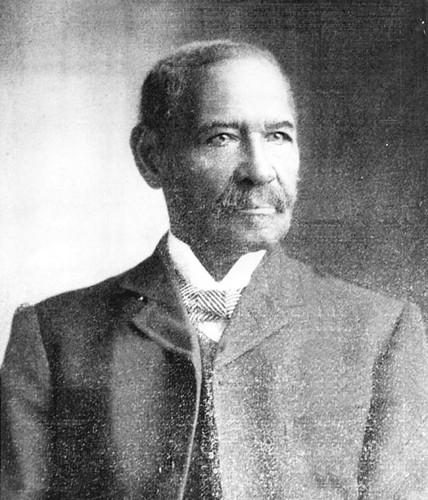
Mifflin Wistar Gibbs: founded the first black newspaper in California, joined hundreds of his peers in leaving San Francisco to find his fortune in Canada, became the first black man to join the Victoria city council and eventually returned to the US where he served as the first elected African American municipal judge in the country.
This week, San Franciscans will observe the 150th anniversary of an exodus of hundreds of free black Californians to Canada in order to escape an increasingly racist state government and fugitive slave laws that endangered their lives and to join a more welcoming community in Victoria, British Columbia. A list of commemorative events is available here. Learn more about African American civil rights struggles during the gold rush era at sfmuseum.org.
4.18.2008
A brief history of yuppies. And Berkeley.
A little bit of Berkeley history in last week's East Bay Express. Best revelation: the word "yuppie" was originally coined to describe Berkeley's affluent baby boomer class.
4.14.2008
Video of the Day
Tonight, in an invitation-only ceremony in San Francisco, two Ecuadorian activists will be receiving the Goldman Environmental Prize for their work fighting ChevronTexico, a company that has caused enormous environmental damage in the Amazon. Here is a little about the prizewinners - Pablo Fajardo Mendoza and Luis Yanza. Chevron (a Bay Area-based company) went to into attack mode and publicly criticized the winners. Here’s Amazon Watch’s public rebuttal:
Thanks Betho for the link!
Thanks Betho for the link!
4.11.2008
Back to the Bay - Old News Reviews
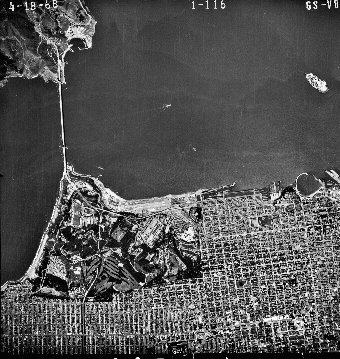
The Center for Land Use Interpretation folks are like rangers of our post-urban and industrial world. Their website offers pointers for modern explorers looking to find the arteries and veins, some still in use, some abandoned, where our fuel, waste, and basic resources have traveled in and out of our communities. Their book, Back to the Bay Exploring the Margins of the San Francisco Bay Region maps the San Francisco, San Pablo, and Suison Bays, using short descriptions and ground level and aerial photos to follow the line where the water meets the land. As you read you'll learn quickly that our coastal area is dominated by a surprising number of sewage treatment plants, salt harvesting ponds, oil refineries, pit mines, and more sewage treatment plants. I found myself a little heartbroken by the amount of shit (and more toxic chemicals) that we pour into our bay from every direction. But the book also suggests the transformation possible in the many places where former toxic industries like explosive and pesticide production have disappeared and the land is turning back into marshes and wilds. (Of course that transformation is bittersweet as well – the jobs that went with those industries have disappeared too, leaving a huge community of underemployed poor people here in the Bay Area. And those toxic industries haven't disappeared – they've simply moved to places in the world with less environmental regulation.)
In any case, this book (which was apparently created to accompany an exhibit at the Yerba Buena Center) is an excellent guide to the parts of the Bay Area that hide in plain view. Keep it in your glove compartment or carry it in your panniers.
4.10.2008
Emory Douglas - Old News Reviews
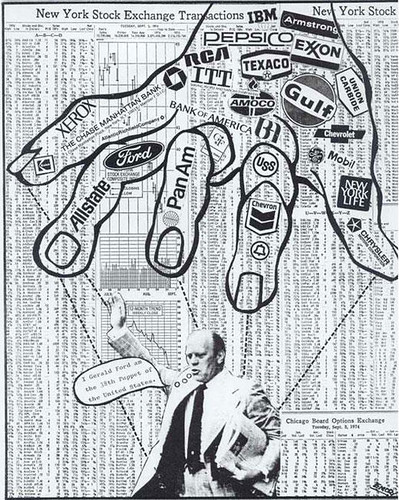
Emory Douglas' perspective on Gerald Ford
It's day 4 of the Week of Book Reviews, and today I'm talking about Black Panther : The Revolutionary Art of Emory Douglas. The essays are good reading for someone new to Black Panther Party history and the interview with Douglas near the end provides insight into his personal story. Mostly this book provides beautiful, large, full-color reproductions of the artwork Douglas produced for the Black Panther Party newspaper. To get a sense of his stlye, you can view a bunch of the posters on the website associated with the MOCA exhibit of his work.
4.09.2008
More Lyle
And on the subject of Erick Lyle, he's written an overview of utopian and dystopian literature about San Francisco for this week's Bay Guardian.
Thanks Leah for the heads up!
Thanks Leah for the heads up!
Scam #5 - Old News Reviews
Five years have passed since our country started its latest war on Iraq. This issue of Erick Lyle's ongoing zine focuses mostly on his adventures in the time around the early bombings and I couldn't help reading it as a historical piece. Total shutdown of San Francisco's financial district seems like a distant memory if not fantasy now. As distant as they felt to staid old me, I love reading Lyle's stories of breaking locks, starting squats, graffiting, and generally fucking shit up. (My favorite old Scam was when he handed out fake Starbucks coupons providing free lattes to the people of San Francisco.) This issue also includes interviews with local mural and graffiti artists and with the founder of the Coalition on Homelessness. Lyle has a "real" book coming out from Soft Skull Press called On the Lower Frequencies: A Secret History of the City. Until then, I'm not sure where to recommend you look for back issues of Scam. I found mine at the Piedmont branch of the Oakland Library.

4.08.2008
The Movement and the Moment – Old News Reviews

I got an email a couple months ago from Mary Uyematsu Kao, the Publications Coordinator at the UCLA Asian American Studies Center Press. She wasn't writing me in any professional capacity, but instead to share her admiration for Ericka Huggins who I'd written about last summer. We got to talking and she mentioned she'd designed a book she thought I'd be interested in, and then she was nice enough to send me a copy. I was interested. Asian Americans: The Movement and the Moment, Edited by Steve Louie and Glenn Omatsu is packed with ephemera of the sixties and seventies Asian American activist scenes: a Yuri Kochiyama quote, Nancy Hom posters, Corky Lee photos, poems, song lyrics, movement newspapers. In between the pictures and quotes are reflective essays on the Third World Strike, the I-Hotel struggle, the Queer Asian movement, and lots, lots more. You can flip through for a quick look or you can settle in for a good long read. Thanks Mary! I love it!
4.07.2008
Arcadia Publishing Photo Books - Old News Reviews
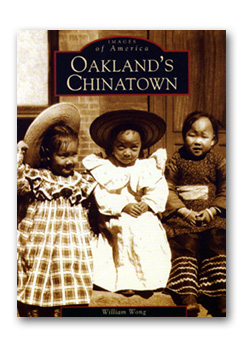
Today through Friday I'm going to post a book review a day. That's only 5 book reviews so I think I can handle it. Instead of thick academic stuff I'm only reviewing photo books, zines, and coffee table books because sometimes that kind of thing is more fun. And for the hell of it I'm starting by reviewing a whole series: the Arcadia Publishing photo books. They're a sort of brilliant, hyper-local niche marketing concept: one photo book for each community, sub-culture, and era within a particular town or region. The photo reproduction is low-quality and the writing varies depending on the editor of each book, but they tend to pick solid, local historian/authors and the photos are priceless even if they're a little grainy.
Some likeable Bay Area centric titles include Oakland's Chinatown by local sweetheart Bill Wong, San Francisco State University by State's own archivist Meredith Eliassen, and The Pullman Porters and West Oakland by a roving pair of black history researchers. But there are dozens of other titles focused on the history of our towns' fire departments, movie theaters, sports teams and neighborhoods.
4.06.2008
Folkstreams
Thanks to WFMU I just discovered a great site called folkstreams. It houses short documentaries about American folk life - mostly the music but also the dances, rituals and work of the cultural groups, villages, and neighborhoods of North America. The films mostly have an anthropology department flavor with square and white, middle-class voiceovers, but I tend to think they're worth it. Here are some of their California focused offerings:
Enjoy folks.
Pizza Pizza Daddy-O about Black girl playground chants.
Two Homes, One Heart about Sikh women living in Sacramento - mostly focusing on Punjabi traditional dance.
Cowboy Poets (OK, not California, but still Western and awesome).
Enjoy folks.
4.04.2008
The Clash of '68
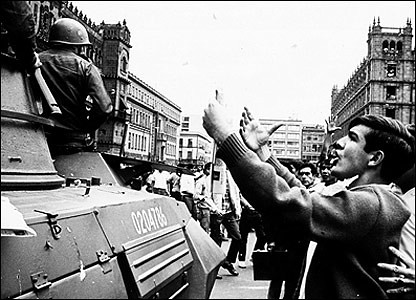
Demonstrator at Tlatelolco, Mexico City, October 2, 1968
from the El Universal archives
The Pacific Film Archive in Berkeley is hosting a little festival called The Clash of 68. Classic revolutionary films from the era as well as contemporary pieces reflecting on that radical time. The program includes the beautiful and inspiring Battle of Algiers and the depressing but pivotal Queimada! which is usually only available in its butchered North American cut.
Subscribe to:
Posts (Atom)
