7.25.2007
whitewashing
A government propaganda film on Japanese "relocation" camps - stunningly bland in its portrayal of the camps as an unfortunate "necessity". (found on metafilter today):


7.23.2007
Ericka Huggins
Dana and I went out to Thai food on Grand Avenue the other day, and happened to sit next to one of my heroes. Later I wished I had said something really thoughtful and articulate like, "Excuse me, I apologize for interrupting your meal, but I couldn't let you leave without telling you how grateful I am for the work you've done to support the liberation of African American people, and of all people, and for the many very real sacrifices you've made over these many years. Thank you." Of course, if I had actually talked to her in the moment, whatever I said would have come out making me sound like a gibbering stalker, (I know this to be true because I ran into her once before, and did talk to her like a gibbering stalker), so it's for the best that I contented myself to bask in the glow of her fashionable (although in no way ostentatious) back, which was seated only a foot or two away from me.
I doubt she's recognized much now, but Ericka Huggins spent a few years being infamous. In 1970, she was a defendant in an internationally notorious and highly politicized murder trial in New Haven, Connecticut. Folks like Dr. Benjamin Spock and writer Jean Genet came to Yale to speak on her behalf. One year before that trial, her husband John Huggins, a leader in the Los Angeles chapter of the Black Panthers, was killed at UCLA by members of a rival activist faction. Throughout the 70s she co-authored a book of poems with Huey Newton, held political offices, and directed a Black Panther school. I wish I knew more about what she's doing now – meditation, spirituality and education seem to be among her current interests, and she does some speaking about her time in the Black Panthers, but it's hard to find out much about her because, although one site says that she's writing a memoir, she clearly isn't out to promote herself, which is a consistent theme for her, actually.
Ericka grew up in Washington, D.C. She was politicized early on, attending the March on Washington when she was 15. The late 60s, the moment when Ericka was coming of age, was a point of increasing militancy among activists in general, and Black activists in particular. (SNCC for example, a major organization in the Civil Rights Movement, officially changed its strategy from specifically nonviolent, to including a broader range of tactics when Stokely Carmichael took over the organization in 1966.) Like thousands of young people around her, Ericka probably felt shocked and horrified by the poverty and violence that Black people and poor people were experiencing around her. Race riots were a regular feature of the late 60s, and were invariably inspired by, and then followed by, harsh police violence. The Vietnam War, and protests against it, escalated around her. Internationally, militancy seemed to be on the increase, with revolutionary movements gaining prominence in Palestine, Northern Ireland, and even next door in Quebec. In this context, in 1968, Ericka joined the Black Panthers. She met John ("Jon" in Ericka's love letters) at college and they moved together to LA where they got very involved in the growing Panther chapter there. They took and then taught political education classes, organized, fundraised, served in the Party social programs, and I'll assume they studied marksmanship, a requirement for all Party members. John took on a leadership position. Ericka got pregnant.
With his beard and bellbottoms, John gave off much more of a hippy vibe than his fellow militants, especially Bunchy Carter, a charismatic former gang leader who was a rising star in the Party (and was known for his impeccable style), and who was with John on the day they met with, and then were shot and killed by members of the US organization at UCLA. I won't pretend that the details of this story aren't complicated*, but one thing we do know from 1975 senate hearings on the FBI's counterintelligence program (Cointelpro) is that the FBI actively sought to increase tension between the Panthers and US**, before and after these killings, by sending inflammatory cartoons and letters to both organizations, and by propagating rumors about each organization. I've read that Richard Held, the FBI officer in charge of the L.A. office at that time took credit for the deaths of Huggins and Carter. I can't back that one up with a citation though.
After John's death, Ericka moved with her daughter Mai to Connecticut where John's parents lived. With local activists, she started a Panther chapter in Bridgeport, and then moved it to New Haven. She was 21.
In her memoir, A Taste of Power, Brown remembers Ericka as being checked out and disconnected after John's death. An interview with a Connecticut Panther in another memoir - David Hilliard's This Side of Glory - describes her as "spaced out but genuine". I don't know why she kept sleepwalking through her activist career at that point. Maybe if your partner is killed for the revolution, you feel you must soldier on, to give his memory meaning. Especially because, as she trudged through what must have been a personal nightmare, the bigger community was turning uglier around her too.
John Huggins was killed on January 17th, 1969. That night, the LAPD raided John and Ericka's home and arrested all twelve Panthers inside, including Ericka with their infant daughter. There were no real charges filed against those arrested – the LAPD justified the arrests by saying that they were preempting retaliatory action towards members of US. This kind of police action towards the Panthers was typical. They raided Panther offices across the country frequently, and often repetitively, sometimes looking for specific suspects, sometimes just to destroy their typewriters, or break up their free breakfast program, which the FBI specifically sought to destroy. (Details on that here. Just search for "breakfast".) In April of '69, 21 New York Panthers were arrested and charged with conspiracy. All 21 were eventually found innocent. Also in April, the Des Moines Panther office was leveled by a bomb blast, injuring two Panthers. In response, local police arrested Panthers. In the first two weeks of May that year, the LAPD arrested 42 Black Panthers. Of course, this hostility wasn't one sided. The Panthers were both a service organization and a militant one, and as much as their free clothing, free food, free medical clinics, ambulance service, and free breakfast programs have been underreported, their armed confrontation of police was also quite real. Panthers regularly engaged in shootouts with police, and not all these were initiated by the cops. After all, the Panthers were trying to engage in a revolutionary struggle.
Outside of the Panthers, even mainstream liberals were aware of how harsh the repercussion could be for activists who opposed the status quo. In August of 1968, Chicago Mayor Richard Daley had sent 12,000 police officers and 7,500 National Guard in to disrupt protests at the Democratic Convention. (Bobby Seale, the Panther's co-founder and essentially second-in-command officer, spent several years fighting legal charges from the Convention protests. He'd famously been bound and gagged in the courtroom during his trial.) In December of 1968, more than 450 students at SF State were arrested in connection with a student strike in support of Black Studies program. And only a few months earlier, police had massacred hundreds of student demonstrators in Mexico City. Vietnam raged on. Nixon had just been inaugurated. Someone who was as involved in the Panthers as Ericka was in early 1969 must have been pretty convinced that the revolution was needed, that it was coming, that a new system of socialist governance prioritizing self-determination for Black people and economic fairness for all seemed like a real possibility. And militant struggle probably felt like it was the strategy for bringing that revolution.
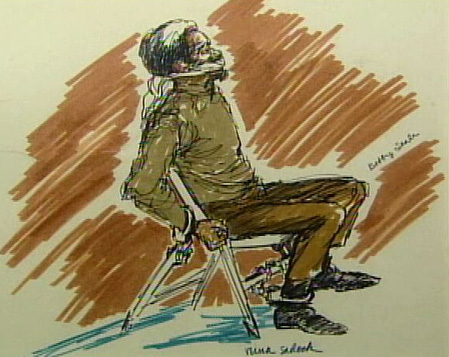
Courtroom illustration of Bobby Seale, bound and gagged during the initial Chicago 8 hearings
It feels important to know all this context before you read what happened next. What happened next is that that someone, a Panther, murdered someone else, another Panther, a 19 year old from New York. And that young murder victim, Alex Rackley, was killed after two days of being tortured – having boiling water poured on his body and so forth. And Ericka was in the house where all this happened.
A mentally-unstable out of town Panther named George Sams instigated the kidnapping and torture of Rackley, who he accused of being an undercover agent. Several New Haven Panthers participated in the torture and then in the murder. Sams only did four years in prison for the killing, and rumors persist that he was an agent provocateur himself, although I've never read any evidence for this. He was certainly crazy, and was heavily medicated during his own trial. And it is unarguable that the Panthers were heavily infiltrated. Still, at the point when you are pouring boiling water on someone, or even watching your comrade pour boiling water on someone, you must take some personal responsibility. Going along with what you're told isn't any more justifiable for revolutionaries than it is for Nazis.
While it's not a justification, I'm sure that Ericka Huggins learned this lesson. After the actual killers were convicted (some confessed, turning state's evidence), she and Bobby Seale were tried for ordering the murders. They spent two years in jail in New Haven during the proceedings, inspiring an international protest movement.*** Yale students staged a months-long strike, starting with a massive May Day rally featuring Abbie Hoffman et al. While she was in prison, Free Jazz pianist Francois Tusques composed a song for her. (You can listen to it on this archived WFMU jazz show. The song starts roughly at minute 1:46 and then restarts at 1:48.)
What shocks me about Ericka Huggins, is that after seeing the absolute ugliest sides of revolutionary movements, she moved to the Bay Area and spent the 1970s working on the Panther newspaper, running for and then serving on the Berkeley Community Development Council (an anti-poverty agency) and on the Alameda County School Board, and eventually running the last surviving segment of the Black Panther Party – their children's school. She was, I guess, one of the last members of the Black Panther Party, since she continued to run the school throughout the 1970s until it finally closed in the early 80s, long after every other Panther institution was gone, and after Huey Newton, the organizations' charismatic but borderline leader had lost all credibility among activists and even most of his friends.
Another thing that strikes me about Ericka Huggins is the way she just doesn't show up in Panther memoirs. Elaine Brown, who named her daughter Ericka dedicates more page space to her than any other Panther alum. As far as I remember, everything Elaine says is positive, and even in her book, there's not much. In other memoirs, Ericka tends to show up for a few pages as a benign force and then disappear, as if she was never there. For someone who was so important in the Party, I can only guess that she found a way to stay out of everyone's way and for the most part, do the work that felt important, instead of engaging in power-plays or battles of ego.
Sitting next to her at dinner, I confess I had a difficult time paying enough attention to my date. What does someone who spent more than a decade trying to make the impossible work feel when it doesn’t? What does it feel like to be so key in a grassroots, militant, educated, disciplined, activist corps - a group that seemed so close to revolution – and then to lose it? Does she resent the way Panther leaders spiraled out of control? Does she feel defeated by the forces of the state – the FBI, the police, the media – that did, in fact defeat her movement? Does she feel manipulated? Is she angry? Her manner is quiet and poised. She projects a feeling of attentive calm. I hope she thinks back on serving free food to children, on writing and explaining, on teaching and running a school that provided a real alternative for kids who needed it and feels proud.
_________
That's how I ended this article. And I was just looking for a few more photos before posting, when I decided to start googling Ericka's name and the world "meditation" (since I know she's a practitioner) and found her to be associated with that ashram on San Pablo – Syda.
Apparently, the New Yorker did an investigation of Syda a few years ago, and quoted members who reported sexual and financial abuses within the largely secretive organization. Former members complained that they were harrassed if they spoke out. There's a website where ex-members share their (bad) experiences, although for the record, most of the alleged abuses happened quite a while ago, and even the New Yorker article points out that most members have no contact with the people at the top of the organization, and simply go to Syda's various ashrams to meditate, chant, and find spiritual community. At this point, I'm feeling a bit depressed by imagining my hero as a cult member. And I'm sure it's more complicated than that anyway. I guess I shouldn't be surprised that she can stomach a degree of unquestioned hierarchy, since she managed to work under an abusive power fiend like Huey Newton for so long.
I really admire Ericka Huggins. I'm not an investigative reporter, and if I was, why would I want to 'expose' someone who has spent most of her life working for good? So what if she likes charismatic leaders? I want to respect the fact that she has a life. Has some privacy. So good luck to you Ericka. I'm not going to read any more about what you did or what you do. Thank you for your work. Good luck to you in your life.
_______________
*Trying to make out what really happened here is completely impossible. Every Panther has their story, and the stories tend to contradict each other.
**Every December I subject some poor soul to my annual anti-Kwanzaa rant. I know that if the holiday has come to have meaning for people, I should support it, but for me it is uglied by the fact that it was created by Ron Karenga (or, as he named himself, Maulana – a Swahili word for master teacher). Karenga was the head of US at the time of the UCLA shooting. He went on to serve prison time for assaulting and torturing two female members of his organization.
** As usual, Snopes does a nice job of clarifying the line of bullshit that circulated on the net a few years ago suggesting that Hillary Rodham, a Yalie, was Ericka's defender. (As if Hillary would have advocated for militants!
If you're not done already with learning about Ericka:
I mentioned it a bunch of times because A Taste of Power talks more about Ericka than most published material on the Panthers. The author, Elaine Brown, has been accused of including some inaccuracies, or maybe outright lies in this book, but it is as good a history of the Black Panther Party as any, and, coming from a woman's perspective, manages to be honest about some of the disparities that did exist in the organization.
Most of what I know about Ericka's trial comes from the long out-of-print Agony in New Haven, which was certainly descriptive. It seemed to depict the four month long jury selection process in real time, detailing each potential juror, each recess called by the judge, and each outfit chosen by the various lawyers. Well written, but only worth while if you're obsessed. There's a newer book I haven't read yet called Murder in the Model City which probably provides some more context.
I know he's become controversial, even among radicals, but Ward Churchill's Agents of Repression (written with Jim Vander Wall) is still the most readable, detailed, and footnoted book I know about Cointelpro and it's where I first learned anything about the Panthers. I recommend it.
Finally, the very best website for Black Panther information is It's About Time. This site has tons of original source material on the Party: newspaper transcriptions, dozens of photos, regional chapter histories, and updates on issues impacting former Panthers now. Most of the photos in this post came from that site (thank you!) and I haven't even gotten half-way through all there is to read there yet. Check it out.
Note that I've made a couple small factual and editorial corrections and changes since I first wrote this, although the post is pretty much the same as the original.
I doubt she's recognized much now, but Ericka Huggins spent a few years being infamous. In 1970, she was a defendant in an internationally notorious and highly politicized murder trial in New Haven, Connecticut. Folks like Dr. Benjamin Spock and writer Jean Genet came to Yale to speak on her behalf. One year before that trial, her husband John Huggins, a leader in the Los Angeles chapter of the Black Panthers, was killed at UCLA by members of a rival activist faction. Throughout the 70s she co-authored a book of poems with Huey Newton, held political offices, and directed a Black Panther school. I wish I knew more about what she's doing now – meditation, spirituality and education seem to be among her current interests, and she does some speaking about her time in the Black Panthers, but it's hard to find out much about her because, although one site says that she's writing a memoir, she clearly isn't out to promote herself, which is a consistent theme for her, actually.
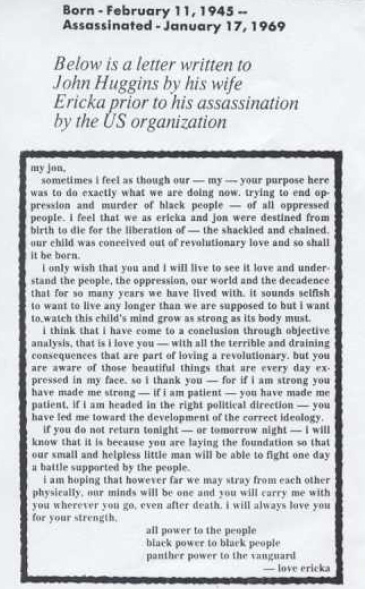
Ericka grew up in Washington, D.C. She was politicized early on, attending the March on Washington when she was 15. The late 60s, the moment when Ericka was coming of age, was a point of increasing militancy among activists in general, and Black activists in particular. (SNCC for example, a major organization in the Civil Rights Movement, officially changed its strategy from specifically nonviolent, to including a broader range of tactics when Stokely Carmichael took over the organization in 1966.) Like thousands of young people around her, Ericka probably felt shocked and horrified by the poverty and violence that Black people and poor people were experiencing around her. Race riots were a regular feature of the late 60s, and were invariably inspired by, and then followed by, harsh police violence. The Vietnam War, and protests against it, escalated around her. Internationally, militancy seemed to be on the increase, with revolutionary movements gaining prominence in Palestine, Northern Ireland, and even next door in Quebec. In this context, in 1968, Ericka joined the Black Panthers. She met John ("Jon" in Ericka's love letters) at college and they moved together to LA where they got very involved in the growing Panther chapter there. They took and then taught political education classes, organized, fundraised, served in the Party social programs, and I'll assume they studied marksmanship, a requirement for all Party members. John took on a leadership position. Ericka got pregnant.
With his beard and bellbottoms, John gave off much more of a hippy vibe than his fellow militants, especially Bunchy Carter, a charismatic former gang leader who was a rising star in the Party (and was known for his impeccable style), and who was with John on the day they met with, and then were shot and killed by members of the US organization at UCLA. I won't pretend that the details of this story aren't complicated*, but one thing we do know from 1975 senate hearings on the FBI's counterintelligence program (Cointelpro) is that the FBI actively sought to increase tension between the Panthers and US**, before and after these killings, by sending inflammatory cartoons and letters to both organizations, and by propagating rumors about each organization. I've read that Richard Held, the FBI officer in charge of the L.A. office at that time took credit for the deaths of Huggins and Carter. I can't back that one up with a citation though.
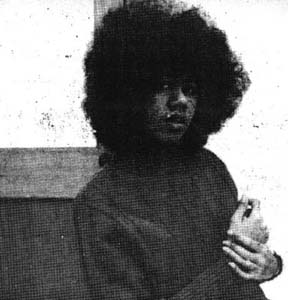
After John's death, Ericka moved with her daughter Mai to Connecticut where John's parents lived. With local activists, she started a Panther chapter in Bridgeport, and then moved it to New Haven. She was 21.
In her memoir, A Taste of Power, Brown remembers Ericka as being checked out and disconnected after John's death. An interview with a Connecticut Panther in another memoir - David Hilliard's This Side of Glory - describes her as "spaced out but genuine". I don't know why she kept sleepwalking through her activist career at that point. Maybe if your partner is killed for the revolution, you feel you must soldier on, to give his memory meaning. Especially because, as she trudged through what must have been a personal nightmare, the bigger community was turning uglier around her too.
John Huggins was killed on January 17th, 1969. That night, the LAPD raided John and Ericka's home and arrested all twelve Panthers inside, including Ericka with their infant daughter. There were no real charges filed against those arrested – the LAPD justified the arrests by saying that they were preempting retaliatory action towards members of US. This kind of police action towards the Panthers was typical. They raided Panther offices across the country frequently, and often repetitively, sometimes looking for specific suspects, sometimes just to destroy their typewriters, or break up their free breakfast program, which the FBI specifically sought to destroy. (Details on that here. Just search for "breakfast".) In April of '69, 21 New York Panthers were arrested and charged with conspiracy. All 21 were eventually found innocent. Also in April, the Des Moines Panther office was leveled by a bomb blast, injuring two Panthers. In response, local police arrested Panthers. In the first two weeks of May that year, the LAPD arrested 42 Black Panthers. Of course, this hostility wasn't one sided. The Panthers were both a service organization and a militant one, and as much as their free clothing, free food, free medical clinics, ambulance service, and free breakfast programs have been underreported, their armed confrontation of police was also quite real. Panthers regularly engaged in shootouts with police, and not all these were initiated by the cops. After all, the Panthers were trying to engage in a revolutionary struggle.
Outside of the Panthers, even mainstream liberals were aware of how harsh the repercussion could be for activists who opposed the status quo. In August of 1968, Chicago Mayor Richard Daley had sent 12,000 police officers and 7,500 National Guard in to disrupt protests at the Democratic Convention. (Bobby Seale, the Panther's co-founder and essentially second-in-command officer, spent several years fighting legal charges from the Convention protests. He'd famously been bound and gagged in the courtroom during his trial.) In December of 1968, more than 450 students at SF State were arrested in connection with a student strike in support of Black Studies program. And only a few months earlier, police had massacred hundreds of student demonstrators in Mexico City. Vietnam raged on. Nixon had just been inaugurated. Someone who was as involved in the Panthers as Ericka was in early 1969 must have been pretty convinced that the revolution was needed, that it was coming, that a new system of socialist governance prioritizing self-determination for Black people and economic fairness for all seemed like a real possibility. And militant struggle probably felt like it was the strategy for bringing that revolution.
Courtroom illustration of Bobby Seale, bound and gagged during the initial Chicago 8 hearings
It feels important to know all this context before you read what happened next. What happened next is that that someone, a Panther, murdered someone else, another Panther, a 19 year old from New York. And that young murder victim, Alex Rackley, was killed after two days of being tortured – having boiling water poured on his body and so forth. And Ericka was in the house where all this happened.
A mentally-unstable out of town Panther named George Sams instigated the kidnapping and torture of Rackley, who he accused of being an undercover agent. Several New Haven Panthers participated in the torture and then in the murder. Sams only did four years in prison for the killing, and rumors persist that he was an agent provocateur himself, although I've never read any evidence for this. He was certainly crazy, and was heavily medicated during his own trial. And it is unarguable that the Panthers were heavily infiltrated. Still, at the point when you are pouring boiling water on someone, or even watching your comrade pour boiling water on someone, you must take some personal responsibility. Going along with what you're told isn't any more justifiable for revolutionaries than it is for Nazis.
While it's not a justification, I'm sure that Ericka Huggins learned this lesson. After the actual killers were convicted (some confessed, turning state's evidence), she and Bobby Seale were tried for ordering the murders. They spent two years in jail in New Haven during the proceedings, inspiring an international protest movement.*** Yale students staged a months-long strike, starting with a massive May Day rally featuring Abbie Hoffman et al. While she was in prison, Free Jazz pianist Francois Tusques composed a song for her. (You can listen to it on this archived WFMU jazz show. The song starts roughly at minute 1:46 and then restarts at 1:48.)
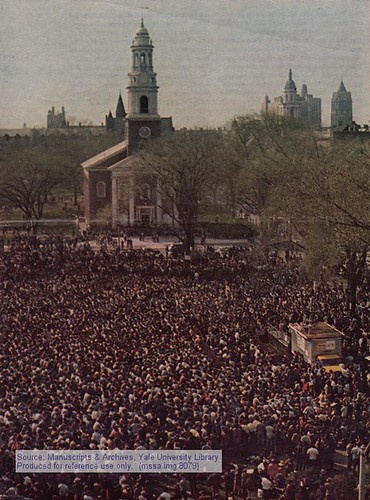
What shocks me about Ericka Huggins, is that after seeing the absolute ugliest sides of revolutionary movements, she moved to the Bay Area and spent the 1970s working on the Panther newspaper, running for and then serving on the Berkeley Community Development Council (an anti-poverty agency) and on the Alameda County School Board, and eventually running the last surviving segment of the Black Panther Party – their children's school. She was, I guess, one of the last members of the Black Panther Party, since she continued to run the school throughout the 1970s until it finally closed in the early 80s, long after every other Panther institution was gone, and after Huey Newton, the organizations' charismatic but borderline leader had lost all credibility among activists and even most of his friends.
Another thing that strikes me about Ericka Huggins is the way she just doesn't show up in Panther memoirs. Elaine Brown, who named her daughter Ericka dedicates more page space to her than any other Panther alum. As far as I remember, everything Elaine says is positive, and even in her book, there's not much. In other memoirs, Ericka tends to show up for a few pages as a benign force and then disappear, as if she was never there. For someone who was so important in the Party, I can only guess that she found a way to stay out of everyone's way and for the most part, do the work that felt important, instead of engaging in power-plays or battles of ego.
Sitting next to her at dinner, I confess I had a difficult time paying enough attention to my date. What does someone who spent more than a decade trying to make the impossible work feel when it doesn’t? What does it feel like to be so key in a grassroots, militant, educated, disciplined, activist corps - a group that seemed so close to revolution – and then to lose it? Does she resent the way Panther leaders spiraled out of control? Does she feel defeated by the forces of the state – the FBI, the police, the media – that did, in fact defeat her movement? Does she feel manipulated? Is she angry? Her manner is quiet and poised. She projects a feeling of attentive calm. I hope she thinks back on serving free food to children, on writing and explaining, on teaching and running a school that provided a real alternative for kids who needed it and feels proud.

_________
That's how I ended this article. And I was just looking for a few more photos before posting, when I decided to start googling Ericka's name and the world "meditation" (since I know she's a practitioner) and found her to be associated with that ashram on San Pablo – Syda.
Apparently, the New Yorker did an investigation of Syda a few years ago, and quoted members who reported sexual and financial abuses within the largely secretive organization. Former members complained that they were harrassed if they spoke out. There's a website where ex-members share their (bad) experiences, although for the record, most of the alleged abuses happened quite a while ago, and even the New Yorker article points out that most members have no contact with the people at the top of the organization, and simply go to Syda's various ashrams to meditate, chant, and find spiritual community. At this point, I'm feeling a bit depressed by imagining my hero as a cult member. And I'm sure it's more complicated than that anyway. I guess I shouldn't be surprised that she can stomach a degree of unquestioned hierarchy, since she managed to work under an abusive power fiend like Huey Newton for so long.
I really admire Ericka Huggins. I'm not an investigative reporter, and if I was, why would I want to 'expose' someone who has spent most of her life working for good? So what if she likes charismatic leaders? I want to respect the fact that she has a life. Has some privacy. So good luck to you Ericka. I'm not going to read any more about what you did or what you do. Thank you for your work. Good luck to you in your life.
_______________
*Trying to make out what really happened here is completely impossible. Every Panther has their story, and the stories tend to contradict each other.
**Every December I subject some poor soul to my annual anti-Kwanzaa rant. I know that if the holiday has come to have meaning for people, I should support it, but for me it is uglied by the fact that it was created by Ron Karenga (or, as he named himself, Maulana – a Swahili word for master teacher). Karenga was the head of US at the time of the UCLA shooting. He went on to serve prison time for assaulting and torturing two female members of his organization.
** As usual, Snopes does a nice job of clarifying the line of bullshit that circulated on the net a few years ago suggesting that Hillary Rodham, a Yalie, was Ericka's defender. (As if Hillary would have advocated for militants!
If you're not done already with learning about Ericka:
I mentioned it a bunch of times because A Taste of Power talks more about Ericka than most published material on the Panthers. The author, Elaine Brown, has been accused of including some inaccuracies, or maybe outright lies in this book, but it is as good a history of the Black Panther Party as any, and, coming from a woman's perspective, manages to be honest about some of the disparities that did exist in the organization.
Most of what I know about Ericka's trial comes from the long out-of-print Agony in New Haven, which was certainly descriptive. It seemed to depict the four month long jury selection process in real time, detailing each potential juror, each recess called by the judge, and each outfit chosen by the various lawyers. Well written, but only worth while if you're obsessed. There's a newer book I haven't read yet called Murder in the Model City which probably provides some more context.
I know he's become controversial, even among radicals, but Ward Churchill's Agents of Repression (written with Jim Vander Wall) is still the most readable, detailed, and footnoted book I know about Cointelpro and it's where I first learned anything about the Panthers. I recommend it.
Finally, the very best website for Black Panther information is It's About Time. This site has tons of original source material on the Party: newspaper transcriptions, dozens of photos, regional chapter histories, and updates on issues impacting former Panthers now. Most of the photos in this post came from that site (thank you!) and I haven't even gotten half-way through all there is to read there yet. Check it out.
Note that I've made a couple small factual and editorial corrections and changes since I first wrote this, although the post is pretty much the same as the original.
7.19.2007
Sekou Sundiata
I just heard that Sekou Sundiata died this week. If you don't know his work, here's a little:
Based on interviews I've heard, he seems to have been as thoughtful a person as he was a poet. He'll be missed.
Based on interviews I've heard, he seems to have been as thoughtful a person as he was a poet. He'll be missed.
7.16.2007
LaborFest 2007
Hi folks!
I have another entry coming soon - probably Wednesday. In the meantime, there is a ton of Bay Area radical history action going down at laborfest, and I'm missing it because I'm out of the country! Please report back with any laborfest stories here.
I have another entry coming soon - probably Wednesday. In the meantime, there is a ton of Bay Area radical history action going down at laborfest, and I'm missing it because I'm out of the country! Please report back with any laborfest stories here.
7.09.2007
Issues, J's, and Rocky Baird
Next time you're in the Piedmont Avenue neighborhood, I suggest you visit the new and wonderful Issues.
I'm not just saying it's wonderful because the proprietors happen to be friends of mine. That fact only coincides nicely with the simple truth: Issues is rivaled only by DeLauer's on Broadway (which is in fact also super, but which actually doesn't carry a bunch of the magazines that I actually like to read), for the title of "Best East Bay Newsstand Evar". As far as I can tell, they carry every magazine known to humankind including Male Nurse, XLR8R, and the usual Family Circle etc. They have newspapers in many languages, 80s buttons, 70s t-shirts, and did I mention the charming staff (owners Joe and Noella)?
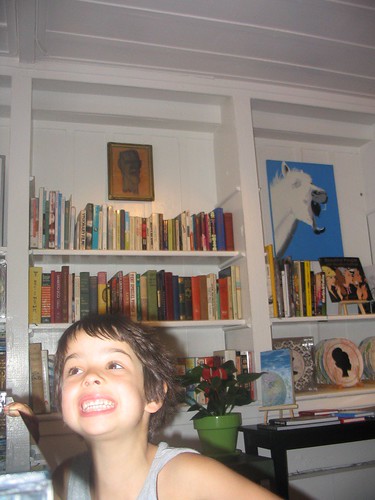
I like Issues so much that I brought my kids there the other day, and let them photograph it for you. So ya, Issues isn't actually dimly lit, out-of-focus, or (generally) full of preschool kids. Enjoy!
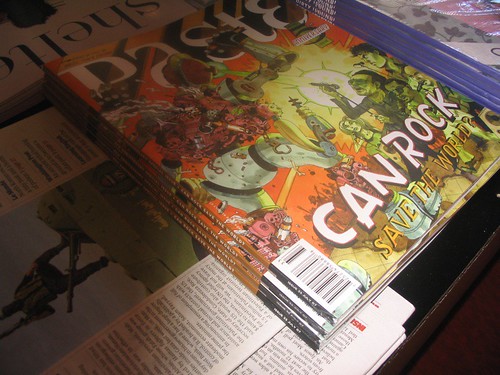
This appears to be some sort of hip music magazine. I wouldn't know, I only bought copies of Vegetarian Times and Sheep! The voice of the independent flock master.
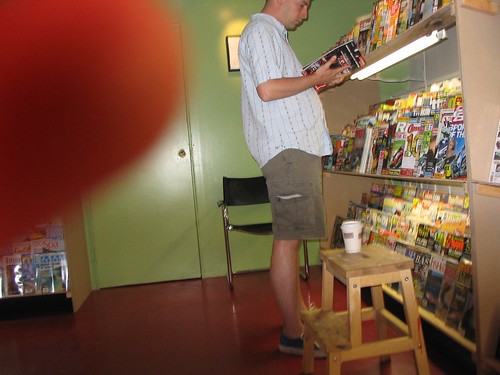
Coffee is welcome at Issues. As are 4 year old members of the Paparazzi.

They're open from 7 to 7!
After you get your copy of Bitch or Bust or whatever, I suggest you bring your reading material over to the last normal restaurant on Piedmont Avenue – J's. Only two doors away from the recently arrived Cesar (tapas and fancy drinks for a lot of dough), J's is an old-fashioned burger joint. Since I'm a vegetarian (well, except for that whole 'fish aren't a vegetable' thing) I suggest going for breakfast. Mexican breakfast will run you about 8 bucks. American the same or cheaper depending on what you get. The portions are big and the coffee refills are free.
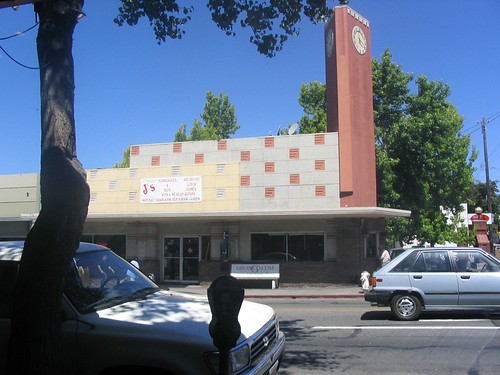
J's.
The best thing about J's though is the historical details. (You were wondering when I was going to get to the history bit weren't you?)
J's used to be a station house for the streetcars that stopped right outside, in what is now a large parking lot. There is still a semi-train-related theme, with clocks representing various time zones and photos of old Key line trains and stations on the walls. Wood paneling lines the walls, and about half-the seating is on rotating bar stools. The stained glass lamp covers add to the warm and low-key feeling.
Once you're full up, head out back to look at Rocky Baird's mural of the Key trains through Oakland's history. I love this mural; it's a much better historical marker than the old-school metal plaque that explains when the last train stopped there (1958).
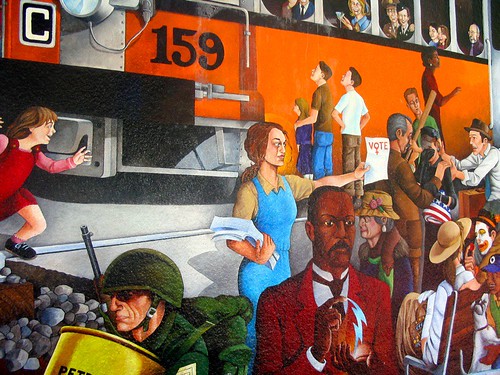
If you want to see more of Baird's work, head down to Gaylord's and get a view of his moving interpretation of the loss of Ohlone culture and land here in Oakland: The Capture of the Solid. The Escape of the Soul.
Then take yourself home to read your magazines. And take care.
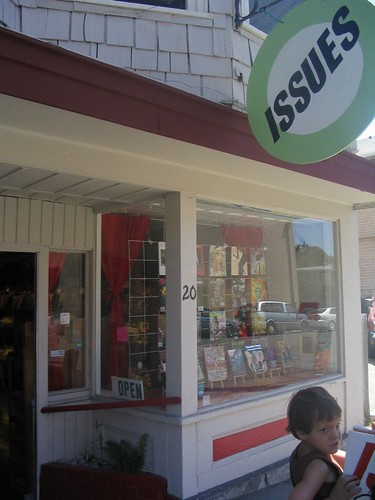
I'm not just saying it's wonderful because the proprietors happen to be friends of mine. That fact only coincides nicely with the simple truth: Issues is rivaled only by DeLauer's on Broadway (which is in fact also super, but which actually doesn't carry a bunch of the magazines that I actually like to read), for the title of "Best East Bay Newsstand Evar". As far as I can tell, they carry every magazine known to humankind including Male Nurse, XLR8R, and the usual Family Circle etc. They have newspapers in many languages, 80s buttons, 70s t-shirts, and did I mention the charming staff (owners Joe and Noella)?
I like Issues so much that I brought my kids there the other day, and let them photograph it for you. So ya, Issues isn't actually dimly lit, out-of-focus, or (generally) full of preschool kids. Enjoy!
This appears to be some sort of hip music magazine. I wouldn't know, I only bought copies of Vegetarian Times and Sheep! The voice of the independent flock master.
Coffee is welcome at Issues. As are 4 year old members of the Paparazzi.
They're open from 7 to 7!
After you get your copy of Bitch or Bust or whatever, I suggest you bring your reading material over to the last normal restaurant on Piedmont Avenue – J's. Only two doors away from the recently arrived Cesar (tapas and fancy drinks for a lot of dough), J's is an old-fashioned burger joint. Since I'm a vegetarian (well, except for that whole 'fish aren't a vegetable' thing) I suggest going for breakfast. Mexican breakfast will run you about 8 bucks. American the same or cheaper depending on what you get. The portions are big and the coffee refills are free.
J's.
The best thing about J's though is the historical details. (You were wondering when I was going to get to the history bit weren't you?)
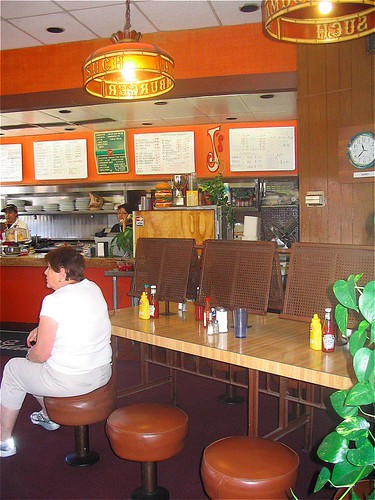
J's used to be a station house for the streetcars that stopped right outside, in what is now a large parking lot. There is still a semi-train-related theme, with clocks representing various time zones and photos of old Key line trains and stations on the walls. Wood paneling lines the walls, and about half-the seating is on rotating bar stools. The stained glass lamp covers add to the warm and low-key feeling.
Once you're full up, head out back to look at Rocky Baird's mural of the Key trains through Oakland's history. I love this mural; it's a much better historical marker than the old-school metal plaque that explains when the last train stopped there (1958).
If you want to see more of Baird's work, head down to Gaylord's and get a view of his moving interpretation of the loss of Ohlone culture and land here in Oakland: The Capture of the Solid. The Escape of the Soul.
Then take yourself home to read your magazines. And take care.
7.06.2007
Thank you!
It looks like somebody just donated a paid Flickr account to me. What, do you want to make me cry or something?
Thanks whoever you are. I mean it when I say, that meant a lot.
Thanks whoever you are. I mean it when I say, that meant a lot.
7.02.2007
Locke, CA
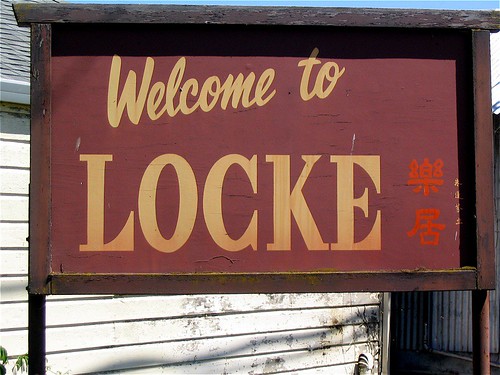
Little Rutabaga and I left my folks' house in Sacramento on Sunday, and drove along the levee road, watching the river, and listening to an audio tape of Stuart Little, which probably doesn't need any advertising, but, in my opinion, should be regarded as one of the masterpieces of 20th century fiction. Little Stuart is as complex as any literary hero: he's gutsy and self-assured enough to win a toy sailboat race in his first time at 'sea', but also so proud that he misses his chance with the first woman he meets who shares his diminutive stature. At first I thought Stuart's predicament – as the mouse child of human parents – was a metaphor for homosexuality. Stuart is a bit of a dandy, meticulous in his grooming and manners, carrying a small cane within his first few weeks of life, and with none of the loud, messy habits of his 'normal' older brother, but I gave up that theory at the point in the story when he falls for the bewitching songbird, Margalo. Stuart's status as an outsider is a classic theme, subject to a number of interpretations, but I shouldn't try to make his story mean too much. I enjoyed it more when I was just enjoying the understated, dry storytelling of E.B. White. Please, no one tell me if he had some horrible skeletons in his closet because he was really super writer.
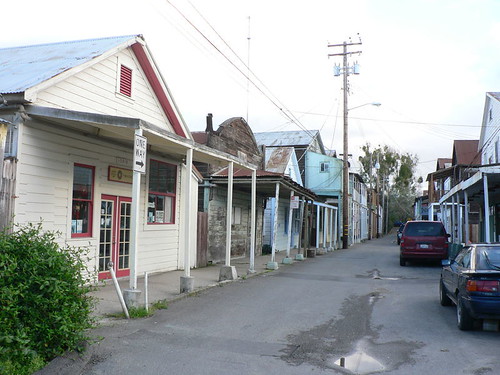
Photo © 2005 David Monniaux
The tape ended (in a wonderfully ambiguous conclusion) just as Ru and I got to Locke, a small town in the Sacramento Delta that is still entirely made up of the wooden homes and businesses that were constructed there in the early 1900's. Some of the old buildings haven't been maintained much in the last 30 or 50 years, but most are still habited in one way or another. There are a lot of art galleries now, Al the Wop's bar (full of bikers) seems to be doing well, and the Locke Garden restaurant was very busy. Even though Locke is completely authentic in its original construction, it's not a tourist version of an oldentymestown. There are no Locke t-shirts for sale, no saltwater taffies, no spinning rainbow windsocks. For a few dozen people, Locke is just home.
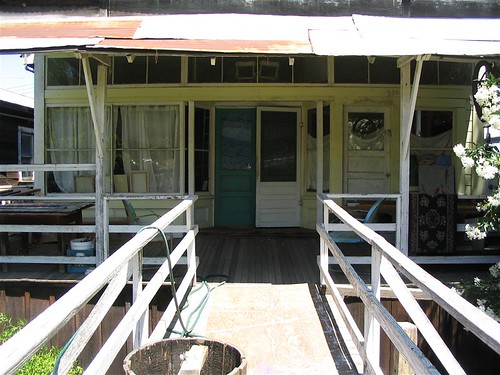
Houses facing the levee were built high to avoid the periodic flooding from the Sacramento River.
I lived in Sacramento for 6 years, but I'd never been to Locke or any of the other agricultural towns in the Sacramento Delta. I'd never even driven through, and it's only about an extra half hour to get back to Oakland that way, along 160, the levee road, to Highway 24. At Dai Loy, now a museum but once one of a number of casinos in Locke, the attendant told me that she hears that all the time. Even folks who drive along 160 to Antioch don't stop much.
Of course, there's not so much to see while you're there. Locke is literally two streets and even though my parents warned me that it was tiny, I was still surprised. The houses and businesses are built neatly and closely in two small rows, maybe because in 1914 when Locke was founded, Chinese-Americans weren't allowed to own land, and the town founders had to lease their little chunk of property from George Locke, a white farmer who owned the land.
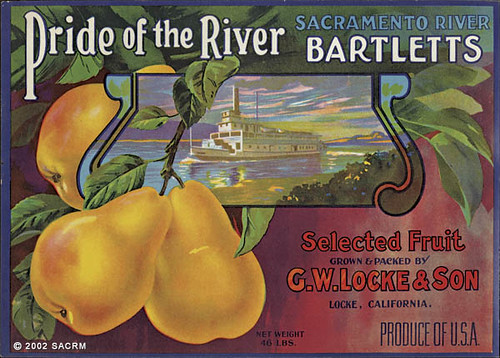
Actually 'grown and packed by' Chinese, Japanese, and Philippino laborers paid a dollar and maybe a meal for each day of work.
Locke is the only surviving all-Chinese rural town in the United States. It was built during the depression, after the Chinatown in neighboring Walnut Grove burned down. Unlike many Chinatowns where distinct ethnic groups of Chinese immigrants lived together, speaking different languages (dialects = languages, or at least, the difference between a dialect and a language is arbitrary), sometimes competing for control of various resources, Locke was settled and occupied almost exclusively by immigrants from the Zhongshan region in China. It lacked the tension that, in other communities, sprang up between competing and ethnically separate Tongs. (Kind of like competing mob families, Tongs tended to control the prostitution, gambling, and opium sales in the community.)
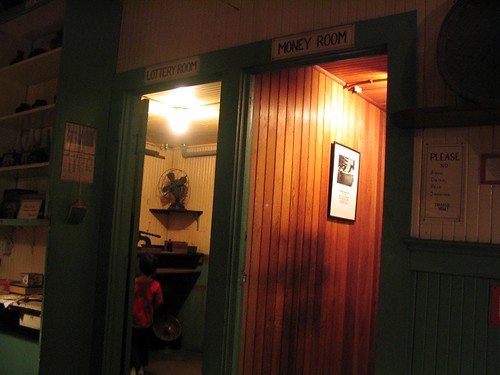
Dai Loy, once a casino, now a casino museum. Do I choose the lottery room or the money room?
Gambling was a major part of Locke's economy. At one point there were 3 separate casinos featuring lotteries, various Chinese betting games, and later, Blackjack tables. Locke also had five brothels (at times the only businesses in town owned by white people) and during prohibition, a couple speakeasies.
Despite the vice-filled main street, lots of folks raised their kids in Locke. Most residents lived on the second street, behind the business district. With the river right there, kids had a great time fishing and swimming and playing outdoors. Because they were Chinese, most were forced into the segregated Delta schools (until WWII when the internment of Japanese-Americans reduced the number of students at the Asian schools to the point that they couldn't stay open). In the afternoons, after public school, Locke kids went to the Kao Ming School, where they got instruction in their language and culture. The school went through a couple incarnations, and finally closed permanently in the '80s when there weren't enough Chinese kids around to keep it going.
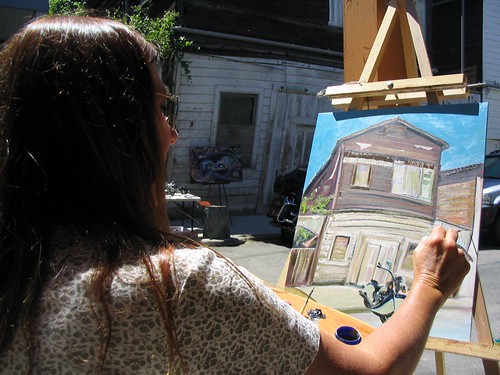
Martha Esch painting the old Star Theater. She's got a gallery in town and hosts studio painting sessions and other events there.
Rutabaga and I spent a couple hours in Locke, eating Mu Shu vegetables at the Locke Garden Restaurant (housed in the town's oldest building), and checking out the art galleries and bikers. I'm not sure if bikers are a regular feature of the town or of this was just a big rally weekend. Feel free to let me know members of the biker community. The streets were surprisingly full for such a little place, but of course nothing like in its hayday.
At its peak, Locke had hundreds of residents. During pear season, and on certain weekends, more than a thousand people stayed in the rooming houses, gambled in the casinos, ate at the restaurants, and shopped in the markets and dry goods stores. Now, the Chinese populations is around 10. I saw one Chinese-American guy in town, a biker at Al the Wops. Most all of the young people of Locke moved away to bigger cities – many going to college and mainstreaming into the larger culture. The folks who stuck around got older. Most have died.
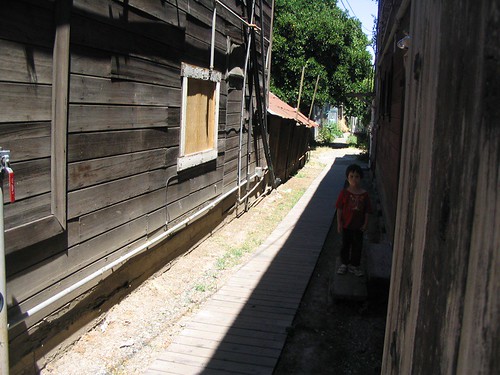
Rutabaga hides in the shade of a Locke alley.
I just finished reading a lovely oral history of Locke, with photos accompanying the stories of the elderly residents. Written and photographed in the 70's and early 80's by James Motlow, a white guy who had lived in Locke, along with a co-writer Jeff Gillenkirk, and Connie Chan, a Locke native who worked as their interpreter for the project, Bitter Melon presents a range of experiences: the relatively successful men who got work as foremen or ran the local businesses, the women who worked in local canneries and often had to leave their kids to fend for themselves, and the dollar-a-day laborers who never made enough to get married and start families, go back to visit parents in China, or to move out of the little town as it shrank away.
In the 80s, a Historic American Buildings Survey documented the town. The whole report is worth checking out, especially the photo series of the town.
Finally, and I probably should have put this first, you should check Locke's own website. You can see photos of just about every building, and read about the galleries and historic sites that are there now.
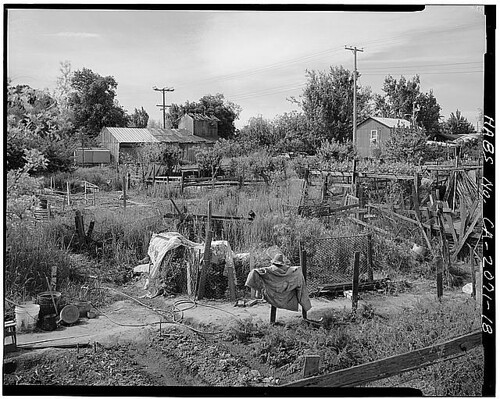
The community garden behind the town of Locke, from the Historic American Buildings Survey of the National Park Service.
On the way back to our car, Rutabaga and I passed a family trying to resolve some engine trouble outside of their home on Locke's second street. They seemed to be immigrants too, Latin American not Chinese, as Mexican and other Central American immigrants are now the main laborers along the Delta and throughout our country's agricultural sectors. A couple of visiting painters were packing up their little canvases of Locke's scenic buildings and getting ready to drive off too. Ru and I pulled out onto the road. Not north (like Stuart Little), but (like him) I somehow felt I was headed in the right direction.
6.26.2007
S.F. Shootout

I'm glad that I'm not a professional historian because if I were, I might have to find some other way to express this: Dennis Kearney* was an utter ass-wipe. An immigrant himself, Kearney founded California's briefly influential (and highly racist) Workingman's Party. He made a political career out of the thoughtful slogan, "The Chinese Must Go". His fiery speeches were quite radical – he advocated lynching of wealthy business owners – but he wasn't marginal. His political ally, Isaac Kalloch, became San Francisco's mayor in 1879.
That is disturbing, but not surprising. Here's the crazy part: in the 1870s, the founder and editor of the Chronicle, Charles de Young, railed against Kearney and Kalloch (then only a mayoral candidate) in his paper. I haven't read the editorials directly – anyone know of where I can find those archives online? But from what I understand, de Young wasn't particularly concerned with Kalloch's racism, but more with his popularity. Trying to undermine the mayoral candidate, he publicly exposed a sex scandal that Kalloch (a Baptist minister) had been involved with in another state. Kalloch ridiculed de Young right back and from the pulpit, calling de Young's mother "whore-mongering", and then in retaliation de Young, the editor of the Chronicle, shot Kalloch, the mayoral candidate!

Kalloch survived, and won the election in part because of the sympathy he garnered for his injury, but a year later his son, defending the family honor, fatally shot de Young. He admitted to the shooting but got off free. Fortunately, Kearney's Workingman's Party faded shortly thereafter, but Kalloch did fine, serving two years as mayor.
*Note that Wikipedia reveals that Kearny Street, which runs right through Chinatown in SF is not actually named after Dennis Kearney. This information comes as a relief, but I wasn't too excited to learn who it was named after: Stephen Kearny, who founded of the US Cavalry and used those troops to expand white US occupation into Native American homelands in the Western part of the continent. He went on to command a number of battalions in the Mexican-American War, winning California for the US of A, which, I imagine, is why he got a street named after him in San Francisco. Related: we can also breathe a sigh of relief that Geary street is named after a former postmaster, not California Congressman Thomas Geary, who wrote an 1892 law extending the Chinese Exclusion Act, and expanding it to require Chinese-Americans to carry permits at all times, or risk deportation or punishment by hard labor. His act also denied habeus corpus to imprisoned Chinese-Americans, removing their rights to ask a judge to review the legality of their detentions. If you want to know who any other SF streets are not named for, look at this site.
6.25.2007
Anti-Chinese violence
I’m going to do a few entries about the history Chinese-Americans in the Bay Area, and the relationship between the white labor movement and Chinese workers. It's been pretty disturbing reading about this stuff. I had a sense of some of the racism that was historically directed at Chinese immigrants, but I certainly didn't understand the scale. The most appropriate word to describe what happened to Chinese people here is probably 'pogroms'. I grew up here in California, and I definitely didn't learn about any of this in school. Anyway, here's the first post – about labor:
During the Gold Rush, prospectors, mostly men, flooded into San Francisco from all over the world. Most came from the Eastern United States, but also from outside of the country, especially Chile and China. Chinese gold-seekers made up a significant portion of the new 'settlers', setting up communities in San Francisco and in rural areas too.
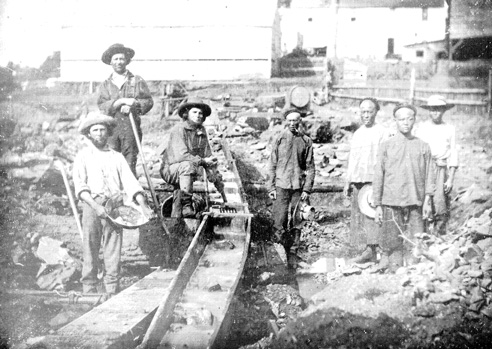
This 1852 photo by J. B. Starkweather shows a rare site: Chinese and European Americans working together in a gold mining operation.
Over the next few decades, Chinese immigrants became involved in a wide-range of work: Rurally, Chinese settlers created the fishing industry here, established agriculture in the Central Valley, and worked as laborers building the levee systems on the Delta, almost always living in isolated, Chinese-only communities. By the 1860s, 2/3 of the laborers building the Western portion of the transcontinental railroad were Chinese men.
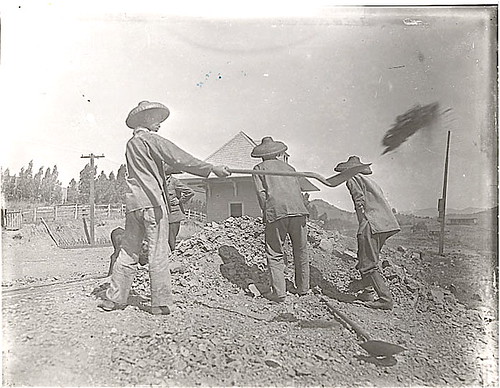
Chinese rail workers in 1898, from the California Historical Society, San Francisco
In urban settings, Chinese workers took jobs in just about every trade: manufacturing, building, and running small businesses including laundries, restaurants, markets, and repair shops. Around the Bay Area, traveling Chinese peddlers sold fresh produce out of large baskets that they'd carry from house to house, and later from the back of horse-drawn produce carts.
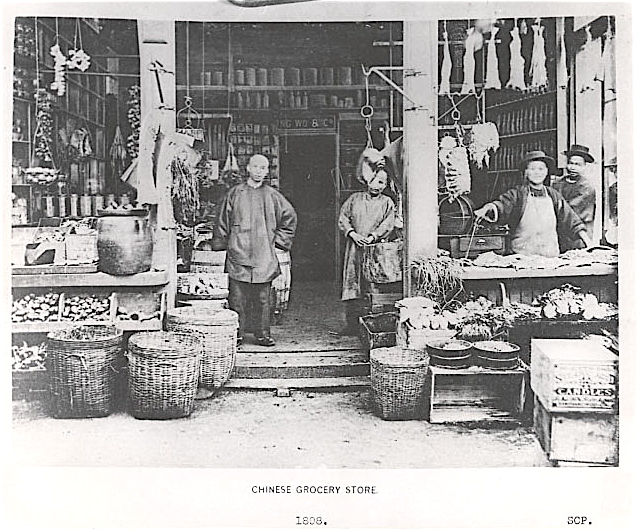
1898 – a produce market. Photo by Roy Graves
Like many immigrants, new arrivals from China tended to stick together in the same neighborhoods, seeking out and forming supportive associations with people who came from their same regions and extended families back home. But the segregation of Chinese men and women into Chinatowns wasn't just a preference of the residents there. It was mandated by law and required for safety.
It would be difficult to exaggerate the level of hostility and violence directed towards Chinese-Americans in the late 19th century. Before I started reading about this a few weeks ago, I had no idea how overwhelming and horrific this bit of history was: white Americans, encouraged by labor leaders and sometimes officially sanctioned by local governments, perpetrated a series of pogroms against Chinese communities throughout the late 1800s. A few examples:
- In 1871 in Los Angeles a brutal race riot left roughly 20 Chinese men dead, after white residents ransacked Chinatown there.
- In 1885, in Wyoming, European immigrant mine workers rioted against Chinese workers (who were paid less than white workers and who had historically been recruited as strikebreakers), killing 28 Chinese miners and destroying 75 of their homes.
- In 1886, virtually every Chinese resident of Seattle was rounded up in an attempt to remove them from the city.
- In 1887, 31 Chinese gold miners were murdered by bandits in Oregon, and no one was prosecuted for the murders.
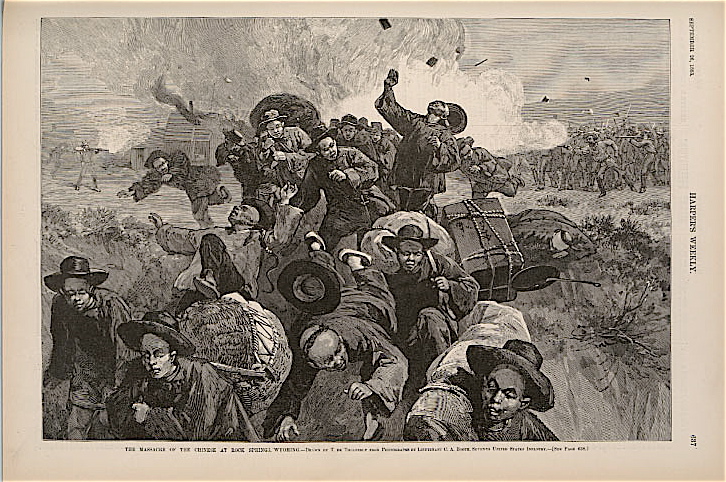
"Massacre of the Chinese at Rock Springs, Wyoming" From Harper's Weekly housed at the Bancroft Library, University of California, Berkeley
Legal repression of Chinese immigrants escalated dramatically as the years progressed: By 1852, Chinese gold miners were subject to a significant foreigner tax that no other international miners were required to pay. Two years later, the Supreme Court of California extended to Chinese people a ban already in place prohibiting 'Negroes' and 'Indians' from testifying for or against white people. In 1872, Chinese people were barred from owning real estate or business licenses in California. And devastatingly, in 1882, Congress enacted the Chinese Exclusion Act, barring Chinese laborers from entering the country. This ban was generally applied to almost every Chinese person, making it impossible for example for Chinese men already living in the US to bring their families here to join them. (And because the immigrants who came here from China were almost exclusively male, and because the Exclusion Act prohibited anyone else from coming, the Chinese community dwindled as its bachelor class aged without raising children.) The Chinese Exclusion Act wasn't repealed until the 1940s and the severe immigration quotas reserved only for Chinese immigrants weren't ended until 1965. 1965!
Theorists and intellectuals fell over each other advocating for the removal of Chinese people from this country. Here's a fairly typical anti-Chinese screed of the time, devoted to the "Chinese Question". I confess, I didn't read this whole steaming pile of garbage, and instead skipped to the final chapter (starts on 196) titled "One course, and one course only, can stay the Eastward migration of the yellow race, and its gradual conquest of the land." You can guess what course that is. 'Progressive' non-Chinese thinkers tended to advocate for Chinese immigrants solely on the basis that they were willing to do the tedious, humiliating, or back-breaking work that white people were refusing to take. Hmm, sounds familiar.
Government leaders and others in the mainstream were certainly responsible for the legal sanction of racism here, but labor leaders in particular should be held culpable for the anti-Chinese hysteria of that time. By the 1870s, the country was experiencing a post-Civil War economic downturn. Jobs were hard to come by. In California, the gold that so many people had flooded in to find was already mostly gone by the early 1850s. Meanwhile, the monopolistic railway companies (and most other industries), exploited Chinese workers by paying them less than the going wage for white workers. Instead of directing their hatred solely at the Goliath-like industrial giants, white labor turned to a seemingly easier target. A couple quick examples:
Samuel Gompers, founder of the AFL, co-authored a paper entitled, "Some Reasons for Chinese Exclusion. Meat vs. Rice. American Manhood against Asiatic Coolieism. Which Shall Survive?"
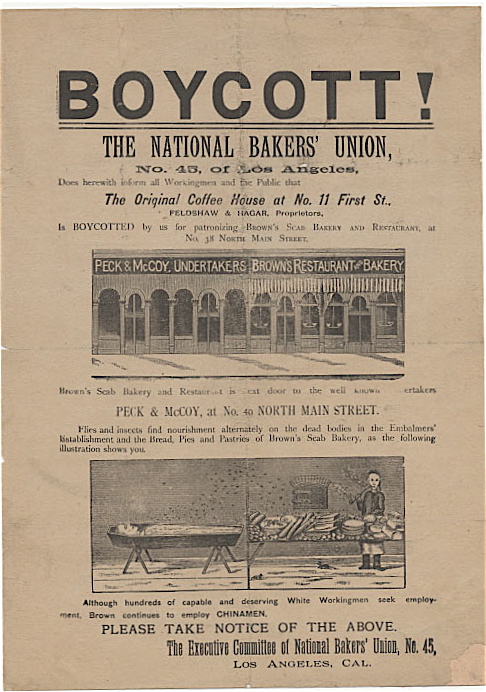
I'm not going to reproduce the most grossly offensive posters, pamphlets, and cartoons I've found that were produced by labor advocates in opposition to the Chinese, but here's a typically racist 1889 poster promoting a boycott of a business that was rumored to have hired Chinese workers: It's from the California Historical Society.
In San Francisco, anti-Chinese sentiment was common. The city's most famous anti-Chinese 'advocate' was Dennis Kearney publicly advocated rioting against both bosses and Chinese people at the old Sand Lot near City Hall.
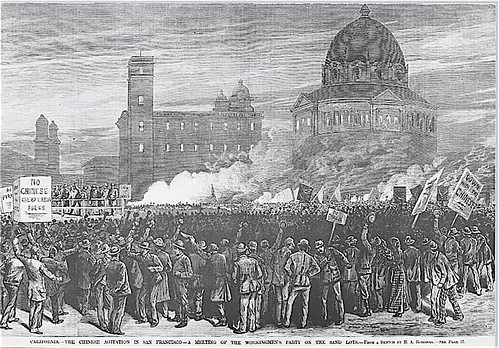
White labor's anti-Chinese hysteria was horrifying, and it was also a missed opportunity. Directing rage towards immigrants (rather than business owners) didn't change labor conditions, or make workers wealthier. As usual, bigotry trumped solidarity.
Anti-Chinese violence peaked in the 1880s, but it's probably obvious that anti-Chinese sentiment (and legislation) wasn't over. It wasn't until WWII that there were significant improvements in legal and living conditions for Chinese people living here. And of course, racism directed at Chinese-American's is still a major issue. A 2001 phone study indicated that one in four Americans has 'strong negative feelings' towards Chinese Americans.
I'm going to close this out for now. Next week I should have some more on Chinese resistance to racism.
Signing off,
During the Gold Rush, prospectors, mostly men, flooded into San Francisco from all over the world. Most came from the Eastern United States, but also from outside of the country, especially Chile and China. Chinese gold-seekers made up a significant portion of the new 'settlers', setting up communities in San Francisco and in rural areas too.
This 1852 photo by J. B. Starkweather shows a rare site: Chinese and European Americans working together in a gold mining operation.
Over the next few decades, Chinese immigrants became involved in a wide-range of work: Rurally, Chinese settlers created the fishing industry here, established agriculture in the Central Valley, and worked as laborers building the levee systems on the Delta, almost always living in isolated, Chinese-only communities. By the 1860s, 2/3 of the laborers building the Western portion of the transcontinental railroad were Chinese men.
Chinese rail workers in 1898, from the California Historical Society, San Francisco
In urban settings, Chinese workers took jobs in just about every trade: manufacturing, building, and running small businesses including laundries, restaurants, markets, and repair shops. Around the Bay Area, traveling Chinese peddlers sold fresh produce out of large baskets that they'd carry from house to house, and later from the back of horse-drawn produce carts.
1898 – a produce market. Photo by Roy Graves
Like many immigrants, new arrivals from China tended to stick together in the same neighborhoods, seeking out and forming supportive associations with people who came from their same regions and extended families back home. But the segregation of Chinese men and women into Chinatowns wasn't just a preference of the residents there. It was mandated by law and required for safety.
It would be difficult to exaggerate the level of hostility and violence directed towards Chinese-Americans in the late 19th century. Before I started reading about this a few weeks ago, I had no idea how overwhelming and horrific this bit of history was: white Americans, encouraged by labor leaders and sometimes officially sanctioned by local governments, perpetrated a series of pogroms against Chinese communities throughout the late 1800s. A few examples:
- In 1871 in Los Angeles a brutal race riot left roughly 20 Chinese men dead, after white residents ransacked Chinatown there.
- In 1885, in Wyoming, European immigrant mine workers rioted against Chinese workers (who were paid less than white workers and who had historically been recruited as strikebreakers), killing 28 Chinese miners and destroying 75 of their homes.
- In 1886, virtually every Chinese resident of Seattle was rounded up in an attempt to remove them from the city.
- In 1887, 31 Chinese gold miners were murdered by bandits in Oregon, and no one was prosecuted for the murders.
"Massacre of the Chinese at Rock Springs, Wyoming" From Harper's Weekly housed at the Bancroft Library, University of California, Berkeley
Legal repression of Chinese immigrants escalated dramatically as the years progressed: By 1852, Chinese gold miners were subject to a significant foreigner tax that no other international miners were required to pay. Two years later, the Supreme Court of California extended to Chinese people a ban already in place prohibiting 'Negroes' and 'Indians' from testifying for or against white people. In 1872, Chinese people were barred from owning real estate or business licenses in California. And devastatingly, in 1882, Congress enacted the Chinese Exclusion Act, barring Chinese laborers from entering the country. This ban was generally applied to almost every Chinese person, making it impossible for example for Chinese men already living in the US to bring their families here to join them. (And because the immigrants who came here from China were almost exclusively male, and because the Exclusion Act prohibited anyone else from coming, the Chinese community dwindled as its bachelor class aged without raising children.) The Chinese Exclusion Act wasn't repealed until the 1940s and the severe immigration quotas reserved only for Chinese immigrants weren't ended until 1965. 1965!
Theorists and intellectuals fell over each other advocating for the removal of Chinese people from this country. Here's a fairly typical anti-Chinese screed of the time, devoted to the "Chinese Question". I confess, I didn't read this whole steaming pile of garbage, and instead skipped to the final chapter (starts on 196) titled "One course, and one course only, can stay the Eastward migration of the yellow race, and its gradual conquest of the land." You can guess what course that is. 'Progressive' non-Chinese thinkers tended to advocate for Chinese immigrants solely on the basis that they were willing to do the tedious, humiliating, or back-breaking work that white people were refusing to take. Hmm, sounds familiar.
Government leaders and others in the mainstream were certainly responsible for the legal sanction of racism here, but labor leaders in particular should be held culpable for the anti-Chinese hysteria of that time. By the 1870s, the country was experiencing a post-Civil War economic downturn. Jobs were hard to come by. In California, the gold that so many people had flooded in to find was already mostly gone by the early 1850s. Meanwhile, the monopolistic railway companies (and most other industries), exploited Chinese workers by paying them less than the going wage for white workers. Instead of directing their hatred solely at the Goliath-like industrial giants, white labor turned to a seemingly easier target. A couple quick examples:
Samuel Gompers, founder of the AFL, co-authored a paper entitled, "Some Reasons for Chinese Exclusion. Meat vs. Rice. American Manhood against Asiatic Coolieism. Which Shall Survive?"
I'm not going to reproduce the most grossly offensive posters, pamphlets, and cartoons I've found that were produced by labor advocates in opposition to the Chinese, but here's a typically racist 1889 poster promoting a boycott of a business that was rumored to have hired Chinese workers: It's from the California Historical Society.
In San Francisco, anti-Chinese sentiment was common. The city's most famous anti-Chinese 'advocate' was Dennis Kearney publicly advocated rioting against both bosses and Chinese people at the old Sand Lot near City Hall.
White labor's anti-Chinese hysteria was horrifying, and it was also a missed opportunity. Directing rage towards immigrants (rather than business owners) didn't change labor conditions, or make workers wealthier. As usual, bigotry trumped solidarity.
Anti-Chinese violence peaked in the 1880s, but it's probably obvious that anti-Chinese sentiment (and legislation) wasn't over. It wasn't until WWII that there were significant improvements in legal and living conditions for Chinese people living here. And of course, racism directed at Chinese-American's is still a major issue. A 2001 phone study indicated that one in four Americans has 'strong negative feelings' towards Chinese Americans.
I'm going to close this out for now. Next week I should have some more on Chinese resistance to racism.
Signing off,
6.19.2007
Some self indulgence
My next topic – Chinese-American workers and the relationship of the white labor movement to the Chinese community of the Bay Area is kind of enormous. While I continue my 'research' (mostly late night googling), you can tide yourself over with documentation of my efforts.
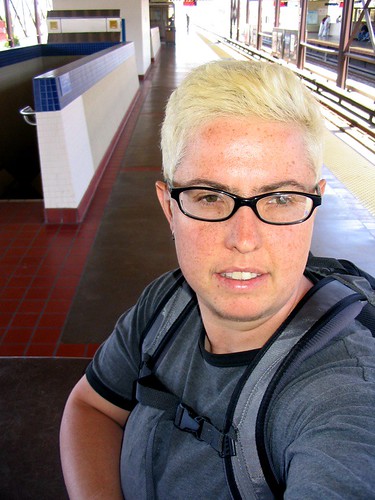
Friday afternoon: our intrepid blogger sets off for a research mission.
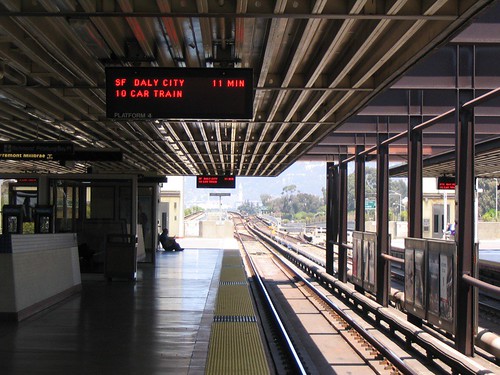
Damn. Missed my train. Yet, in less time than it takes me to answer my emails, I made it to San Francisco. Near, and yet far from my provincial home in Oak Land. First attraction in SF, the F line.
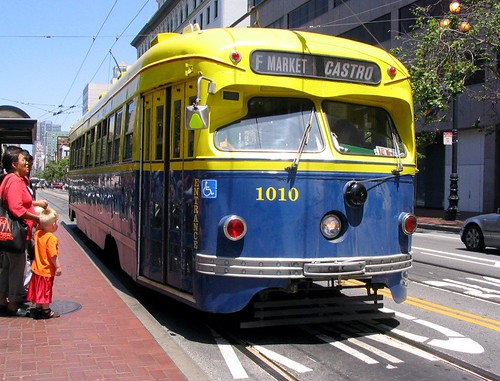
It's designed for the enjoyment of history nerds like me! And of course to attract tourist dollars. But so what! It's so shiney!
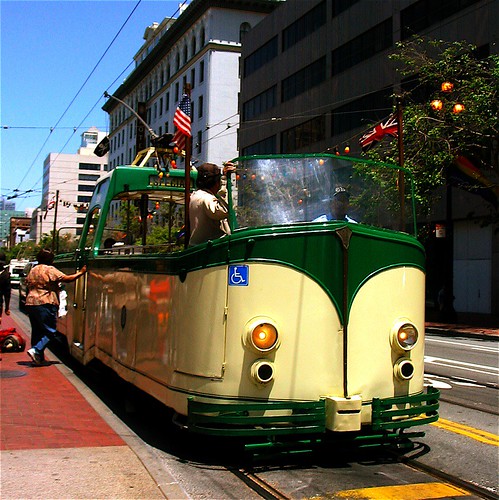
Woo-hoo! Boat train!
OK, time to go to the library. Every time I come to the San Francisco Main branch I play "Where are the books?"
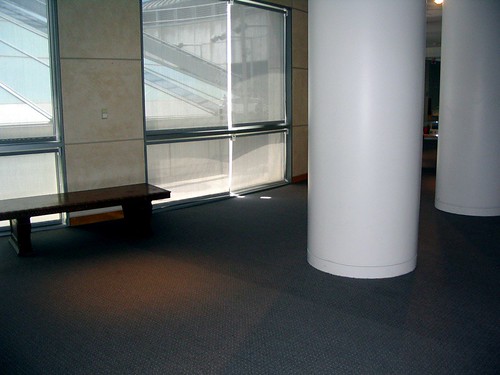
Nope, not here:
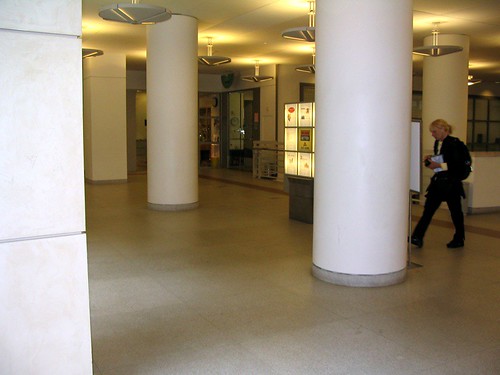
Not here either.
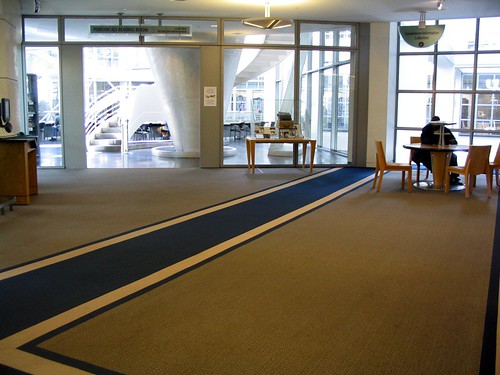
None here either. Oh well, who has time for books anyway - time is limited when you've got to think about childcare. I quickly move on to the hallowed grounds of the SF History Center! Here, you must check your bags, sign in at the front desk, and walk silently among the softly-lit shelves.
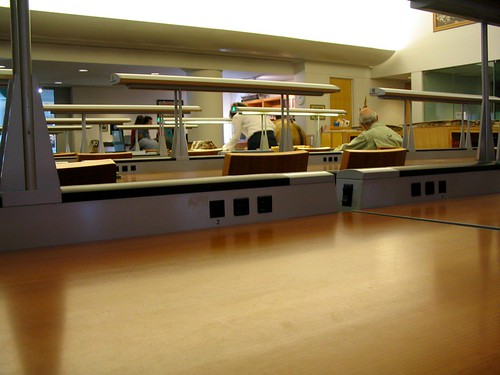
It's best to speak in hushed tones around the historians - they scare easily. And frankly, I was kind of sweaty and incoherent when I arrived. I cornered a soft-spoken librarian and described my blog project to him in detail. When I was finished he nodded helpfully and then said, "It would be easier if you put your request in the form of a question."
He was able to assist me though by piling a large stack of bibliographies in front of me. Since I've never done academic research of any kind, I'm not sure if that's the best place to start, but at least I now know what to look up when I go back.
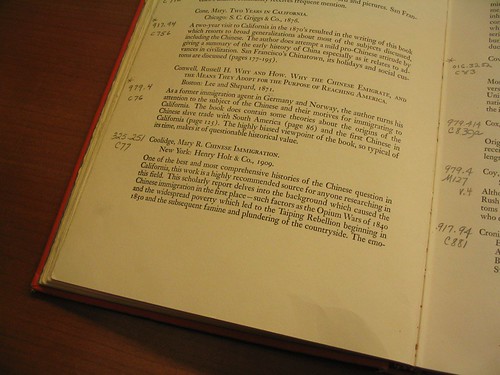
I really hit pay dirt with this bibliography about Chinese American's in California. I love picturing the poor soul (or enthusiastic obsessive compulsive) who hand wrote the dewey decimal number for each entry into the margins.
I spent most of the afternoon reading from this congressional report on Chinese Immigration – a nauseating foundation for the Chinese Exclusion Act of 1882.
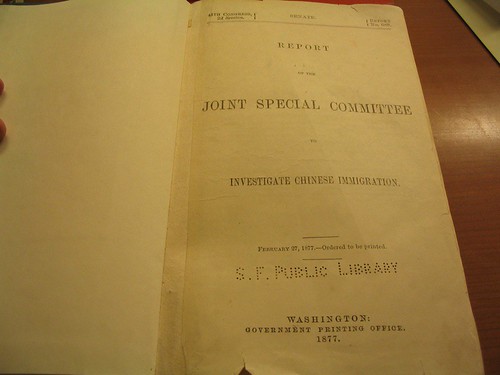
I found out later that the whole ugly thing is digitized. So if I can make it through hundreds of pages of the white men of business and congress falling over each other to present Chinese immigrants as gamblers, prostitutes, and disease vectors, I'll be able to complete it at my leisure.
Several hours later, my childcare was about to run out. I collected my backpack from the quiet librarian, and as I left, he mentioned that perhaps I should check the Chinese Center on the third floor. WTF?! I should have been there in the first place!
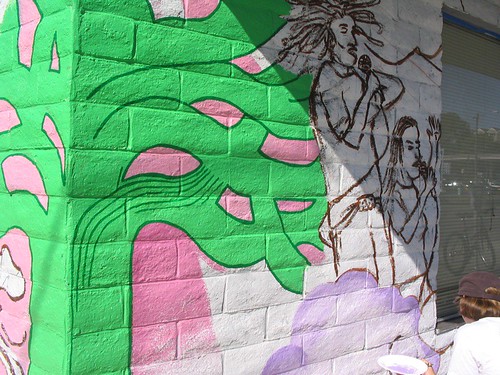
Still, I was in a good mood – a history junkie happily fixed – the whole way home. I even stopped to say hello to the folks painting a new mural on the Ella Baker Center. Good luck muralists! Way to represent for Oakland!
Friday afternoon: our intrepid blogger sets off for a research mission.
Damn. Missed my train. Yet, in less time than it takes me to answer my emails, I made it to San Francisco. Near, and yet far from my provincial home in Oak Land. First attraction in SF, the F line.
It's designed for the enjoyment of history nerds like me! And of course to attract tourist dollars. But so what! It's so shiney!
Woo-hoo! Boat train!
OK, time to go to the library. Every time I come to the San Francisco Main branch I play "Where are the books?"
Nope, not here:
Not here either.
None here either. Oh well, who has time for books anyway - time is limited when you've got to think about childcare. I quickly move on to the hallowed grounds of the SF History Center! Here, you must check your bags, sign in at the front desk, and walk silently among the softly-lit shelves.
It's best to speak in hushed tones around the historians - they scare easily. And frankly, I was kind of sweaty and incoherent when I arrived. I cornered a soft-spoken librarian and described my blog project to him in detail. When I was finished he nodded helpfully and then said, "It would be easier if you put your request in the form of a question."
He was able to assist me though by piling a large stack of bibliographies in front of me. Since I've never done academic research of any kind, I'm not sure if that's the best place to start, but at least I now know what to look up when I go back.
I really hit pay dirt with this bibliography about Chinese American's in California. I love picturing the poor soul (or enthusiastic obsessive compulsive) who hand wrote the dewey decimal number for each entry into the margins.
I spent most of the afternoon reading from this congressional report on Chinese Immigration – a nauseating foundation for the Chinese Exclusion Act of 1882.
I found out later that the whole ugly thing is digitized. So if I can make it through hundreds of pages of the white men of business and congress falling over each other to present Chinese immigrants as gamblers, prostitutes, and disease vectors, I'll be able to complete it at my leisure.
Several hours later, my childcare was about to run out. I collected my backpack from the quiet librarian, and as I left, he mentioned that perhaps I should check the Chinese Center on the third floor. WTF?! I should have been there in the first place!
Still, I was in a good mood – a history junkie happily fixed – the whole way home. I even stopped to say hello to the folks painting a new mural on the Ella Baker Center. Good luck muralists! Way to represent for Oakland!
6.17.2007
GLBT Historical Archives
I'm working on an entry about the history of SF and Oakland Chinatowns, but in the meantime, let me turn your attention to the Gay, Lesbian, Bisexual, and Transexual Historical Society's page on youtube. This is the greatest use of youtube I can possibly imagine.
The first video I found there, theoretically of Black Sabbath playing the Folsom Street Parade in 1970, has been vexing me for a while. When I first discovered it, everyone I knew said "there's no fucking way that's Ozzy". I'm no expert on Oz, but I was also confused by the "Folsom Street Parade" thing. Folsom Street Fair didn't start until 1984. What was this drag parade doing South of Market with a big float advertising Sabbath?
Well, thanks to the rocker/investigators of youtube, I finally have my answer. According to user Terrible1, that dude in black atop the Sabbath float is noted San Francisco Satanist, Anton LeVay. Apparently, Ozzy himself also makes a brief appearance. Oz fans, feel free to let me know if you see him here.
Moving on to gayer historical matters, here's Sylvester tearing it up in 1985:
Cakalingus at 5:05.
Seriously, there's a lot of great stuff to explore on their page. This footage of the 1989 Castro sweep is probably only interesting to those of you who were there, but I always enjoy watching queers scream at riot cops. Listen for that catchy slogan: "Media is Bullshit! It's all a pack of LIES!"
I'll finish this post off with an extremely special video of the 1975 Mr. and Miss Gay San Francisco contest. I kind of like that there's no sound, it adds to the ethereal, Antediluvian quality.
The first video I found there, theoretically of Black Sabbath playing the Folsom Street Parade in 1970, has been vexing me for a while. When I first discovered it, everyone I knew said "there's no fucking way that's Ozzy". I'm no expert on Oz, but I was also confused by the "Folsom Street Parade" thing. Folsom Street Fair didn't start until 1984. What was this drag parade doing South of Market with a big float advertising Sabbath?
Well, thanks to the rocker/investigators of youtube, I finally have my answer. According to user Terrible1, that dude in black atop the Sabbath float is noted San Francisco Satanist, Anton LeVay. Apparently, Ozzy himself also makes a brief appearance. Oz fans, feel free to let me know if you see him here.
Moving on to gayer historical matters, here's Sylvester tearing it up in 1985:
Cakalingus at 5:05.
Seriously, there's a lot of great stuff to explore on their page. This footage of the 1989 Castro sweep is probably only interesting to those of you who were there, but I always enjoy watching queers scream at riot cops. Listen for that catchy slogan: "Media is Bullshit! It's all a pack of LIES!"
I'll finish this post off with an extremely special video of the 1975 Mr. and Miss Gay San Francisco contest. I kind of like that there's no sound, it adds to the ethereal, Antediluvian quality.
6.13.2007
South African strike
Speaking of general strikes, South African public sector workers are all out this week, with support from some private sector unions as well.
More at the Mail and Guardian and the BBC
More at the Mail and Guardian and the BBC
6.12.2007
Oakland General Strike Part II
Read Part I
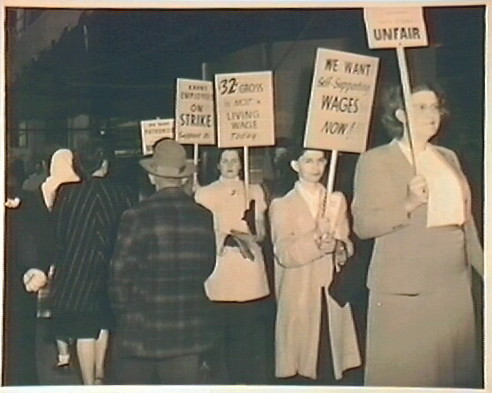
Striking department store clerks, photo from the Oakland Museum of California.
In the first few days of December 1946, retail workers at Hastings' and Kahn's department stores, across the street from each other where Broadway meets Telegraph, had been on strike for more than a month. Most of the workers were women. Their pay was shitty, less than $16 a week, and worse, they were subjected to an absurd procedure where they had to show up to work first thing in the morning, and then wait in the basement (unpaid), until they were called to the floor to work. A clerk could easily be stuck in the basement all morning, or even all day.
The Teamsters local had supported the retail workers strike from the beginning. They refused to deliver anything to the struck stores. (When I was at the Labor Archives, I even saw minutes from the Teamsters Local 70 meeting showing a member being expelled for trying to deliver to Kahn's in November.) The local NAACP and National Negro Congress publicly supported the striking workers. And union laborers had stopped painting and construction of a new elevator at Kahn's in solidarity.
On the business side, the Oakland Tribune, then run by republican powerhouse Joe Knowland, advocated a citywide ban of pickets. According to Albert Lannon's Fight or Be Slaves, right-wing city council members were publicly objecting to the use of the word 'scab'. Most detrimentally, the city agreed to send out the police force to escort delivery trucks to the stores, so they could keep stock for the Christmas shopping season.
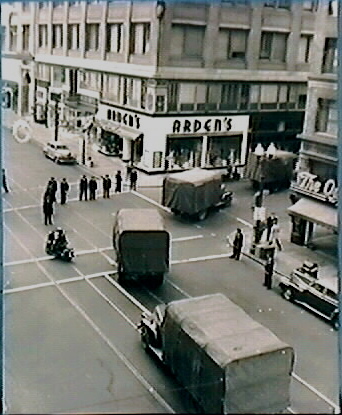
OPD escorting delivery trucks from the notoriously anti-union company G.I. Trucking. From the Oakland Museum of California.
That move was too much for the local labor council. The night of December 1st, a Saturday, Teamsters patrolled every roadway into Oakland to keep the delivery trucks away, and the labor council organized members to use their cars to block the parking spaces surrounding the effected stores. Several hundred picketers came out in the middle of the night to keep the scabs out.
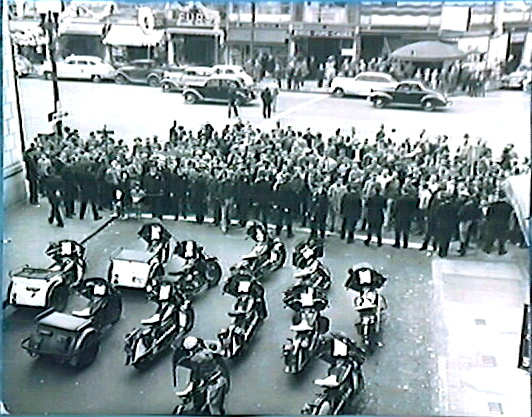
Cops block the street to keep strikers out. From the Oakland Museum of California
At 4 in the morning the cops started towing the strikers cars and blocking off sections of Broadway, Telegraph, and San Pablo. When they waved the streetcars through their police line at 6:30 Sunday morning, a driver told the cops that he'd never crossed a picket line, got out of the car and removed its control box, causing an immovable backup along the streetcar line. The general strike was on, although it was another day before the whole city was out.
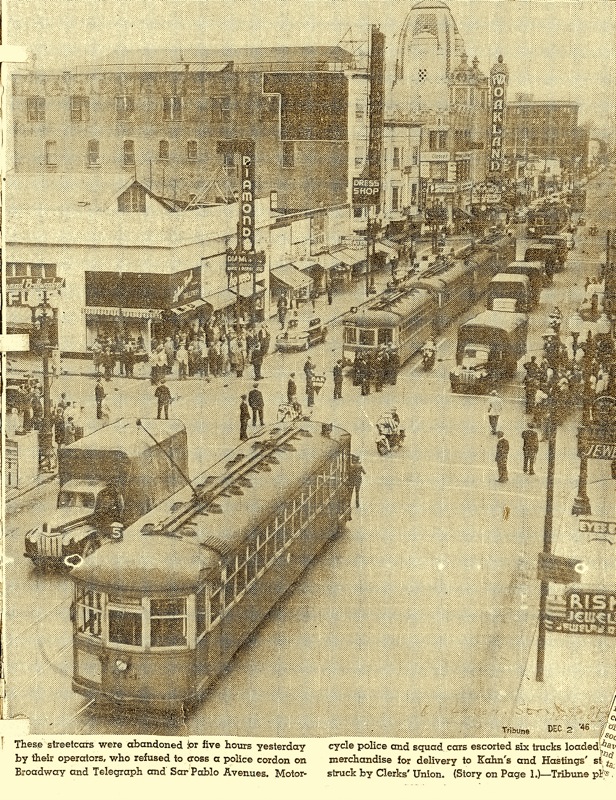
Tribune clipping from the Oakland History Room.
At a long and fevered meeting of various local AFL union leaders Sunday afternoon (the clerks were affiliated with the AFL), Teamsters pledged that because of the strikebreaking deliveries, they would shut down work in the East Bay starting Monday. Every other union but the milk truck drivers' agreed, and the milk truck drivers only insisted on working in order to get milk to local hospitals. Labor leaders went on the radio to declare Monday a 'work holiday' and to call everyone downtown, to the center of the strike, to show their support.
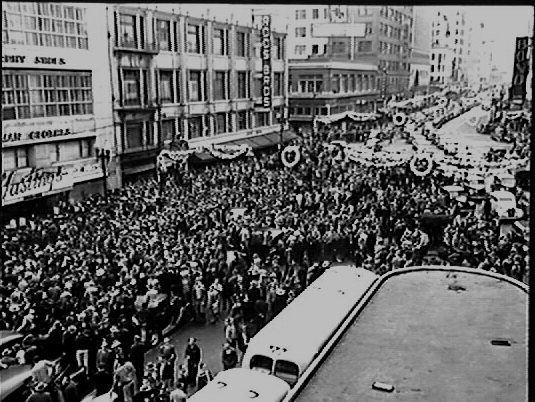
From the Oakland Museum of California.
At the peak, as many as 30,000 people were packed into the rainy downtown streets. The mood was excited to say the least. Bars were allowed to stay open, but they were only allowed to serve beer, and were told to turn their jukeboxes out to face the street, where people were literally dancing. All AFL building trades were shut down. All East Bay newspapers were shut down. Buses, streetcars, greyhounds, taxis, and trucking were stopped. Gas stations were closed too. Hotels, movie theaters, and larger restaurants and grocery stores were shut.
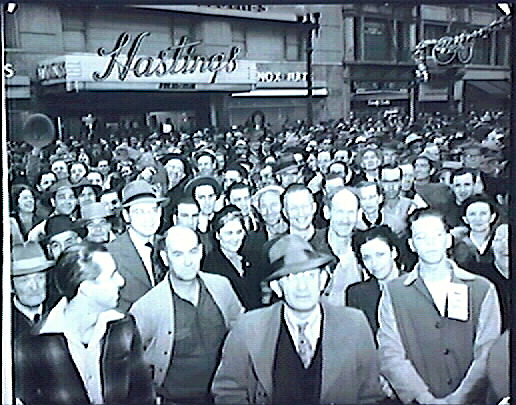
The picture's pretty blurry, but can you make out those huge grins? From the Oakland Museum again.
I've read conflicting stories on this, but from what I understand, the CIO, the second-largest umbrella union organization in Oakland, had offered their support the night before the strike. They were patently turned down. AFL leaders didn't want to be associated with the CIO whose on-the-ground organizers were largely communist. Robert Ash, the head of the labor council was quite progressive, but balked at working together, imagining headlines in the paper saying "Reds cause Anarchy Downtown" and so forth. Besides the communist associations, the AFL and CIO were rivals not comrades. Working directly with the CIO would have brought about ugly repercussions from national AFL leadership. The CIO honored picket lines anyway, and finally, on the third day of the strike, called for a general meeting to vote on whether to walk out themselves. A CIO walkout would have cut off gas and electricity to most of the city. At this suggestion, Oakland's city manager was ready to settle.
But the unions had lost the upper hand. The national vice president of the Teamsters, Dave Beck, told the local to withdraw from the general strike. He didn't support revolution, and apparently, the strike was developing that flavor. Rumors circulated that Governor Earl Warren was going to send in the National Guard, and the mayor had declared a state of emergency.
Instead of holding their ground, the union negotiated with Oakland's city manager only for an agreement that police would not be used to break strikes. There was no settlement for the department store clerks (who stayed on strike for eight more months, and then had to settle for a weak contract before they finally negotiated a better deal and a closed union shop in May of '47). There was certainly no attempt to make structural change in the city. Robert Ash from the Labor Council admitted later, in retrospect, that had they held out, they could have had more. Maybe they could have gotten the whole right-wing city leadership to resign.
But even that laudable goal suffers from a failure of imagination. Workers owned the city for those three days. They could have done anything. On the other hand, what can you do when you suddenly control your own world? When you have the power to rearrange everything, if only you can agree with tens of thousands of others who share that power? Who knew what to do with complete worker control of a city?
A year later that kind of question hardly mattered anyway. In 1947, congress passed the Taft-Hartley Act outlawing secondary boycotts (boycotts of union companies that do business with a struck company), removing government protection for wildcat (unofficial) strikers, and allowing the president to force workers back to their jobs if he feels that their strike "imperils the national health". The phenomenon of the General Strike came to an abrupt end.
In the aftermath, the Teamsters local withdrew from the central labor council (and not long after, the national Teamsters withdrew from the AFL). Voters elected a labor slate of candidates for the City Council in '47, but not enough to get a majority, and the winners didn't work very well as a team, and were voted out a few years later. Oakland changed dramatically after the war, demographics changed, the beginnings of civil right struggles emerged, but worker control was not on the agenda.
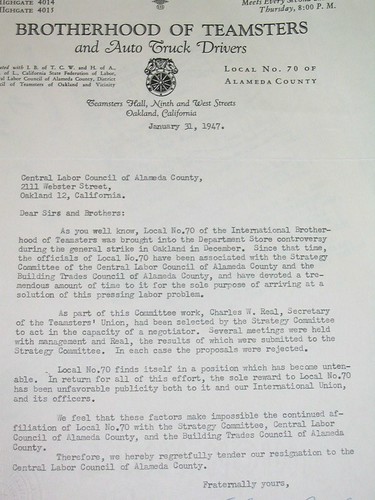
Found at the Oakland History Room.
If you're interested in the Oakland general strike, I'd recommend Chris Rhomberg's No There There. Online you can listen to a nice KPFA documentary on the strike that features interviews with participants and more on the historical context that led to the strike. Also, check out longshoreman and publisher Stan Weir's account of the strike at the very cool libcom.org or Dick Meister's summery on ZNet.
Striking department store clerks, photo from the Oakland Museum of California.
In the first few days of December 1946, retail workers at Hastings' and Kahn's department stores, across the street from each other where Broadway meets Telegraph, had been on strike for more than a month. Most of the workers were women. Their pay was shitty, less than $16 a week, and worse, they were subjected to an absurd procedure where they had to show up to work first thing in the morning, and then wait in the basement (unpaid), until they were called to the floor to work. A clerk could easily be stuck in the basement all morning, or even all day.
The Teamsters local had supported the retail workers strike from the beginning. They refused to deliver anything to the struck stores. (When I was at the Labor Archives, I even saw minutes from the Teamsters Local 70 meeting showing a member being expelled for trying to deliver to Kahn's in November.) The local NAACP and National Negro Congress publicly supported the striking workers. And union laborers had stopped painting and construction of a new elevator at Kahn's in solidarity.
On the business side, the Oakland Tribune, then run by republican powerhouse Joe Knowland, advocated a citywide ban of pickets. According to Albert Lannon's Fight or Be Slaves, right-wing city council members were publicly objecting to the use of the word 'scab'. Most detrimentally, the city agreed to send out the police force to escort delivery trucks to the stores, so they could keep stock for the Christmas shopping season.
OPD escorting delivery trucks from the notoriously anti-union company G.I. Trucking. From the Oakland Museum of California.
That move was too much for the local labor council. The night of December 1st, a Saturday, Teamsters patrolled every roadway into Oakland to keep the delivery trucks away, and the labor council organized members to use their cars to block the parking spaces surrounding the effected stores. Several hundred picketers came out in the middle of the night to keep the scabs out.
Cops block the street to keep strikers out. From the Oakland Museum of California
At 4 in the morning the cops started towing the strikers cars and blocking off sections of Broadway, Telegraph, and San Pablo. When they waved the streetcars through their police line at 6:30 Sunday morning, a driver told the cops that he'd never crossed a picket line, got out of the car and removed its control box, causing an immovable backup along the streetcar line. The general strike was on, although it was another day before the whole city was out.
Tribune clipping from the Oakland History Room.
At a long and fevered meeting of various local AFL union leaders Sunday afternoon (the clerks were affiliated with the AFL), Teamsters pledged that because of the strikebreaking deliveries, they would shut down work in the East Bay starting Monday. Every other union but the milk truck drivers' agreed, and the milk truck drivers only insisted on working in order to get milk to local hospitals. Labor leaders went on the radio to declare Monday a 'work holiday' and to call everyone downtown, to the center of the strike, to show their support.
From the Oakland Museum of California.
At the peak, as many as 30,000 people were packed into the rainy downtown streets. The mood was excited to say the least. Bars were allowed to stay open, but they were only allowed to serve beer, and were told to turn their jukeboxes out to face the street, where people were literally dancing. All AFL building trades were shut down. All East Bay newspapers were shut down. Buses, streetcars, greyhounds, taxis, and trucking were stopped. Gas stations were closed too. Hotels, movie theaters, and larger restaurants and grocery stores were shut.
The picture's pretty blurry, but can you make out those huge grins? From the Oakland Museum again.
I've read conflicting stories on this, but from what I understand, the CIO, the second-largest umbrella union organization in Oakland, had offered their support the night before the strike. They were patently turned down. AFL leaders didn't want to be associated with the CIO whose on-the-ground organizers were largely communist. Robert Ash, the head of the labor council was quite progressive, but balked at working together, imagining headlines in the paper saying "Reds cause Anarchy Downtown" and so forth. Besides the communist associations, the AFL and CIO were rivals not comrades. Working directly with the CIO would have brought about ugly repercussions from national AFL leadership. The CIO honored picket lines anyway, and finally, on the third day of the strike, called for a general meeting to vote on whether to walk out themselves. A CIO walkout would have cut off gas and electricity to most of the city. At this suggestion, Oakland's city manager was ready to settle.
But the unions had lost the upper hand. The national vice president of the Teamsters, Dave Beck, told the local to withdraw from the general strike. He didn't support revolution, and apparently, the strike was developing that flavor. Rumors circulated that Governor Earl Warren was going to send in the National Guard, and the mayor had declared a state of emergency.
Instead of holding their ground, the union negotiated with Oakland's city manager only for an agreement that police would not be used to break strikes. There was no settlement for the department store clerks (who stayed on strike for eight more months, and then had to settle for a weak contract before they finally negotiated a better deal and a closed union shop in May of '47). There was certainly no attempt to make structural change in the city. Robert Ash from the Labor Council admitted later, in retrospect, that had they held out, they could have had more. Maybe they could have gotten the whole right-wing city leadership to resign.
But even that laudable goal suffers from a failure of imagination. Workers owned the city for those three days. They could have done anything. On the other hand, what can you do when you suddenly control your own world? When you have the power to rearrange everything, if only you can agree with tens of thousands of others who share that power? Who knew what to do with complete worker control of a city?
A year later that kind of question hardly mattered anyway. In 1947, congress passed the Taft-Hartley Act outlawing secondary boycotts (boycotts of union companies that do business with a struck company), removing government protection for wildcat (unofficial) strikers, and allowing the president to force workers back to their jobs if he feels that their strike "imperils the national health". The phenomenon of the General Strike came to an abrupt end.
In the aftermath, the Teamsters local withdrew from the central labor council (and not long after, the national Teamsters withdrew from the AFL). Voters elected a labor slate of candidates for the City Council in '47, but not enough to get a majority, and the winners didn't work very well as a team, and were voted out a few years later. Oakland changed dramatically after the war, demographics changed, the beginnings of civil right struggles emerged, but worker control was not on the agenda.
Found at the Oakland History Room.
If you're interested in the Oakland general strike, I'd recommend Chris Rhomberg's No There There. Online you can listen to a nice KPFA documentary on the strike that features interviews with participants and more on the historical context that led to the strike. Also, check out longshoreman and publisher Stan Weir's account of the strike at the very cool libcom.org or Dick Meister's summery on ZNet.
Happy Loving Day
The supreme court finally struck down miscegenation laws 40 years ago, on this day. Happy Loving Day everybody!
(Found on metafilter.)
(Found on metafilter.)
6.07.2007
THIS IS A STRIKE support our CAUSE - The Oakland General Strike
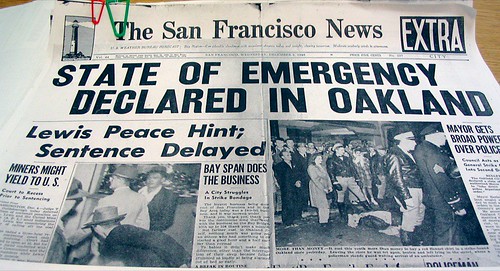
General Strike! The photo at right shows police milling around an injured shopper in front of a struck Oakland department store. Headline at left refers to a nationwide coal miners strike. This clipping is from the Labor Archives and Research Center at SFSU.
Someone with my politics (anarchist, idealist) tends to think of the general strike as a kind of labor-movement Excalibur, whose ass-kicking powers were so great that it could blind King Arthur's enemies simply by being drawn from its scabbard. (In this problematic analogy, King Arthur = The People.)
A general strike is the ultimate exercise of worker solidarity and worker power and basically, it happens like this: everyone (well, almost everyone), in every industry, stops working until their collective demands are met. One hopes that their demands go beyond asking for better pay or other simple benefits, and begin to address the big problems that go with a society where a few people own everything and do nothing, and others own nothing and do all the work.
And if that is your idea of the purpose and potential of general strikes, then it's clear that they haven't been very successful. Part of the problem though might be that there isn't always a clear purpose, even if there is a lot of potential. In the case of Oakland's 1946 general strike, we had an unbelievable potential power. I'm not so clear on the purpose.
I have so much to say about the Oakland strike, I'm going to split this into a few entries. Here's part 1, the context:
The Bay Area had gained half a million people between 1940 and 1945, when immigrants from around the country flooded in to find work in the war industries (mostly shipbuilding) centered here. The East Bay was so packed, there was nowhere to put everyone. I love the image in Marilyn S. Johnson's book The Second Gold Rush, a quote from an Oakland police captain saying in 1942, "Hundreds of men, women, and children [are] sleeping nightly on outdoor benches in public parks, in chairs in all night restaurants, in theatres, in halls of rooming houses, in automobiles, even in the City Hall corridors." Even with so many people, there were labor shortages. Between the shipyards and the businesses that supported them, there was an almost insatiable need for workers.
But a year after WWII ended, Oakland's economy had already started to wobble. Soldiers came back to a new and newly crowded Bay Area looking for jobs just as the war industries were beginning to contract. And the population boom and economic stressors weren't the only pressures. The need for labor had overruled some long standing social and political rules here and everywhere, most obviously, many more women, including for the first time middle class women, started working in factories and other industries. And Black immigrants to the Bay started to integrate the segregated neighborhoods and jobs here. Returning soldiers too had been transformed by their battlefield experiences. Maybe they expected to be able to make changes that hadn't seemed possible before.
Working conditions hadn't been great during the war, but most unions had signed patriotic No Strike pledges. After the war, business leaders and government officials found it impossible to stuff a broadening political agenda back into a box. In '46, a massive strike wave spread around the country (and internationally). The rail and coal mining industries were debilitated by strikes that year, and a number of cities held general strikes.
I found a newsreel that nicely captures the panic that industrialists felt about the rail strike at archive.org.
In this context, of a country and world that was changing by the second, where worker power seemed possible and real, and let's face it, where communists were all over the place, the idea of shutting down a city wasn't just a fantasy. At least, that's what I understand from what I've read.
Next time I'll post about the strike itself. I've got some links to original accounts and a nice documentary too. Stay tuned.
6.04.2007
Hometown
The house was built in 1921, part of a construction boom that was still reverberating through Oakland 15 years after the San Francisco earthquake. When the city burned, residents turned to less developed or agricultural land in the East Bay where forward thinking real estate developers had already bought up (or squatted) massive tracts in hopes of making a lot of cash. After buying the land, the developers would generally build a few impressive houses, and then run a streetcar to the new 'neighborhood' to bring people in.
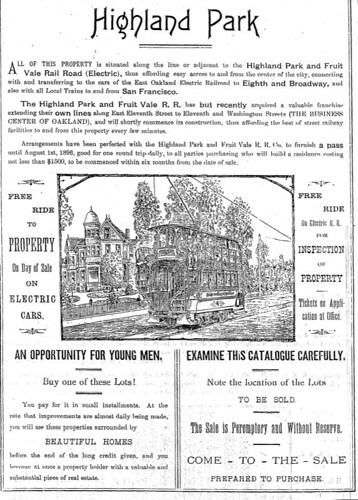
Unfortunately for E.C., he was ahead of his time, and ended up selling off his land in small parcels before the neighborhood took off in the 20s. (Highland Hospital, a few blocks away, and the beloved Parkway Theatre down the street on Park Blvd. were built in the '20s too.)
My parents moved to the house around 1970, and paid $200 a month for three bedrooms, a living room, formal (if small) dining room, and a rumpus room downstairs, along with the backyard and its decrepit gazebo. Oakland had changed a lot from the pastoral (and profitable) oasis that developers like E.C. Sessions had imagined. In my neighborhood, the two story streetcars had long been replaced by more uniform Key System trains, which subsequently disappeared too. The city as a whole had never fully recovered from a post-WWII economic downturn, and because of the efforts of dozens of civil rights groups, it was just beginning to grow out of long-standing policies of racial discrimination.
By the time I was school aged, Oakland had a reputation as a crime center. Crack was beginning its ascent, and I'm sure even my not-so-deep section of East Oakland was impacted. But my sense of my home was that it was safe and that it was stable. My young neighbors and I hid in the bushes of my house to throw berries at passing cars, played football in the parking lot around the corner, and walked back and forth to the liquor store up the street for Now-and-Laters and Chick-o-Sticks.
Like anybody's hometown anywhere, Oakland is, to me, the place I know in and out, the place I can tell my kids about when I'm trying to help them understand my sense of the world. Lucky for me, and for them, they live here too, so they can compare their stories to my stories, and find their own adventures in a spot where they have roots.
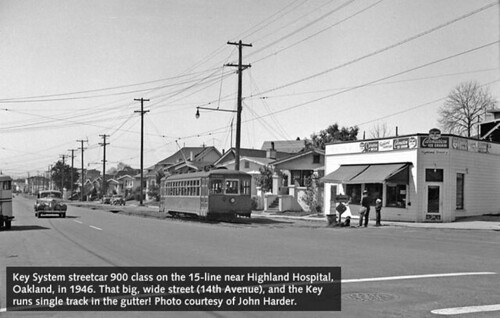
Thanks too for photos on this site: the Highland Park advertisement is from the Oakland History Room, and the Key Line streetcar came from keyrailpics.org, an awesome photo site full of Bay Area streetcar photos.
Subscribe to:
Posts (Atom)
